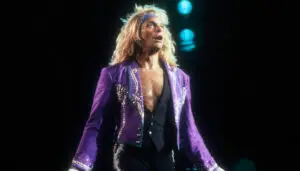
October 2, 1986. The Glens Falls Civic Center. A Thursday night in the Adirondack foothills, and David Lee Roth — six months removed from the biggest breakup in rock and roll — was standing on a riser in front of four thousand people, doing a full split in leather pants while Steve Vai shredded a note so high it probably rattled the Zamboni doors.
This was the Eat ‘Em and Smile tour. Cinderella opened. The setlist leaned heavy on Van Halen cuts because Roth knew what he was doing — he was not running from the band that made him famous. He was proving he could carry those songs without them. And in a civic center tucked between the Adirondacks and Saratoga Springs, in front of a crowd that had driven an hour from Albany or two hours from Syracuse just to see if Diamond Dave still had it, the answer was obvious. He had it. He might have had more of it than ever.
Forty years later, Roth is coming back to the Capital Region. On May 26, 2026, he plays Proctors in Schenectady — a 2,700-seat gilded theater that opened in 1926, the same year vaudeville was still filling seats. It is, by every measure, a different kind of room than the one he played in Glens Falls. And David Lee Roth is, by every measure, a different kind of performer than the shirtless maniac who dominated the 1980s.
That is exactly what makes this show matter.
The Solo Gamble
When Roth left Van Halen in the summer of 1985, the conventional wisdom was that he had lost his mind. Van Halen was the biggest band in America. 1984 had sold ten million copies. “Jump” was the kind of song that transcended rock radio and landed in grocery stores and dentist offices. Walking away from that machine was either the boldest move in rock history or the dumbest.
Roth bet on bold. He assembled a band that, on paper, had no business existing: Steve Vai on guitar — a technical wizard who had apprenticed under Frank Zappa. Billy Sheehan on bass — a player so aggressive he made the instrument sound like a weapon. Gregg Bissonette on drums — tight, powerful, the engine underneath the chaos. Eat ‘Em and Smile dropped in July 1986, and it was not a tentative solo debut. It was a declaration of war.
The tour that followed was massive. Over a hundred dates across North America, running from August 1986 into early 1987. These were not club shows — Roth went straight to arenas. Hampton Coliseum. The Spectrum in Philadelphia. Buffalo’s Memorial Auditorium on September 30. And two nights later, the Glens Falls Civic Center.
For upstate New York, that Glens Falls date was significant. The Civic Center was the kind of venue that punched above its weight — a mid-size room in a small city that somehow kept landing arena-level acts. Roth playing there was not a step down. It was a statement. He could fill a building in the Adirondack foothills on a Thursday night, a hundred miles from the nearest major city, on the strength of his name alone.
Forty Years of Diamond Dave
What followed that first solo peak is a story every rock fan knows in broad strokes, even if they have forgotten the details. Skyscraper in 1988 — another hit record, another world tour. Then the slow fade that catches every frontman eventually. The briefly hysterical Van Halen reunion in 1996 that produced exactly zero albums. The longer, more productive reunion that ran from 2007 through 2015 and reminded everyone why those songs mattered in the first place.
Then came the ending. In October 2021, Roth announced his retirement. Five final shows at the House of Blues in Las Vegas, January 2022, and that was it. He was done. The shoes were thrown.
Except they were not.
In May 2025, Roth walked onto the stage at the M3 Rock Festival in Maryland — his first solo performance in over five years — backed by an eight-piece band with four dedicated vocalists. He joked about it. He called it the end of his first retirement. The 21-date tour that followed was called “The Last Tour Unless It Isn’t,” which is either the most honest tour name in rock history or the most cynical, depending on how well you know David Lee Roth.
The 2026 run is 30 dates. It started in April in Washington state. It ends in August in Sturgis, South Dakota. And right in the middle of it, on a Tuesday night in late May, Roth walks into Proctors.
Why Proctors Matters
There is a version of this story where Roth comes back to upstate New York and plays MVP Arena in Albany. Seventeen thousand seats. Jumbo screens. The full production. That is not what is happening.
Instead, he is playing a hundred-year-old theater where the plasterwork on the ceiling is original, where the balcony seats still creak, where you can see the performer’s face without a screen because there is not a bad seat in the house. Proctors is the kind of room where the architecture does half the work. It was built for showmen, and whatever else David Lee Roth is or is not in his early 70s, he remains, irreducibly, a showman.
The contrast with Glens Falls in 1986 is not what you might expect. It is not small room to big room. Both venues were mid-size by the standards of their respective tours. The real contrast is in what the rooms say about the performer. The Civic Center was a concrete box — functional, loud, built for hockey and trade shows and the occasional rock concert. It did not care who was on stage. Proctors is a theater that elevates whoever walks into it. The room itself is a performance.
In 1986, Roth did not need the room. He was the room. He generated enough energy to make a civic center feel like Madison Square Garden. In 2026, the room will meet him halfway. And there is something fitting about that — an artist who spent his entire career commanding attention, playing a space that was designed, a century ago, to give attention freely.
The Ticket
David Lee Roth plays Proctors in Schenectady on May 26, 2026. Showtime is 7:30 PM. Tickets are available now through Ticketmaster.
Whether this is a farewell or another act in a career defined by refusing to stay gone, nobody knows. Roth himself does not seem to know, and he does not seem to care. What he does know is how to walk into a room and make every person in it forget about everything except the next two hours.
He did it in Glens Falls in 1986. He will do it in Schenectady in 2026. The rooms change. The splits may or may not still happen. But the show goes on.