For thirty-eight years, the East Coast folk community has marked a single weekend in late July on the calendar before anything else gets scheduled. The venue has changed three times. The state has changed twice. The festival has not. From July 24 through 26, 2026, Falcon Ridge Folk Festival returns to the Goshen Fairgrounds in Litchfield County, Connecticut for its 38th annual edition — four stages, three days, and a lineup that includes Susan Werner, Vance Gilbert, Joe Jencks, and Damn Tall Buildings, with more acts to be announced as the spring unfolds.
That continuity is the story. Falcon Ridge has outlived festivals that were larger, better-capitalized, and based in more accessible cities. It has weathered two venue moves and a global pandemic. The audience — many of whom have been attending since the festival’s earliest years on a Hillsdale ski slope — has followed it across state lines because what Falcon Ridge does cannot be reproduced elsewhere. It is the gathering place for a particular American folk tradition, and for the working musicians, songwriters, and listeners who keep that tradition alive.
The festival was founded in 1988 as a two-day event at a ski slope, with Howard Randall credited as its creator. It moved in 1991 to Long Hill Farm in Hillsdale, New York, where it spent the next fourteen years building the reputation that still defines it — the four-stage format, the camping, the children’s programming, and the Grassy Hill Emerging Artist Showcase that has functioned as the festival’s structural heart for much of its history. In 2005, the festival relocated to Dodds Farm, also in Hillsdale, where it remained through the 2019 edition. The COVID-19 pandemic interrupted in-person operations in 2020, when the festival was presented as a virtual event. Organizers used the pause to reset, and in 2021 the festival reopened in Goshen, Connecticut — a one-day, hybrid edition that has since grown back into the full three-day weekend it always was.
The Hillsdale Question
For listeners in the Capital Region, the Hudson Valley, and the Berkshires, the move from Hillsdale to Goshen was an adjustment. Long Hill Farm and Dodds Farm both sat in Columbia County, New York, at the foot of the Berkshires, drawing from a regional audience that could be at the gate within ninety minutes from Albany, Hartford, or western Massachusetts. The Hillsdale era — nearly three decades across two nearby properties — became synonymous with the festival itself. To call it Falcon Ridge for many fans was to picture that specific stretch of New York hill country in July.
Goshen is a different geography. The Goshen Fairgrounds sit in Litchfield County, Connecticut, about ninety minutes from Albany and an hour from Hartford. The drive from the eastern Hudson Valley adds time but not much else — the festival is still firmly within the geographic zone the East Coast folk community has always traveled. What it lost in the Hillsdale name recognition it has begun to recover in a permanent home with the infrastructure of a working fairgrounds: established stages, parking, camping, water, power. For organizers, that operational stability is a meaningful upgrade over years of building and tearing down a festival site on a working farm.
For longtime attendees, the loss is real but the festival is not. The acts that defined Falcon Ridge in its Hillsdale years — Vance Gilbert, Richard Shindell, Lucy Kaplansky, Dar Williams, John Gorka, Ellis Paul, Tracy Grammer — are the same acts that define it now. Vance Gilbert, in fact, is on the 2026 main stage. The continuity is in the music, the community, and the structure. The geography is a footnote.
The Music
The 2026 confirmed lineup leads with Susan Werner — the singer-songwriter NPR memorably labeled “the empress of the unexpected” for her willingness to reinvent the form. Raised on an Iowa farm, Werner has built one of the most genre-restless catalogs in contemporary folk: I Can’t Be New in 2004 turned to Tin Pan Alley and cabaret; The Gospel Truth in 2007 took on the music of belief; Classics in 2009 spliced Stevie Wonder with Chopin and Cat Stevens with Bach across piano-and-cello arrangements; Hayseed in 2013 returned her to the family farm with a concept album about American agriculture. She is a Falcon Ridge–type booking precisely because she resists category, and her writing reliably finds new angles on subjects that less ambitious songwriters treat as settled.
Vance Gilbert’s booking is a homecoming. A veteran of the Boston folk scene since the early 1990s, Gilbert came up through Club Passim in Cambridge — the longest continuously running coffeehouse in the country and a sister institution to Caffè Lena in spirit and importance. Shawn Colvin pulled him onto her 1992 Fat City tour after hearing him on the Boston open mic circuit, and his career has never slowed since. Sixteen albums in, with three on Philo/Rounder, Gilbert remains one of the great live performers in folk music — a vocalist who came up wanting to sing R&B and jazz before discovering that the singer-songwriter form gave him room for stories his other voices could not hold. He has performed at Falcon Ridge across multiple eras and is a touchstone for what the festival has always valued.
Joe Jencks brings a 25-year career on the international folk circuit, anchored by his work as co-founder of Brother Sun — the harmony trio he formed in 2010 with Greg Greenway and Pat Wictor. Brother Sun’s 2013 release Some Part of the Truth hit number one on folk radio that year, and Jencks’s composition “Lady of the Harbor” took number one song. Trained in conservatory voice, rooted in Irish and working-class traditions, Jencks works the seam where labor song, folk hymn, and craft songwriting meet. He is the kind of artist Falcon Ridge has always programmed centrally — a player’s player, with a national reputation built one festival stage at a time.
Damn Tall Buildings rounds out the confirmed bill so far. The trio met as students at Berklee and started busking on Newbury Street in Boston — guitarist Max Capistran, fiddler Avery Ballotta, and upright bassist Sasha Dubyk all contributing vocals. The Boston Globe called them “the Carter Family for the millennial generation,” which oversimplifies a band that has coined its own term — “guerrilla roots” — to describe its hybrid of early-twentieth-century Americana, bluegrass, and original songwriting. They are exactly the kind of younger band Falcon Ridge has historically used to bridge generations, and their inclusion signals that the festival’s booking eye is as sharp as it has been in any era.
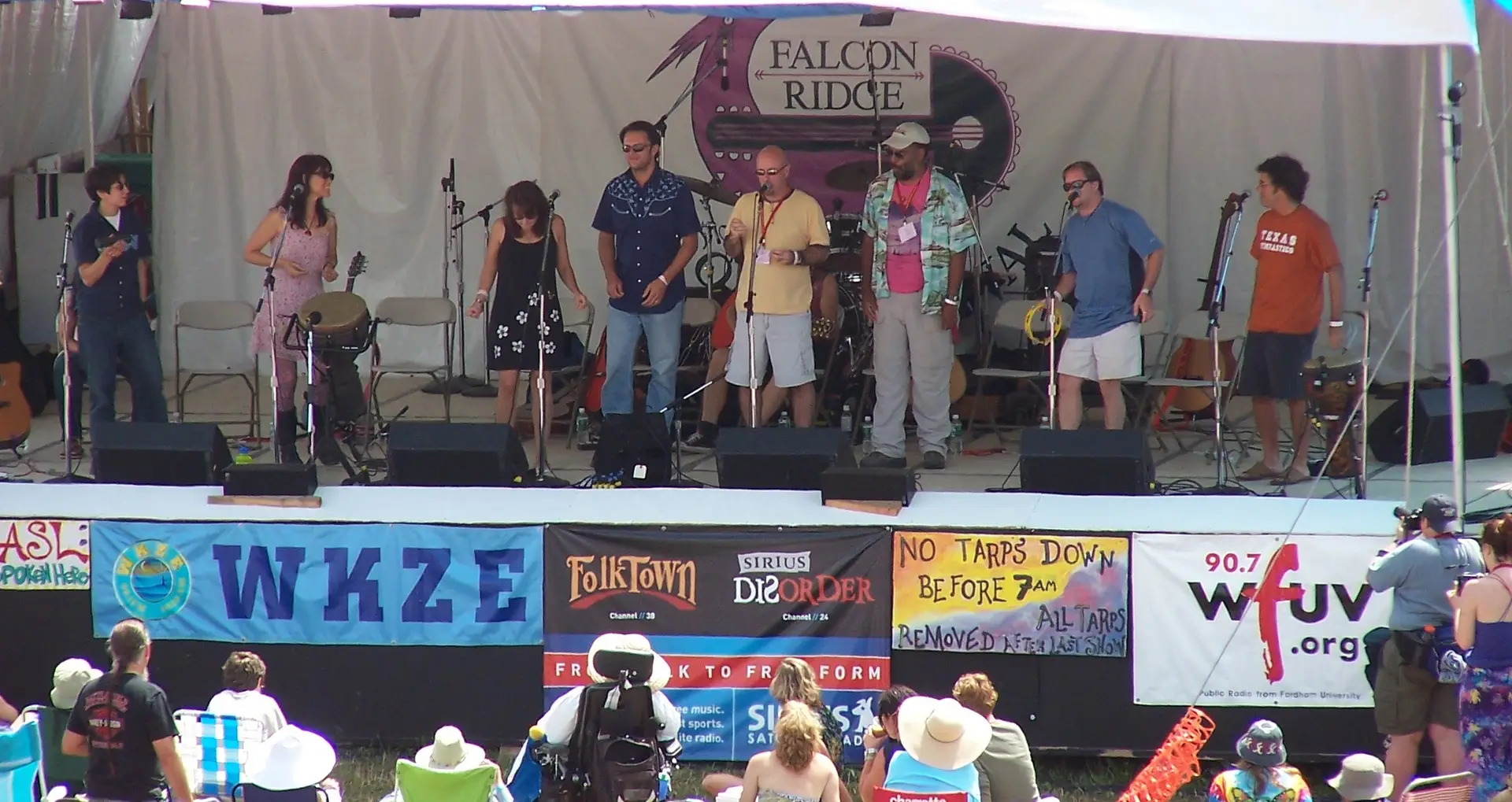
The four-stage format — Main Stage, Dance Stage, Family Stage, and Workshop Stage — has long been the festival’s structural signature. The Workshop Stage is where artists collaborate across acts, swap songs, and interrogate craft in front of an audience that genuinely cares about the answers. The Dance Stage anchors traditional contra and squares with live bands. The Family Stage runs dedicated programming for younger attendees. Past editions have featured Dar Williams, Richard Shindell, Lucy Kaplansky, John Gorka, Ellis Paul, Tracy Grammer, Tom Paxton, Ani DiFranco, Holly Near, Shawn Colvin, Janis Ian, Arlo Guthrie, and Richie Havens — a roster that doubles as a partial census of the modern American folk canon.
The Most Wanted
The Grassy Hill Emerging Artist Showcase is the structural heart of Falcon Ridge, and understanding how it works is the fastest way to understand the festival. Each year, applicants submit recordings for a $20 fee. A committee of three music professionals selects fifteen artists, who each get a two-song or ten-minute slot on the Main Stage on Friday afternoon. The showcase artists receive full festival admission, on-site camping, and meals for the weekend, plus a guest pass each. The 2026 showcase runs Friday, July 24, beginning at noon on the Main Stage.
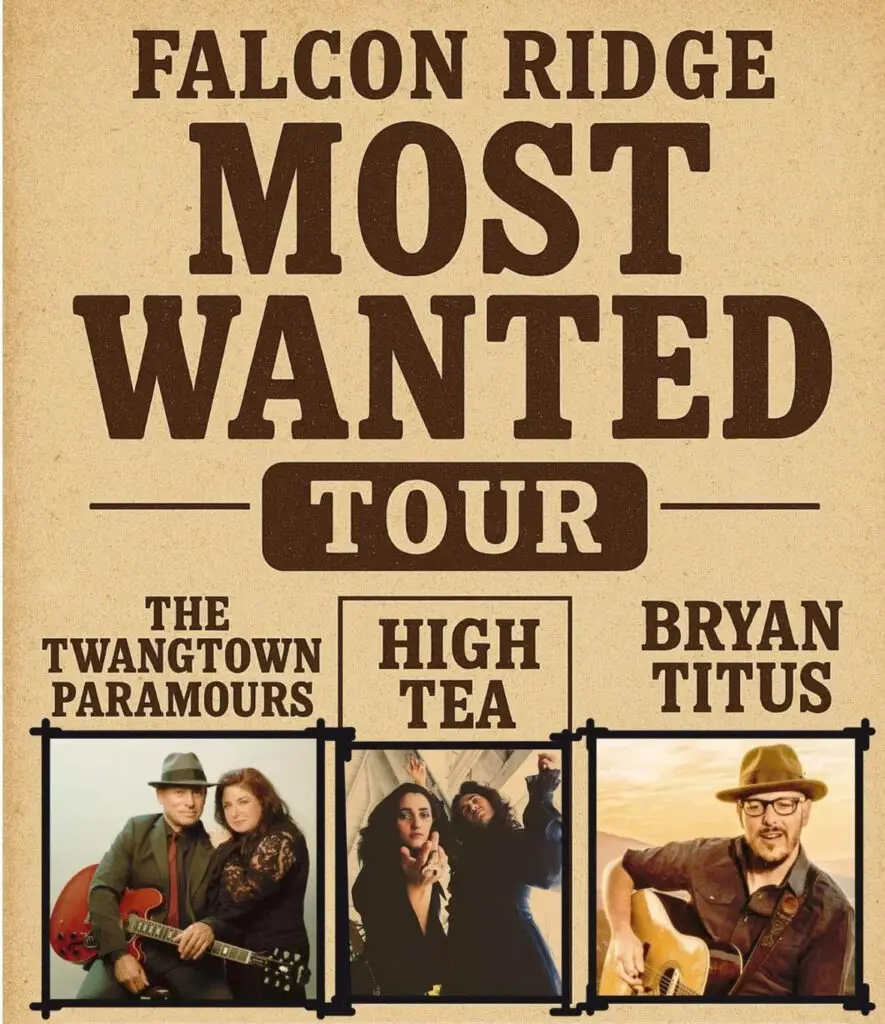
The mechanism that makes it consequential is the audience vote. After the showcase, festival-goers are surveyed for which three artists they most want to see return the following year. Those three artists are invited back as paid Main Stage acts for the Most Wanted Song Swap — the centerpiece programming slot of the next year’s festival. Showcase artists are not competing for a prize; they are auditioning for the audience, which then drafts the next year’s emerging artist class itself.
The effect compounds. Many of the names now considered folk-circuit staples were Falcon Ridge showcase artists at one point. The festival’s Most Wanted alumni tour through the year between editions, playing dates at folk venues across the Northeast and Midwest, building audiences in front of the very listeners who first voted them onto a bigger stage. It is one of the few genuine emerging-artist pipelines in American roots music, and it has been a defining feature of the festival for most of its run.
The Experience
Falcon Ridge is a camping festival in temperament if not always in fact. Many attendees stay on-site, where camping is built into the festival fabric — a working folk village that sets up Thursday afternoon and breaks down Sunday night. The Goshen Fairgrounds provide established camping fields, water, and the kind of operational infrastructure a long-running fair already has on hand. Day-trippers from Hartford, Albany, Northampton, and New Haven are common, but the festival’s social texture is set by the campers, who form the floating audience that drifts between the four stages from morning workshops through the late-night song circles around campsite fires.
Litchfield County in late July is one of the more pleasant parts of the Connecticut summer. Goshen sits at elevation in the northwest hills of the state, far enough from the coast that the humidity drops at night and the mornings can be cool. The fairgrounds are surrounded by working farmland and forest, and the drive in from any direction passes through some of the prettiest country in southern New England. The town itself is small — under three thousand residents — but the surrounding area, including Litchfield village and the towns along Route 7, supports the kind of small inns, farm stands, and restaurants that round out a festival weekend.
The vibe between sets is intergenerational in a way that distinguishes Falcon Ridge from most contemporary festivals. Families with young children share campsites near artists with thirty-year catalogs. The Family Stage runs concurrent programming so parents can rotate listening shifts. The audience is, by demographic accident or intentional cultivation, an actual community — many of whom have been showing up to the same patch of grass every July since the Long Hill Farm years.
Getting There and Know Before You Go
The Goshen Fairgrounds are located at 116 Old Middle Street in Goshen, Connecticut, in the northwest hills of Litchfield County. From Albany, the drive is approximately ninety minutes via the Taconic State Parkway and Route 7 south, or via I-90 east to the Berkshires and then south through Great Barrington. From Hartford, the festival is about an hour northwest via Route 4 and Route 63. From Boston, plan two and a half to three hours west via the Mass Pike to Route 8 south.
On-site camping is the dominant lodging mode and is included in weekend ticket packages — tent and small-vehicle camping for the full festival, with separate sections for quieter and more active areas. For attendees who prefer indoor lodging, Litchfield, Torrington, and Great Barrington each have a range of inns, B&Bs, and hotels within twenty to thirty minutes of the fairgrounds. Book early — folk festival weekends are also peak Berkshires tourism season, and inventory tightens by late spring.
Tickets are sold as single-day passes and full-weekend packages, with camping included in weekend tickets. Late July weather in Goshen is typically warm in the day, cool at night, with the chance of an afternoon thunderstorm. Bring layers, a rain jacket, a folding chair, and sunscreen. The festival runs rain or shine. Pre-festival activities, including a Farm Market and evening programming, take place on Wednesday, July 23.
Why This Festival Matters
Falcon Ridge has done something almost no American music festival manages — it has survived intact for thirty-eight years across two states and three venues without diluting what made it valuable in the first place. It has done so without corporate ownership, without festival-brand expansion, and without abandoning the model that defined it from year one: a four-stage gathering of working folk musicians, a robust emerging artist pipeline, and an audience that treats the festival not as a destination event but as a yearly reunion. The Hillsdale era was beloved, and its loss is genuine for the New York listeners who grew up driving Route 22 to Long Hill Farm. But the festival is the lineup, the format, and the community — not the address. Goshen is the festival’s home now, and the people who built Falcon Ridge in Hillsdale are the same people building it in Connecticut. For the East Coast folk community, that continuity is the gift. The 38th edition is proof that the institution still works.
Falcon Ridge Folk Festival runs July 24 through 26, 2026, at the Goshen Fairgrounds in Goshen, Connecticut, with pre-festival activities on July 23. Lineup and tickets at falconridgefolk.com.