
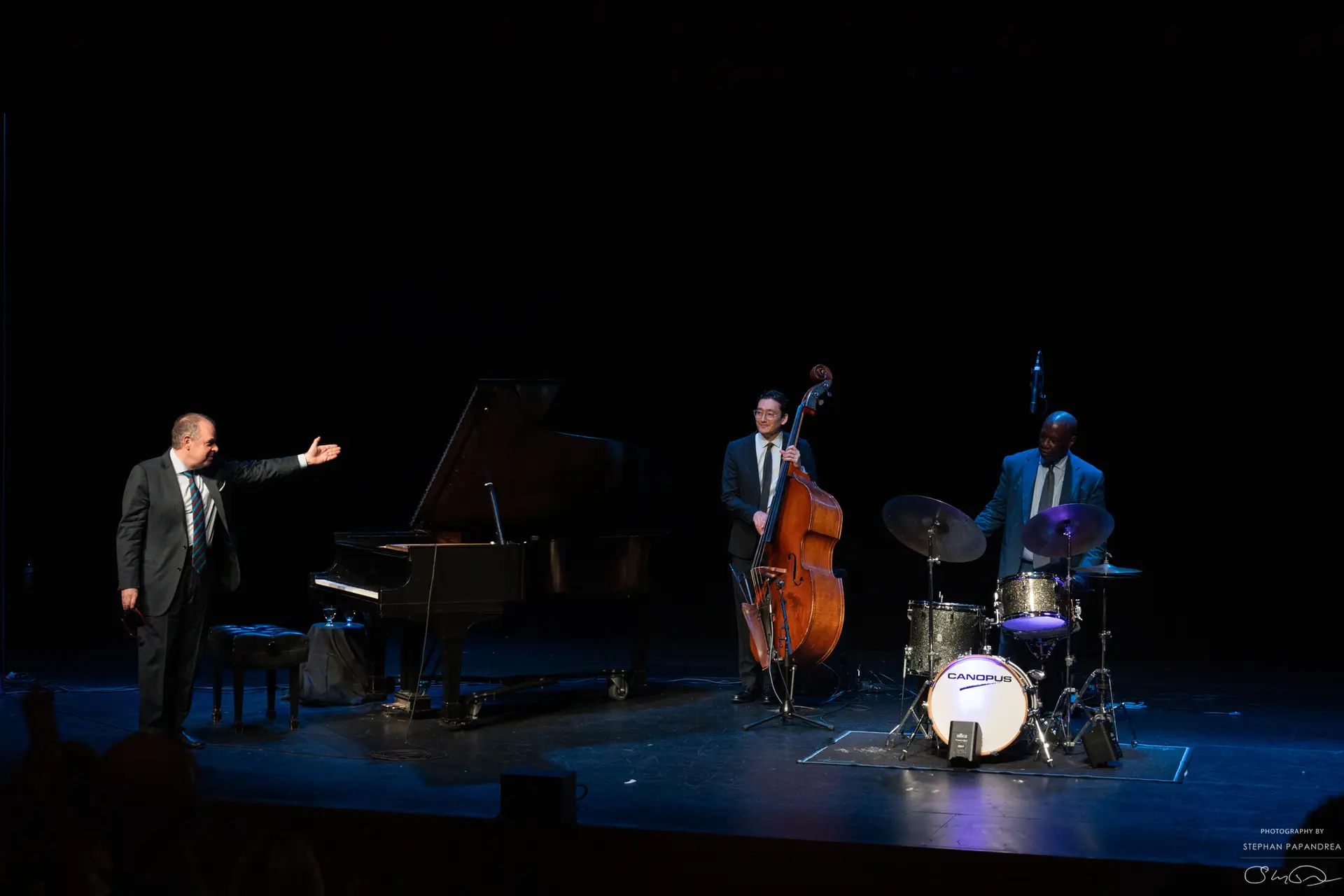
The Litchfield Hills of northwestern Connecticut do not announce themselves. The landscape arrives gradually — rolling farmland giving way to forested ridges, small towns with white clapboard churches, roads that curve along rivers rather than cutting through them. It is the kind of terrain that rewards patience, and the Litchfield Jazz Festival, held each July in the town of Washington, has been rewarding patient listeners since 1996.
Pastoral Jazz
The Litchfield Jazz Festival occupies a unique position in the Northeast jazz calendar. Smaller than Newport, more intimate than the Montreal or Toronto festivals, it draws its identity from the specific convergence of serious jazz programming and a setting that belongs in a New England landscape painting. The July 24-26 weekend unfolds on grounds where the visual field — meadows, tree lines, hills — competes with the music for your attention, and both benefit from the contest. Jazz performed outdoors in a pastoral setting triggers a different kind of listening than the same music in a city club. The space between notes has room to breathe.
The Jazz Camp Connection
What distinguishes Litchfield from most jazz festivals is its organic relationship with the Litchfield Jazz Camp, an educational program that has trained young musicians at the site for years. This connection infuses the festival with an educational dimension that goes beyond the typical masterclass add-on. Student ensembles perform alongside established artists, and the faculty — working professionals drawn from New York’s jazz scene and beyond — bring a pedagogical energy that shapes the festival’s atmosphere. There is a seriousness of purpose here that coexists comfortably with the laid-back setting, a combination that appeals to listeners who want their jazz served with substance rather than spectacle.
Programming and Scale
The festival’s programming emphasizes acoustic jazz, straight-ahead and contemporary, with the occasional venture into Latin jazz, fusion, and vocal performance. The scale is deliberately intimate — this is not a festival where you choose between five simultaneous stages. You sit, you listen, you absorb. The audience reflects this ethos: knowledgeable, attentive, and inclined to let a pianist’s solo develop without interruption. Between sets, the grounds offer food vendors, instrument displays, and the kind of unhurried socializing that only happens when the crowd shares a genuine common interest.
The Closest International-Caliber Jazz Festival to Upstate
Washington, Connecticut sits roughly two hours from the mid-Hudson Valley, making Litchfield the most accessible dedicated jazz festival for much of Upstate New York. The drive south through the Taconic corridor or across Route 44 passes through some of the prettiest country in the Northeast, and the surrounding Litchfield Hills offer enough inns, restaurants, and antiquing to build a full weekend around the music. For jazz listeners in the Capital Region or Hudson Valley who have always meant to get to Newport but never quite made the trip, Litchfield offers something Newport cannot: the feeling that the festival was built for listeners rather than crowds, in a landscape that makes the music sound the way it was meant to.