
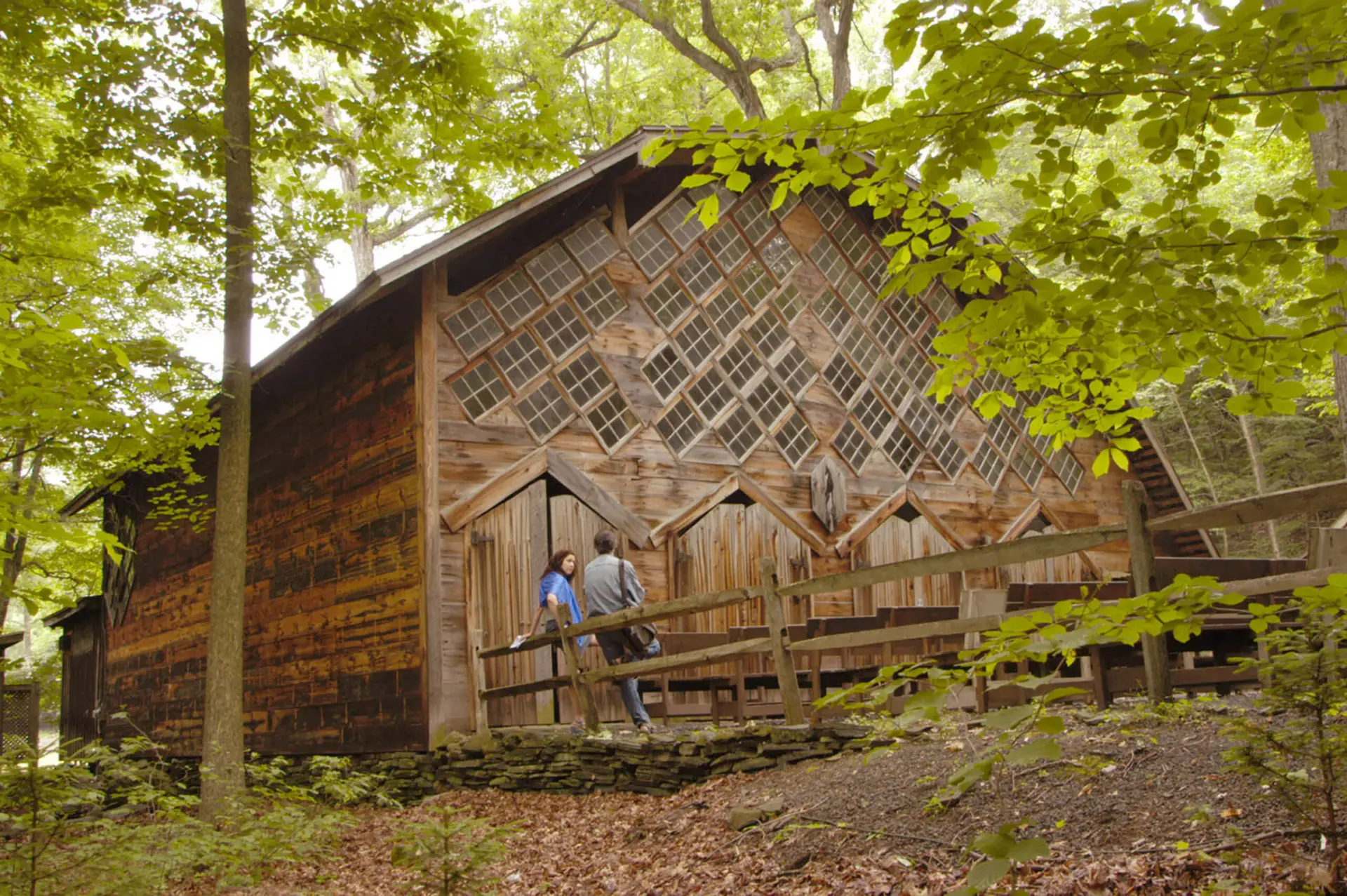
On August 29, 1952, a pianist named David Tudor walked onto the stage of a hand-built wooden hall in the woods outside Woodstock, sat down at a piano, and did not play it. He closed the keyboard lid to mark the beginning of the first movement. He opened it briefly, then closed it again, to mark the second. He did this once more for the third. Four minutes and thirty-three seconds after he started, he stood up and walked off. The audience, depending on which account you believe, either laughed, walked out, or shouted “Good people of Woodstock, let’s drive these people out of town.” The piece was John Cage’s 4’33”, and its world premiere happened in a barn-like hall on Maverick Road that had already been hosting chamber music concerts every summer for thirty-six years.
That hall is still standing. Those concerts are still happening. In 2026, Maverick Concerts celebrates its 110th season — making it, by any honest accounting, the oldest continuously operating summer chamber music festival in the United States. The season runs June 27 through September 13. The hall has not changed in any meaningful way since Hervey White and his friends finished building it in 1916. The acoustics are still considered some of the finest in the country for chamber music. And the festival is still, somehow, treated by parts of the classical music world as a kind of well-kept secret — which is mystifying, because everything about it is the opposite of a secret. It is older than Tanglewood. It is older than Marlboro. It is, in fact, older than almost every American institution dedicated to chamber music.
The Hall Is the Story
You cannot write about Maverick Concerts without writing about the building itself, because the building is the festival. The hall was constructed in 1916 by Hervey White and a loose group of artists, writers, and musicians living on a 102-acre former farm just outside Woodstock that White had named the Maverick. It is a barn — a literal timber-framed barn with a gambrel roof, wood shingles, and wide plank walls — but it was built specifically as a concert hall, and the carpenters who put it together apparently had an uncanny instinct for what wood does with sound. The acoustics are not just good for a rustic hall. They are good in the absolute sense, the kind of thing that visiting musicians remark on afterward in interviews. The room is intimate enough that a violin’s overtones do not get lost and resonant enough that a string quartet feels like it is filling a cathedral.
The hall was listed on the National Register of Historic Places on December 9, 1999, and the Preservation League of New York State has recognized its restoration with an Award for Excellence in Historic Preservation. Inside, an eighteen-foot wooden statue called The Maverick Horse, carved by the sculptor John Flannagan in 1924, stands on the stage — a horse emerging from a man’s open hands. It has been there for over a century. Audiences who walk in for the first time tend to stop and look at it before they look at the seats.
Hervey White and the Other Woodstock
The town of Woodstock is famous, of course, for the 1969 music festival that wasn’t actually held in Woodstock. What gets lost in that story is that Woodstock was already an arts colony — internationally known, taken seriously by working artists and writers — fifty-three years before Jimi Hendrix played “The Star-Spangled Banner” sixty miles away in Bethel. The town’s identity as a place where serious art happens was built deliberately, in the early 1900s, by a small group of utopian thinkers. Hervey White was one of them.
White was born in Iowa in 1866, raised on a Kansas farm, and educated at Harvard, where he absorbed the writings of John Ruskin and developed a lifelong commitment to socialism, communal living, and the idea that art was not a luxury but a necessity. He worked for a time at Hull House in Chicago, the pioneering settlement house founded by Jane Addams. In 1902 he joined Ralph Radcliffe Whitehead and Bolton Brown in founding the Byrdcliffe Colony in Woodstock — a utopian community of studios and workshops in the Catskills. Within a few years White had broken with Whitehead, whom he found too autocratic, and in 1905 he bought a farm of his own with two friends and named it the Maverick.
The Maverick was the rougher, more bohemian, more permissive cousin of Byrdcliffe. Artists and writers built tiny cabins on the property. There was a printing press that produced little magazines called The Wild Hawk and The Plowshare. There were communal meals, sometimes pageants, and starting in 1915 there were the legendary Maverick Festivals — annual costumed bacchanals held to raise money to dig a well for the colony, which by the 1920s drew thousands of people and became, in retrospect, the prototype for the entire American counterculture festival tradition. The Maverick Festival itself was suspended in 1931, casualty of Prohibition-era bootlegging and rowdy crowds the colony could no longer manage. But by then White had already founded the concerts.
The first Maverick concert took place in 1916, in the brand-new hall, as a way to raise additional money for the colony and to give resident musicians a place to perform. White’s biographers describe him as a freethinker with “a genius for friendship,” someone whose vision was less about building an institution than about giving young talent “a chance to earn its living until its recognition.” A century later, the institution he built almost as an afterthought is the part of the Maverick legacy that has survived.
The Music
The 2026 season is organized into three series, each with a distinct character. The Maverick Chamber Music Festival — the founding tradition — runs as a sequence of Sunday afternoon concerts from late June through mid-September. This is the heart of what Maverick does: world-class chamber ensembles, intimate solo recitals, programs that pair canonical repertoire with contemporary commissions. The Maverick Friday and Saturday Nights series, running 8 to 10 PM, expands the programming beyond the strictly classical — jazz, Americana, world music, and contemporary work. The Maverick Family Saturdays series presents free interactive morning events designed for children in grades K-6, an explicit gesture toward audience development at a moment when most classical institutions are struggling with it.
Music Director Alexander Platt, who has led the festival since 2003, has built the 2026 program around a thematic frame: American composers and performers, in recognition of the 250th anniversary of the Declaration of Independence. The headlining ensembles and soloists include the KASA Quartet with pianist Anthony Ratinov, who open the chamber series on June 28; a Ragas program featuring saxophonist Paul Winter, pianist Henrique Eisenmann, and bansuri master Steve Gorn; guitarist and composer Joel Harrison and Friends presenting a program of “American Songs from Everywhere” on July 4; the GRAMMY-winning duo ARKAI, making their Maverick debut after taking the 2026 award for Best Contemporary Instrumental Album; pedal steel virtuoso Cindy Cashdollar; Rachael Yamagata with Larry Campbell and Teresa Williams; and an independent production of Mozart’s Requiem by the choral ensemble Ars Choralis on June 20-21, which functions as a pre-season opener.
The piano roster is unusually deep. Angela Hewitt — one of the most respected Bach interpreters working today — appears alongside Awadagin Pratt, Reed Tetzloff, Brian Zeger, Henry Kramer, Carter Johnson, and Ratinov. That is a stack of pianists that any festival in the country would be glad to claim, and Maverick puts them in a 100-year-old wooden hall with no amplification, an arrangement that strips the performance down to the instrument and the room.
Maverick’s booking philosophy has, since at least the Platt era, been to combine canonical chamber music with contemporary commissions and adventurous programming. The festival’s Award for Adventurous Programming from Chamber Music America and ASCAP recognizes that approach formally. The hall’s roster across the decades has included Paul Robeson and John Cage and an ongoing parade of major chamber ensembles, with members and alumni of the Cleveland, Cavani, Emerson, Guarneri, St. Lawrence, and Brentano string quartets all having worked at or with the festival over the years.
The Experience
Maverick is not a festival you stumble into. The hall is at 120 Maverick Road, about three miles south of the village of Woodstock, set down a dirt road and surrounded by woods. There is no signage to speak of. You park in a clearing under the trees. You walk toward the building. You can hear the musicians warming up before you see the hall.
The hall seats roughly 350 inside, on wooden benches arranged in straight rows facing the stage. On weekends with high demand — a Hewitt recital, the season opener, a name jazz act — additional seating is opened up on covered porches outside, where the music carries through open doors. The setting outside the hall matters as much as the music inside it. Tall pines, dappled afternoon light, the kind of stillness that allowed John Cage to argue that there was no such thing as silence. Audience members bring picnics for the lawn before concerts. The drive in is a thing of beauty in itself — winding roads through Catskill forest, a kind of pilgrimage that has not been engineered for convenience.
Inside, the music sounds the way music sounds when it is made by skilled players in a room built specifically to amplify them without electricity. Visiting musicians describe the experience as a kind of revelation — being able to hear the wood of the violin and the breath in the flute and the way the harmony resolves in the room rather than in a recording. This is not a small claim. Chamber music in most concert venues is fighting against the acoustics of the space. At Maverick, the acoustics are doing half the work.
Getting There and Know Before You Go
Maverick Concerts is located at 120 Maverick Road in Woodstock, NY 12498, in Ulster County in the Hudson Valley. From the New York State Thruway, take Exit 19 (Kingston) and follow Route 28 west toward Woodstock, then turn south onto Maverick Road. The drive from Kingston is about fifteen minutes; from Albany, roughly 75 minutes; from New York City, around two and a half hours. The hall is not on a public transit route. Plan to drive.
Parking is on a dirt lot adjacent to the hall and is free. Sunday afternoon chamber concerts typically begin at 4 PM. Friday and Saturday evening shows begin at 8 PM. Family Saturdays run 11 AM to 12 PM and are free. Tickets for the Chamber Music Festival and the Friday/Saturday Nights series are sold through Tix.com and via the Maverick website. Single tickets, series subscriptions, and Maverick membership tiers (which include priority ticketing and member benefits) are all available.
The hall has no air conditioning. It is, after all, a hundred-and-ten-year-old wooden barn. Bring a fan and a bottle of water for hot summer matinees. There is no on-site food service, though many concertgoers picnic on the grounds before performances. The village of Woodstock — with restaurants, lodging, galleries, and shops — is a short drive away and worth building into the trip. Lodging options range from Woodstock B&Bs and inns to hotels in Kingston and Saugerties. For weekend concerts during the height of the season, book well in advance.
Why This Festival Matters
The argument for Maverick Concerts is straightforward, but it has to be made carefully, because the festival is so easy to mischaracterize. It is not a quaint regional curiosity. It is not a footnote in the history of American music. It is, by a wide margin, the oldest continuous summer chamber music festival in the country, and it has been booking world-class musicians into a hand-built wooden hall in the woods for 110 consecutive summers. The hall itself is one of the most important small concert spaces in American music history — the room where 4’33” premiered is no less significant than the room where Beethoven premiered the Ninth — and the festival around it has, against considerable odds, kept the place vital rather than turning it into a museum.
Woodstock’s identity as an arts capital was built in the early 1900s by Hervey White and the Byrdcliffe and Maverick communities, decades before the 1969 festival accidentally borrowed the town’s name. Maverick Concerts is the most direct living link to that original Woodstock — the utopian, art-first, take-music-seriously Woodstock that existed before “Woodstock” became cultural shorthand for something else entirely. The festival is older than the Boston Symphony’s Tanglewood (1937), older than Marlboro Music (1951), older than Aspen (1949), older than Bard’s SummerScape (2003), older than every American summer chamber music festival worth naming. It started before American chamber music had an audience to speak of, and it built that audience one Sunday afternoon at a time.
For 2026, the 110th season, that history is the entire context. A new generation of musicians will play in the hall that David Tudor walked onto in 1952, that Hervey White built with friends in 1916, that has hosted continuous chamber music for longer than any comparable American institution. That is not nostalgia. That is a working concert hall that has outlasted everything around it by being exactly what its founder said it should be: a place where the music comes first and everything else organizes itself around that.
Maverick Concerts’ 110th season runs June 27 through September 13, 2026, at the Maverick Concert Hall, 120 Maverick Road in Woodstock, NY. Lineup and tickets at maverickconcerts.org.