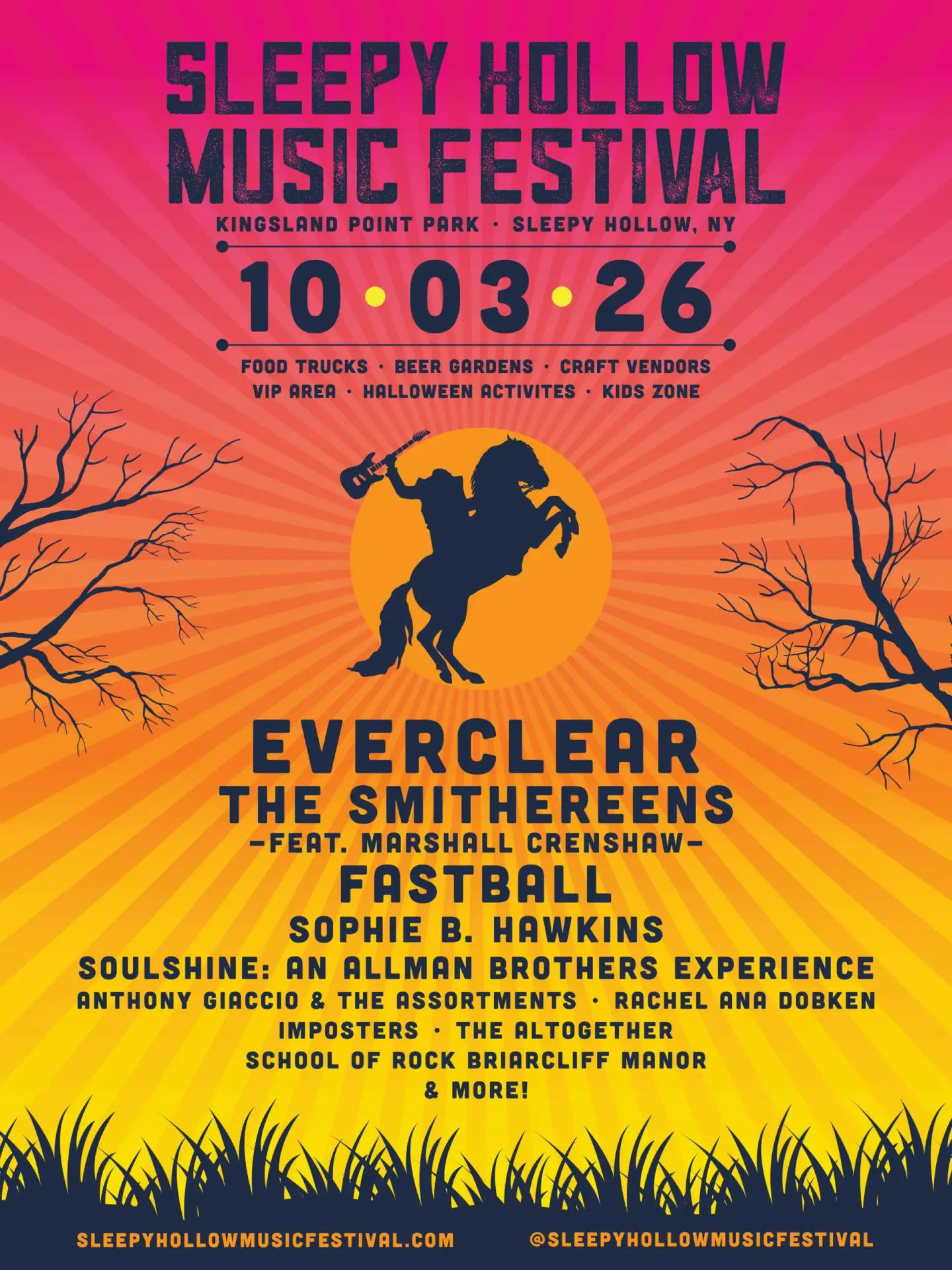
There is a particular kind of audacity required to throw an outdoor music festival in the actual village of Sleepy Hollow, on the first Saturday of October, with a Headless Horseman scheduled to gallop across the field between sets. Either you commit to it completely or you don’t do it at all. The Sleepy Hollow Music Festival, returning to Kingsland Point Park on October 3, 2026, for its third annual edition, is committed.
The lineup is a respectable read of 1990s alternative-rock royalty grafted onto a regional bill — Everclear headlining, The Smithereens featuring Marshall Crenshaw, Fastball, and SoulShine: An Allman Brothers Experience filling out the main stage, with Anthony Giaccio & the Assortments rounding out the top tier. A second stage hosts regional acts including Rachel Ana Dobken, Imposters, The Altogether, and student musicians from the School of Rock Briarcliff Manor. Two stages, no overlapping sets, eleven acts, 11 AM to 8 PM. Early-bird general admission is $55. Children twelve and under are free with a ticketed adult.
None of that is the most interesting thing about this festival. The most interesting thing is the address.
Sleepy Hollow Is the Real Place
Washington Irving published “The Legend of Sleepy Hollow” in 1820 as part of The Sketch Book of Geoffrey Crayon, Gent. He set it in a real Dutch settlement along the eastern shore of the Hudson River, used real landmarks, and based his Headless Horseman on a folk tradition that had circulated in the area for decades — most likely tied to a Hessian soldier killed at the Battle of White Plains in 1776, whose decapitation by a cannonball was documented in a letter by General William Heath. Irving knew the territory. He lived a few miles south at Sunnyside, his home in present-day Irvington, and he is buried in Sleepy Hollow Cemetery, on the hill above the Old Dutch Church that anchors the geography of his most famous story.
For most of the 20th century, the village was officially called North Tarrytown. In 1996, residents voted to change the name to Sleepy Hollow — formalizing what the rest of the world had been calling the place for 175 years. The Headless Horseman appears on town signs, on police patches, on the school district’s logo. The Tarrytown Lighthouse sits at the western edge of Kingsland Point Park. The Pocantico River — Irving used the name in the story — empties into the Hudson under the entrance road. The Old Dutch Burying Ground is a fifteen-minute walk away. The “bridge by the Old Dutch Church” where Ichabod Crane meets his fate has been rebuilt many times, but the original site still draws tourists every October.
Holding a music festival here on the first Saturday of October is not a gimmick. It is a recognition that the calendar, the geography, and the story have all converged at the same point, and a festival is what falls out the other end.
The Music
Everclear is the headliner that does the most work explaining what kind of festival this is. Art Alexakis has been fronting the band since 1991. “Santa Monica,” from 1995’s Sparkle and Fade, spent three weeks at number one on Billboard’s Album Rock Tracks chart in 1996. “Wonderful,” from 2000’s Songs from an American Movie Vol. One, reached the top three on the alternative charts. Anyone who listened to commercial alternative radio at any point between 1995 and 2003 has Everclear songs lodged in their long-term memory whether they meant to or not. A booking like this signals a festival that knows its audience — Gen X parents with kids in tow, looking for something more meaningful than another pumpkin patch — and is not embarrassed to serve them directly.
The Smithereens featuring Marshall Crenshaw is one of those bookings that requires a short footnote. Pat DiNizio, the band’s founding singer and primary songwriter, died in December 2017 at the age of 62. The surviving members — Jim Babjak, Mike Mesaros, and Dennis Diken — have continued touring with a rotating cast of guest vocalists. Marshall Crenshaw is among them. Crenshaw, whose own 1982 self-titled debut produced the indelible “Someday, Someway,” is exactly the right voice for the Smithereens catalog. His sensibility — sharp pop hooks, jangling guitars, an unfashionable commitment to melody — is cut from the same cloth as the band he is now fronting. “Blood and Roses,” “A Girl Like You,” “Only a Memory,” “Behind the Wall of Sleep” — the songs survive and the performances are credible. This is not a tribute band. It is a continuation.
Fastball arrives with the same kind of stubbornly memorable late-1990s catalog. “The Way,” released in January 1998 from All the Pain Money Can Buy, spent seven weeks at number one on the Modern Rock Tracks chart and is one of those songs that simply refuses to age out of the cultural conversation. Founders Miles Zuniga and Tony Scalzo have been writing together since the 1990s, and the band still tours actively. Their set will be efficient, hook-forward, and likely to produce the loudest sing-along of the day.
SoulShine: An Allman Brothers Experience handles the southern-rock and jam contingent. The Allman Brothers Band ended its 45-year run in 2014, and the touring tribute landscape has filled the gap — SoulShine works in that space with two-drummer arrangements and the extended improvisational reading that the Allman repertoire demands. Anthony Giaccio & the Assortments open the main stage with a regional rock and Americana set.
The regional stage is genuinely regional, not an afterthought. Rachel Ana Dobken is a Jersey Shore-rooted singer-songwriter and drummer with a soul-rock catalog. Imposters and The Altogether bring different shades of rock and indie. The School of Rock Briarcliff Manor performance — student musicians on a real festival stage — is the kind of community programming that festivals talk about but often don’t deliver. With no overlapping sets between the two stages, attendees can actually watch all eleven acts if they want to. That structural decision matters more than it might sound — most multi-stage festivals force constant tradeoffs. This one does not.
The Experience
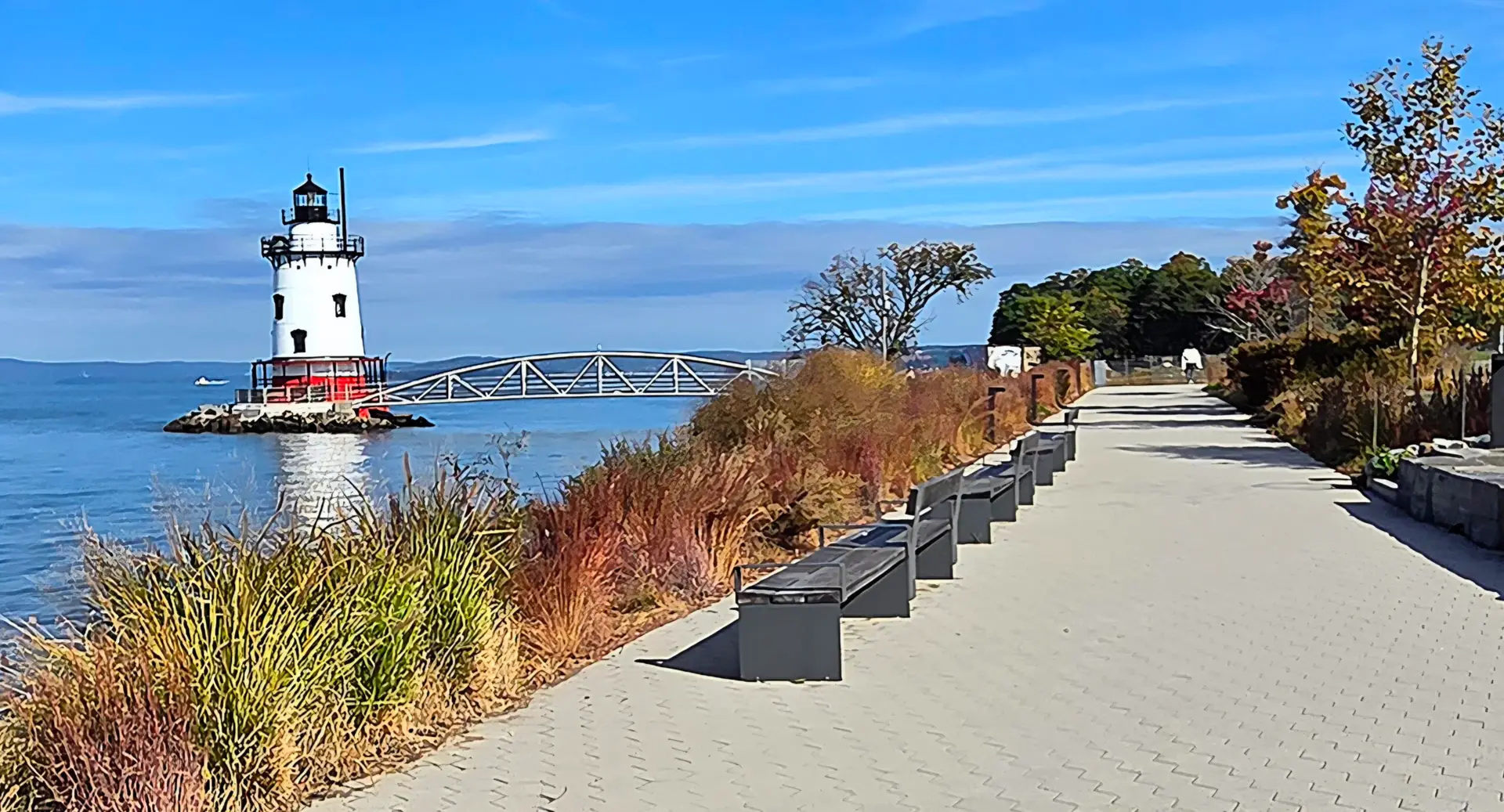
Kingsland Point Park is eighteen acres of waterfront on the eastern bank of the Hudson at the mouth of the Pocantico River. It was built in 1926 and is owned by Westchester County, operated by the village. The Tarrytown Light, also known as the Sleepy Hollow Lighthouse, sits at the park’s western edge — a five-story cast-iron structure built in 1883 that served the Hudson shipping channel until the Tappan Zee Bridge made it obsolete in 1961. The lighthouse has been restored and is open for tours. It is one of the more striking backdrops any regional festival has to work with — a working-class industrial relic looking out over one of the widest stretches of the Hudson, with the Palisades visible on the New Jersey side.
The festival leans into the Halloween setting without crossing into kitsch. A costume parade runs through the day. The Headless Horseman makes scheduled appearances between sets — a costumed performer on horseback, photo ops included. A kids’ zone offers sensory play activities, instrument experiences, and inflatables. The organizers have publicly described the festival as “the most family-friendly and FUN music festival in the tristate,” and the structure of the day supports that framing — re-entry is permitted, twelve-plus food trucks operate on-site, thirty-plus craft and specialty vendors line the perimeter, and a beer garden and VIP lounge handle the adult audience without forcing parents to choose between supervising kids and seeing the music.
The vibe between sets is what the festival is built around. October in the lower Hudson Valley is peak fall foliage — the river corridor north and south of Sleepy Hollow runs through some of the most photographed autumn landscape in the country. The neighboring Great Jack O’Lantern Blaze in Croton-on-Hudson and the broader Halloween tourism economy of Westchester County pull hundreds of thousands of visitors to the region each October. The festival sits inside that ecosystem and benefits from it. A day at Kingsland Point Park can extend into an evening in the village — dinner at a Beekman Avenue restaurant, a walk through the Old Dutch Burying Ground at twilight, a stop at Philipsburg Manor across the road.
Getting There and Know Before You Go
Kingsland Point Park is at the end of Palmer Avenue in Sleepy Hollow, NY — roughly thirty miles north of Midtown Manhattan. From New York City, take the Saw Mill River Parkway or the Henry Hudson Parkway north to the Tappan Zee Bridge interchange, then follow signs into the village. From the north and west, the New York State Thruway (I-87) connects via the Mario M. Cuomo Bridge. Metro-North’s Hudson Line stops at the Philipse Manor station, a short walk from the park entrance — a viable option for visitors from Manhattan who would rather not drive.
Parking at the park itself is limited. The festival has historically used remote parking and shuttle service from satellite lots — check the festival website for the 2026 plan. Walking and rideshare from downtown Sleepy Hollow and Tarrytown are also reasonable for a festival of this size.
Lodging options span the village and the surrounding Hudson Valley. The Tarrytown House Estate, the Doubletree Tarrytown, and a range of Airbnbs in Sleepy Hollow, Tarrytown, and Irvington handle the immediate area. October weekends book up early in this region — the Halloween tourism wave is real, and accommodations within a fifteen-minute drive are often sold out months in advance. Plan accordingly.
October weather in the lower Hudson Valley is typically mild — daytime temperatures in the 50s to low 60s, cool evenings, occasional rain. Layers are essential. The festival runs rain or shine. Tickets start at $55 for early-bird general admission; children twelve and under enter free with a ticketed adult, with a maximum of two children per adult. Re-entry is permitted throughout the day. VIP options and add-ons are available through the festival website.
Why This Festival Matters
The Hudson Valley has a robust festival calendar, but most of it concentrates in the summer months — Bethel Woods, the Clearwater Festival, dozens of smaller events that wrap up by Labor Day. October presents a programming opportunity that few have figured out how to exploit. The combination of fall foliage, Halloween tourism, and the region’s literary mythology is sitting there, largely unmonetized as a music-festival proposition. Sleepy Hollow Music Festival has identified the opening and is moving into it with appropriate ambition — A-list 1990s headliners, a thoughtful regional undercard, family-friendly programming, and a setting that no other festival in the country can replicate.
That last point is the one that matters most. Music festivals are easy to start and hard to differentiate. Most of them end up running on the same playbook — a field, two stages, a beer tent, a roster of touring acts that play forty other festivals a year. Sleepy Hollow has a real claim to a thing no other festival has: the place itself. Washington Irving’s two-hundred-year-old story has done more for regional brand identity than any tourism board in America could engineer from scratch. Holding a music festival inside that brand — on the actual ground, with the actual landmarks visible from the stage — is the kind of move that creates an event with staying power.
The third edition is when a regional festival starts to prove it has legs. The 2026 lineup suggests the organizers are taking that seriously.
Sleepy Hollow Music Festival runs Saturday, October 3, 2026, from 11 AM to 8 PM at Kingsland Point Park in Sleepy Hollow, NY. Lineup and tickets at sleepyhollowmusicfestival.com.