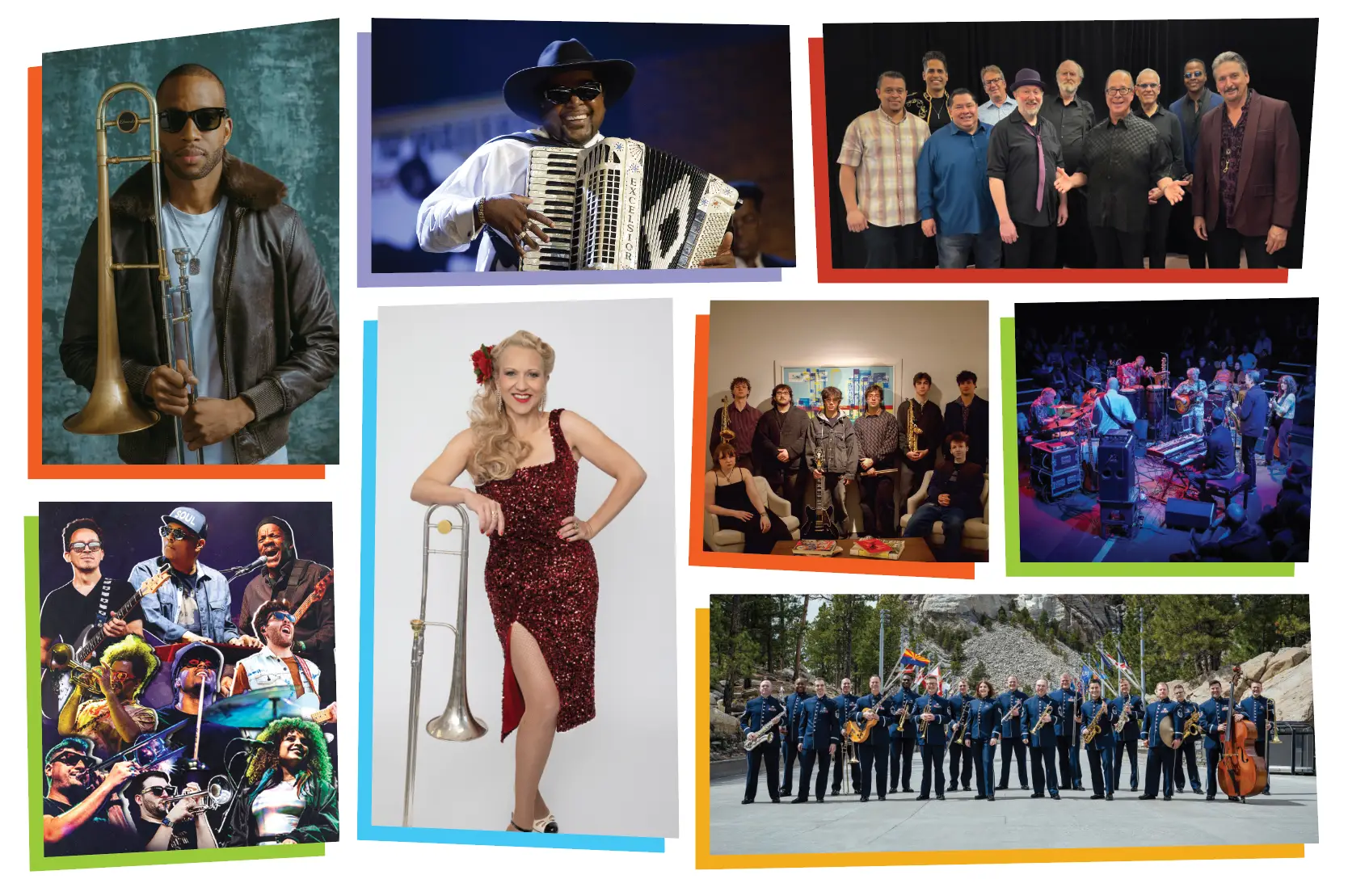
On a Friday night in July 2026, Tower of Power will roll into a working apple orchard in LaFayette, New York, set up on a stage cut into the side of an old cider mill, and play “What Is Hip?” for a Central New York crowd that did not pay a single dollar to get in. The next night, Trombone Shorty and Orleans Avenue will do the same. So will Nathan and the Zydeco Cha Chas, the Joni Mitchell tribute act Hejira, the Sly and the Family Stone tribute Dumpstaphunk, and the Swedish jazz showwoman Gunhild Carling. Syracuse International Jazz Fest, marking its 40th anniversary edition, is still free. That fact, more than the lineup, is the story.
The 40th anniversary edition runs July 9 through 12, 2026, split between two locations: the outdoor stages at Beak & Skiff Apple Orchards in LaFayette and the Syracuse University campus in Syracuse. All performances remain free and open to the public — the model the festival has operated under since moving downtown in the late 1980s. According to DownBeat magazine, that puts Syracuse Jazz Fest in rare company: one of only 25 jazz festivals worldwide to reach a 40-year milestone, and the largest free jazz festival in the Northeast.
Forty Years of Free
The festival was founded in 1982 by Frank Malfitano, a Syracuse-born jazz presenter who had been booking local musicians and lobbying for a real festival in his hometown. The inaugural event was held indoors at Oliver’s club on Erie Boulevard in October 1982, with a lineup of nine local bands. By the next year the festival had moved outdoors to Song Mountain ski resort in Tully, south of Syracuse, where it found its footing as a regional draw. The 2026 edition is being celebrated as the festival’s 40th anniversary, counting only its active years — there have been hiatuses along the way, including a five-year stretch from 2018 to 2022.
Malfitano has run the operation, in one form or another, ever since. He has shepherded the festival through multiple homes — Long Branch Park in Liverpool in the late 1980s, then Onondaga Community College for a long stretch, then a downtown Syracuse run that wound through Clinton Square, Hanover Square, Armory Square, and Hendricks Chapel at Syracuse University. The 2026 move to Beak & Skiff is just the latest chapter in a festival that has always followed the music to where it sounded best.
The headliner roster across four decades reads like a syllabus for postwar American music. Dizzy Gillespie. Dave Brubeck. Ray Charles. B.B. King. Aretha Franklin, who headlined in 2015. Smokey Robinson. Dr. John. Wynton Marsalis and the Jazz at Lincoln Center Orchestra. Buckwheat Zydeco. Diana Krall. Sonny Rollins. Those are not aspirational bookings. Those are the actual people who have stood on a Syracuse Jazz Fest stage, in front of a Central New York crowd.
The Free Question
How does a festival that has hosted Aretha Franklin charge zero dollars at the gate? The answer is a combination of corporate underwriting, public-private partnership, and stubborn institutional will. M&T Bank served as title sponsor for roughly two decades — the festival operated for years as the M&T Bank Syracuse Jazz Festival — and a rotating roster of regional businesses, foundations, and Syracuse University itself have shouldered the production costs that ticket revenue would normally cover. The math is not easy. Losing M&T’s underwriting was one of the factors behind the festival’s hiatus in the late 2010s, and Malfitano has talked publicly about how close to the line the festival has lived for years.
But the free model is not incidental to what the festival is. It is the entire premise. Syracuse Jazz Fest exists to put world-class music in front of audiences who might never otherwise pay $150 for a jazz festival ticket. It is an explicit argument that jazz, funk, soul, gospel, and global music are not boutique products for people who can afford them — they are American cultural patrimony, and access to them is a public good. The festival’s own framing puts it plainly: “world-class music, always and forever free.”
The Music
The 2026 program is a tight four-day arc that opens on Thursday, July 9 at Syracuse University with the USAF Airmen of Note, the U.S. Air Force’s premier jazz ensemble, alongside the SU student band Orange Juice. It is a setup night — pedigreed, easy, gets the campus going.
Friday, July 10 at Beak & Skiff is when the festival turns into a festival. Hejira, a seven-piece British ensemble making its North American debut, plays a 50th anniversary celebration of Joni Mitchell’s jazz-era songbook — the Hejira and The Hissing of Summer Lawns material that took Mitchell out of folk and into something stranger and more durable. Dumpstaphunk, the New Orleans funk band led by Ivan and Ian Neville, plays a tribute set to Sly and the Family Stone. Then Tower of Power closes the night.
Tower of Power is the kind of band that does not need an introduction in any room they walk into. Founded in Oakland in 1968 by Emilio Castillo and Stephen “Doc” Kupka, the band built modern horn-section funk — five horns, tight enough to cut glass, locked to a rhythm section that has anchored everything from “What Is Hip?” to “You’re Still a Young Man” to half the soul records of the 1970s. They are arriving in LaFayette fresh off a three-month international tour through Japan, Australia, and Europe, which means they will be playing at peak road sharpness. An outdoor stage at an apple orchard at dusk in July is exactly the right room for what they do.
Saturday, July 11, is the headline night. Nathan Williams and the Zydeco Cha Chas open the main stage with Grammy-nominated Louisiana zydeco — accordion-driven, hot, made for dancing. Gunhild Carling and the Carling Family Band bring a vaudeville-grade swing show that has earned the Swedish bandleader a cult following on the international jazz circuit. Then Trombone Shorty closes.
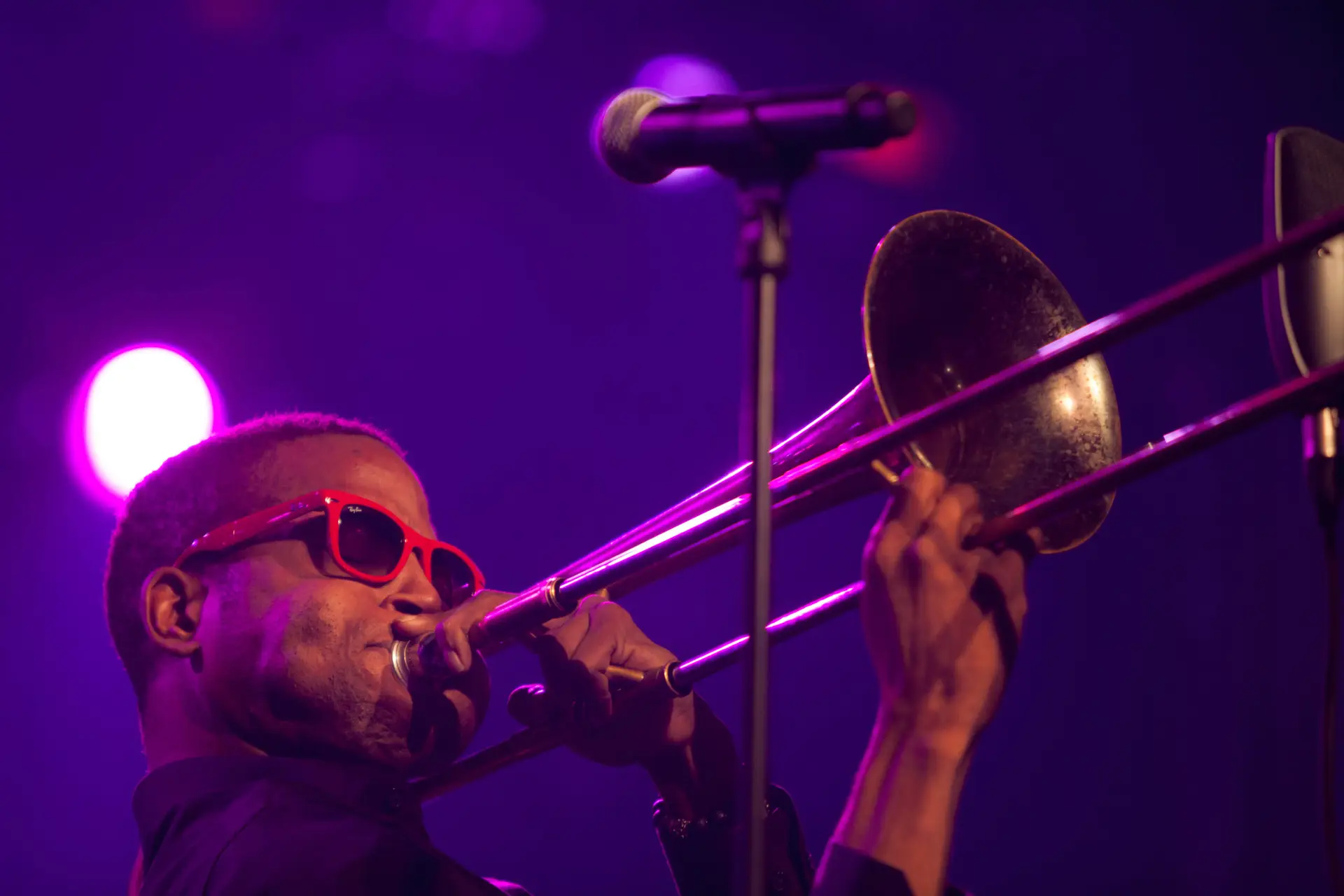
Troy Andrews — Trombone Shorty — grew up in Tremé in New Orleans, started sitting in with brass bands at four, was leading his own band by his teens, and has spent the last two decades building one of the most consequential live music acts in American music. Orleans Avenue, his core band, plays a hybrid of New Orleans brass-band tradition, funk, soul, and rock that he has called “supafunkrock.” He has racked up multiple Grammy nominations, won a Grammy as featured artist on Jon Batiste’s We Are, headlined Jazz Fest in his hometown, and collaborated with everyone from Lenny Kravitz to Pharrell to Foo Fighters. For a free festival in upstate New York to land him as a Saturday headliner is not normal. It is the kind of booking that signals exactly how seriously the festival is taking its 40th year.
Sunday, July 12 closes the festival at Hendricks Chapel on the Syracuse University campus with the Return to Community Gospel Jazz Service — the kind of programming that distinguishes Syracuse from purely commercial festivals. Jazz, gospel, and community are not separate categories in this booking philosophy. They are versions of the same conversation.
The Experience
Beak & Skiff Apple Orchards is a working farm. It has been producing apples in LaFayette, about 15 miles south of downtown Syracuse, since 1911 — five generations of the same family, more than 70 varieties of apples on the trees. It also produces 1911 Established hard cider and spirits, and in recent years has emerged as one of Central New York’s most ambitious outdoor concert venues, hosting the Brite Vibes country music series and large-scale touring shows on its open-air stages. Setting a jazz festival here, in a fully working orchard, gives the 2026 edition a setting that the downtown Syracuse years could not match — a real Central New York agricultural landscape, hills, open sky, the smell of apple trees, the sound of horns carrying across the rows.
The split with Syracuse University matters too. The campus dates anchor the festival to its longest-running institutional partner — SU has supported the festival in various forms for decades, hosting performances, providing venues, supporting Malfitano’s work as a visiting scholar and educator. The bookending of the festival between campus and orchard is a literal version of what the festival has always been: city and country, university and community, jazz and everything jazz has touched.
Getting There and Know Before You Go
Beak & Skiff is at 2708 Lords Hill Road in LaFayette, NY, about a 20-minute drive south of Syracuse via I-81. The orchard has substantial parking on-site; for free-festival days, expect a directed flow with overflow lots and shuttle support depending on attendance. Bring a chair or a blanket. The main stage areas are general admission, lawn-style.
The Syracuse University performances at Hendricks Chapel are at 110 University Place in Syracuse. Campus parking is available in nearby garages — Booth, Irving, Comstock — and the festival typically coordinates with the university on access. Plan extra time on the gospel service Sunday; that one tends to fill the chapel.
July in Central New York means heat, humidity, and a real chance of afternoon thunderstorms. Bring water, sunblock, a rain layer. Food vendors will be on-site at Beak & Skiff. The orchard’s own cider and spirits tasting rooms operate during festival days. No ticket purchase is required for any performance, though VIP and reserved-seat options may be available — check syracusejazzfest.com closer to the dates for the latest details.
Why This Festival Matters
The economics of American music festivals have gotten ugly. Three-day passes at major festivals routinely exceed $500. Single-day general admission at jazz festivals — a genre whose audience skews older and less wealthy than rock or hip-hop crowds — can run $100 or more. The argument for accessibility has been losing for a generation. Syracuse Jazz Fest is one of the most consequential remaining counter-arguments.
That a festival in a mid-sized upstate New York city has hosted Aretha Franklin, B.B. King, Ray Charles, Dizzy Gillespie, and Trombone Shorty over four decades — most of those years at no cost to the audience — is not just a feel-good story. It is a working demonstration that another model is possible. Corporate sponsorship, civic investment, institutional partnership, and one tenacious presenter can, in fact, produce world-class programming at a price that includes everybody.
Forty editions in, Syracuse Jazz Fest is still doing the thing it set out to do. It is, in 2026, a festival the city can call its own, that nobody is priced out of, that takes the music seriously enough to put it in front of as many people as possible.
Syracuse International Jazz Fest runs July 9 through 12, 2026 at Beak & Skiff Apple Orchards in LaFayette and the Syracuse University campus in Syracuse. Full lineup and schedule at syracusejazzfest.com.