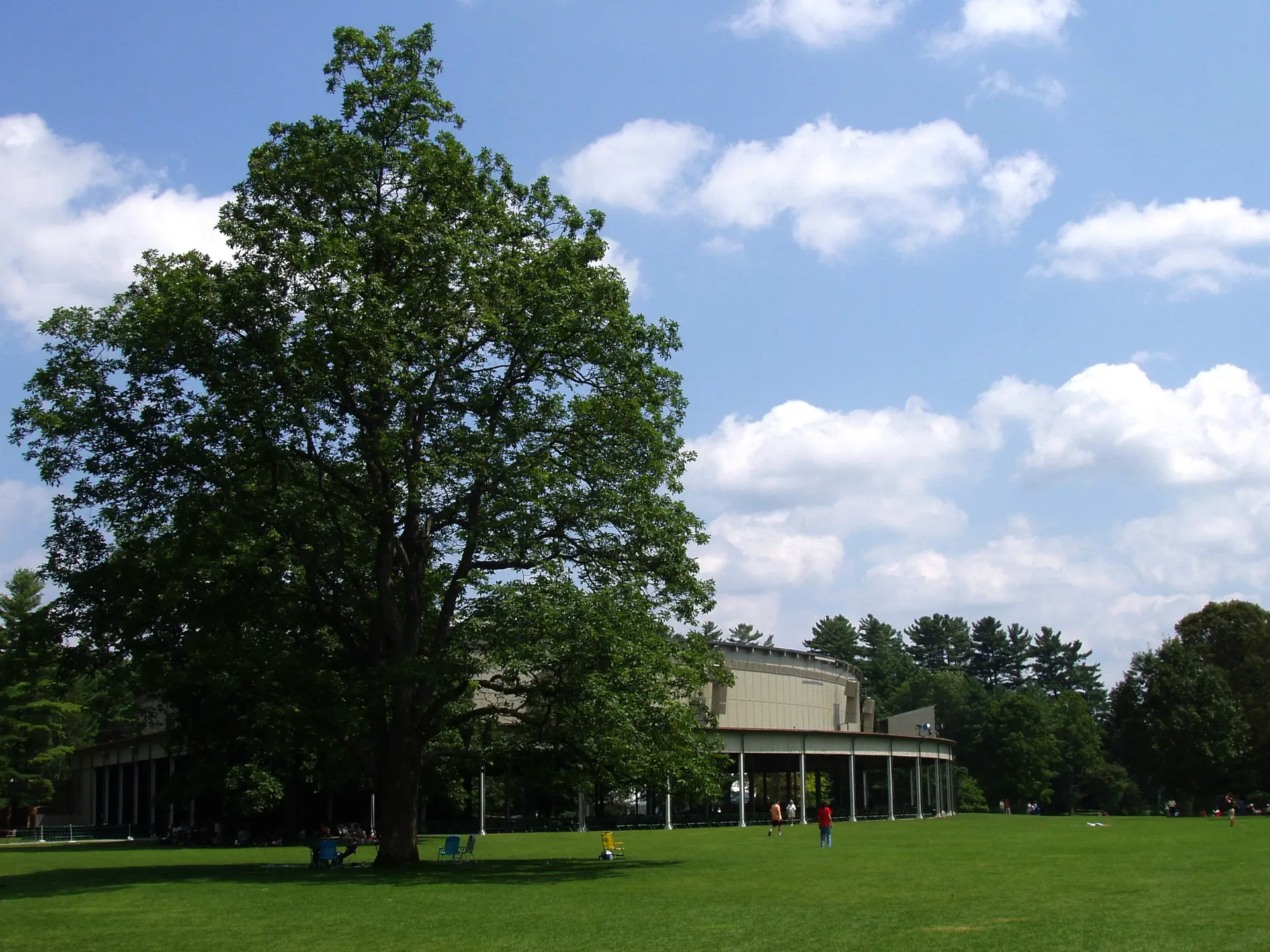
Pull a blanket out of the trunk in the early evening, walk it across the gravel and onto the sloping lawn, and find a spot under the trees. Light a candle. Pour the wine. Wait for the lights to come up inside the Koussevitzky Music Shed and the first downbeat of the Boston Symphony Orchestra to drift out across the Berkshires. There is no American summer music experience that does this — at this scale, with this orchestra, on this property — and there has not been one since 1937. Tanglewood is what every other festival in the country measures itself against, whether it admits it or not.
The 2026 season is the latest iteration of that nearly 90-year tradition, and the lineup is — depending on how you count — either the most accessible Tanglewood has ever been or the clearest argument yet for why classical and popular music belong on the same lawn. Paul Simon plays two nights at the end of June. Jon Stewart kicks off the season’s popular series the week before. Wynton Marsalis brings the Jazz at Lincoln Center Orchestra back for the first time in more than a decade. James Taylor returns for his July 4 weekend tradition. Yo-Yo Ma settles in for a week-long residency in August. Brandi Carlile, Hugh Jackman with Keith Lockhart and the Boston Pops, Carrie Underwood, the Tedeschi Trucks Band, Alabama Shakes with Mavis Staples, John Fogerty and Steve Winwood — all alongside a full Boston Symphony Orchestra and Boston Pops calendar that constitutes one of the most consequential classical-music seasons of any festival in the world.
For Capital Region audiences, Tanglewood is the easiest world-class festival to reach. The drive from Albany is about an hour. There is no air travel, no traffic equivalent of getting out of New York City, no overnight hotel required. It is, functionally, our backyard — and it is the gold standard.
The Music
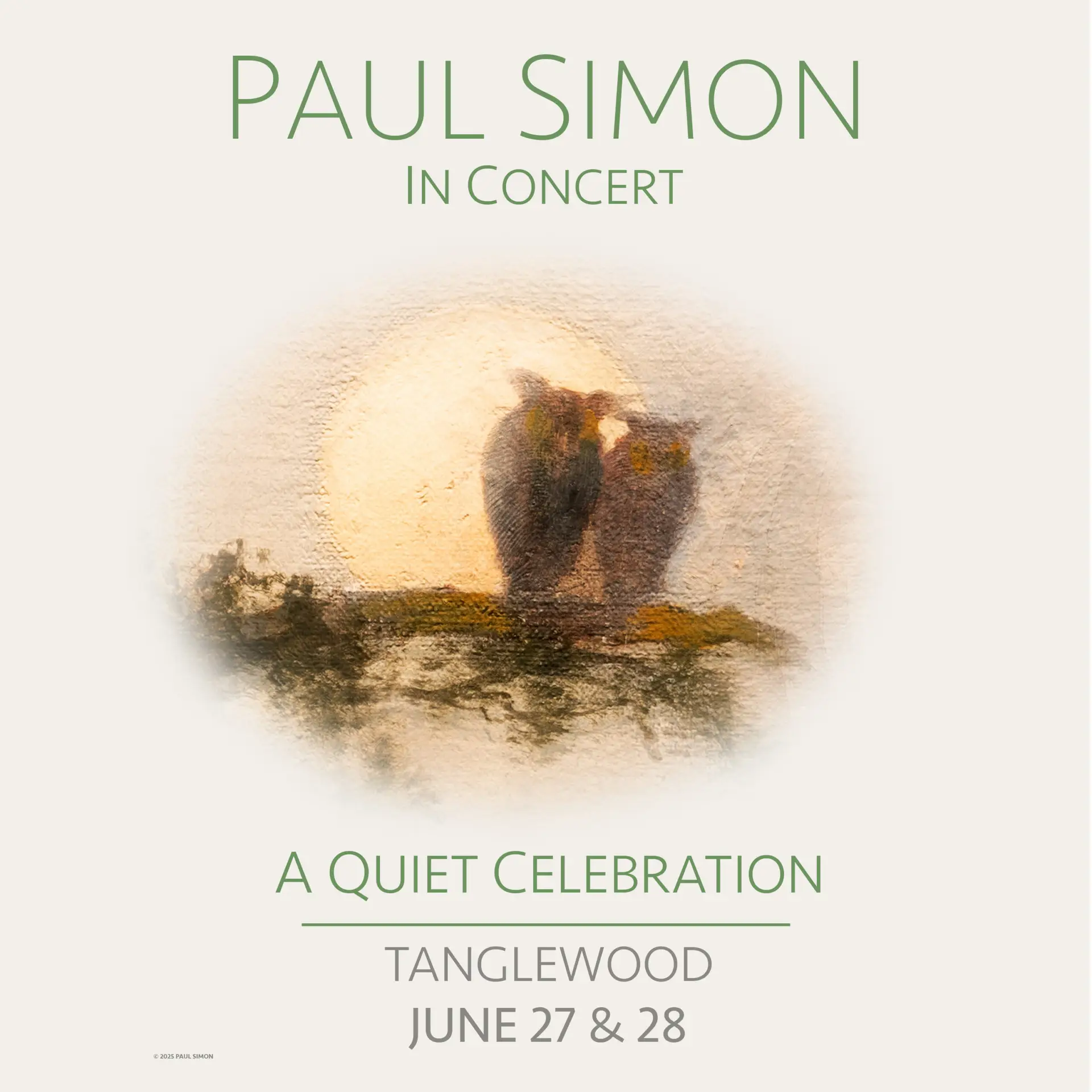
The 2026 popular artist series alone would headline almost any festival in the country. Paul Simon — at 84, still touring behind Seven Psalms and a re-engagement with the back catalog he largely retired from a decade ago — plays Saturday, June 27 and Sunday, June 28. These are not throwaway dates; Simon’s recent shows have been some of the most thoughtful, carefully constructed concerts of his career. To have him for two nights at the Shed is the kind of booking that defines a season.
Wynton Marsalis brings the Jazz at Lincoln Center Orchestra to Tanglewood on Friday, June 26 — a long-awaited return for the orchestra to the Shed. Marsalis at the Shed is Marsalis at his best: a deep big-band setting, an outdoor acoustic that rewards both the precision and the swing, and an audience that came to listen. Jon Stewart opens the popular calendar on June 20 with his band Church and State. Yacht Rock Revue follows on June 21. The Jerry Garcia Symphonic Celebration with Keith Lockhart and the Boston Pops lands on June 30, marking 60 years of the Grateful Dead and Garcia’s enduring presence in American music — orchestral arrangements of “Eyes of the World,” “Sugaree,” “Touch of Grey,” and the rest of the songbook.
James Taylor’s July 4 weekend has become a Tanglewood tradition, and 2026 keeps the run going: Taylor and his All-Star Band on Friday, July 3 and Saturday, July 4, the latter followed by an Independence Day fireworks display over the Stockbridge Bowl. Proceeds from the July 4 concert are donated by Kim and James Taylor back to Tanglewood. The Boston Pops bookend the weekend with all-American programs on July 2 and July 5 — Gershwin, Copland, Bernstein, John Williams.
The popular series runs deep through summer: Ziggy Marley and Trombone Shorty & Orleans Avenue on July 14, “Weird Al” Yankovic’s “Bigger & Weirder” tour with Puddles Pity Party on July 21, Jason Isbell and the 400 Unit with Patty Griffin on July 28, Hugh Jackman with the Boston Pops on August 11, Brandi Carlile on August 18, Cynthia Erivo with the Boston Pops on August 21, Carrie Underwood on August 29, Tedeschi Trucks Band with Lukas Nelson on September 2, Alabama Shakes with Mavis Staples on September 5, and John Fogerty with Steve Winwood on September 6.
The classical calendar — the actual reason Tanglewood exists — runs in parallel and is, if anything, more ambitious. Yo-Yo Ma’s August 4 through 9 residency, “We the People: Our Shared Past, Present and Future,” is curated by Ma himself and spans large orchestral programs alongside intimate chamber settings. Joe Hisaishi makes his Tanglewood debut conducting the BSO. Esa-Pekka Salonen and Marin Alsop appear with the orchestra. John Williams Film Night returns on August 15 — Keith Lockhart leading the Boston Pops in “Maestro of the Movies: A Tribute to John Williams,” with more than 50 minutes of HD film clips synced to Williams’ scores. The BSO’s classical season opens July 10 with Andris Nelsons conducting an all-Tchaikovsky program, with pianist Seong-Jin Cho as soloist in the Piano Concerto No. 1.
The Place
The Tanglewood property is 524 acres of preserved lawn, meadow, and woodland on the western edge of Lenox, Massachusetts, overlooking the Stockbridge Bowl. The land was given to the Boston Symphony Orchestra in the winter of 1936 by Mrs. Gorham Brooks and her aunt, Miss Mary Aspinwall Tappan — the Tappan family had owned the estate since the mid-19th century, when William Aspinwall Tappan and his wife Caroline Sturgis Tappan acquired the land and later built the main house. The first Tanglewood concert on the property took place on August 5, 1937, under a canvas tent, with the BSO playing an all-Beethoven program to the largest festival crowd to that point.
The Koussevitzky Music Shed went up the following year. The architectural story is one of Tanglewood’s better legends: the Finnish-American architect Eliel Saarinen — father of Eero, designer of the St. Louis Gateway Arch — was hired first, and submitted plans that ran well over the $100,000 budget. His revised, simplified plans were still too expensive. Saarinen finally wrote to the trustees that if they insisted on holding the budget, they would end up with “just a shed.” They took him at his word, hired Stockbridge engineer Joseph Franz, and built it ahead of schedule and under budget. The Shed opened on August 4, 1938. It has hosted the BSO every summer since, except for the war years of 1942 through 1945. For its 50th anniversary in 1988, the building was rededicated as the Serge Koussevitzky Music Shed.
The Shed seats about 5,000 inside. The lawn, sloping down from the open back of the structure, holds many thousands more. Sound carries cleanly from stage to back of lawn — the architecture, simple as it is, was tuned for outdoor acoustic projection in a way that contemporary amphitheaters with their PA arrays still cannot match. A lawn ticket to a BSO concert at Tanglewood remains one of the great cultural bargains in American summer life.
The Tradition
Serge Koussevitzky — the BSO’s music director from 1924 to 1949 (stepping down at the end of the 1948–49 season) — was the figure who built Tanglewood into more than a summer concert series. In 1940 he opened the Berkshire Music Center, now known as the Tanglewood Music Center (TMC), as a training academy for young professional musicians. The TMC opened formally on July 8, 1940. Its founding faculty included Aaron Copland and Paul Hindemith. Its first conducting students included Leonard Bernstein, Lukas Foss, Thor Johnson, and Richard Bales.
Bernstein’s connection to Tanglewood is the deepest in American music. He was a TMC fellow in that first 1940 class. He returned year after year for the next half-century as a teacher, mentor, conductor, and presence. His final concert with the Tanglewood Music Center Orchestra was on August 14, 1990. His final concert anywhere was at Tanglewood on August 19, 1990, conducting the BSO in Beethoven’s Seventh Symphony while audibly fighting for breath. He died two months later, on October 14, 1990. The 50-year arc — from first-class fellow to last podium — is held in the Shed itself.
The Tanglewood Learning Institute (TLI), founded in 2019, extends that educational mission to general audiences through pre-concert talks, master classes, nature walks on the property, and immersive multi-day programs. Randall Thompson’s Alleluia, commissioned for the TMC’s 1940 opening exercises, has been sung at every opening exercise since. The continuity is the point. Things that happen at Tanglewood do not happen anywhere else.
The Lawn
The lawn culture at Tanglewood is its own art form. Veteran attendees arrive hours before downbeat with low folding chairs, blankets, picnic baskets, candle lanterns, and dinner spreads that range from grocery-store cheese plates to multi-course productions with stemware. Wine and beer are permitted. The atmosphere between sets, before the music starts, has the quality of a long civilized cocktail party — thousands of strangers in proximity, conversing quietly, eating slowly, anticipating the same music. Then the orchestra tunes, and the conversation tapers, and several thousand people on a hill in the Berkshires go silent for Beethoven.
The picnic-on-the-lawn tradition is not a marketing gimmick. It is genuinely how the festival is consumed by a meaningful percentage of its audience. The Tappan Family Lawn — the open expanse behind the Shed — is the heart of the property. Sight lines from the lawn into the Shed are partial; the experience leans audio. But there are video screens for popular series shows, and for many regulars the lawn is preferred to the Shed seats even when seats are available.
Getting There and Know Before You Go
Tanglewood is at 297 West Street in Lenox, Massachusetts, about 5 minutes off the Massachusetts Turnpike at Exit 2. From Albany, take I-90 East about 45 minutes to the Lee/Lenox exit; from there it is another 10 to 15 minutes on Route 20 and Route 7. Total drive from downtown Albany is approximately one hour, traffic permitting. From the Capital Region’s southern suburbs the drive is even shorter. Parking on-site is free for most events. Gates typically open two hours before showtime.
Lodging in Lenox and the surrounding Berkshire towns — Stockbridge, Lee, Great Barrington, Pittsfield — is plentiful but expensive in peak summer. Book well in advance for marquee weekends (Paul Simon, James Taylor, Yo-Yo Ma’s residency, John Williams Film Night). Day-trips from the Capital Region are entirely practical and remove the lodging problem entirely.
Single tickets and lawn tickets went on sale March 5, 2026. Lawn tickets are typically the most affordable option, often in the $25 to $40 range for BSO concerts (popular series pricing runs higher). Tickets and the full schedule are available directly through the BSO at tanglewood.org, by phone at 617-266-1200, or via email at customerservice@bso.org.
Why Tanglewood Matters
There are larger music festivals in America. There are festivals with more current-relevance booking on the popular-music side. There are venues with newer technology, flashier production, more aggressive sponsorship integration. There is not another festival on this continent — and arguably anywhere — that combines a top-five symphony orchestra in residence for a full summer, an 88-year-old open-air shed with the acoustics of a concert hall, a training academy that has shaped American classical music for 86 years, and a popular-artist series that brings Paul Simon and Brandi Carlile and Wynton Marsalis to the same stage where Leonard Bernstein took his last bow.
Carnegie Hall has the winter. Tanglewood has the summer. That symmetry is not casual — the BSO and the New York Philharmonic and the Cleveland Orchestra and every other major American ensemble look to Tanglewood as the standard for what a festival residence should be. For the Capital Region, that standard is an hour’s drive away. There is no good reason not to make the trip at least once a summer.
The Tanglewood 2026 season runs June 20 through September 6, 2026, at the Koussevitzky Music Shed and Ozawa Hall in Lenox, Massachusetts. Schedule and tickets at tanglewood.org.