
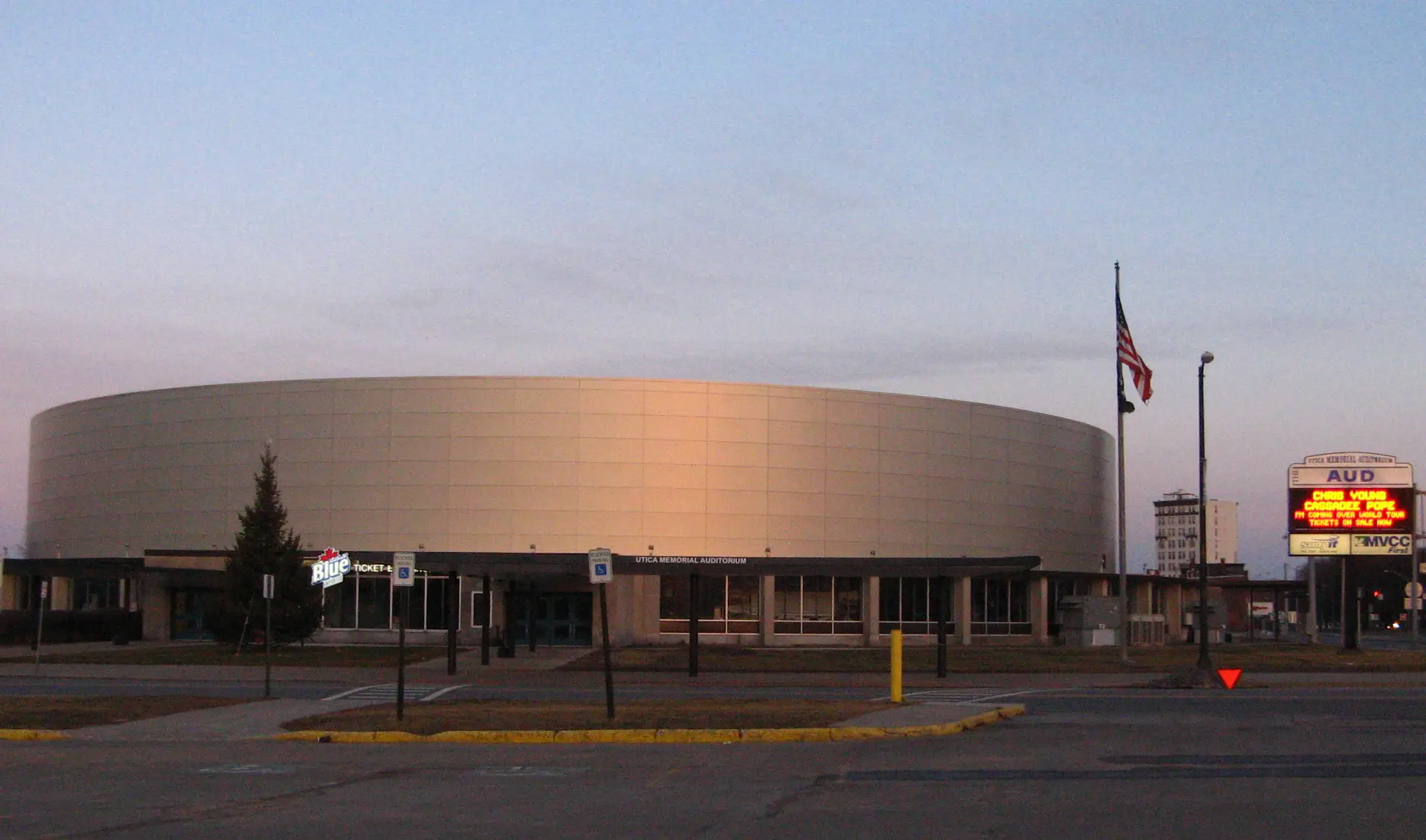
Locals just call it The Aud. They’ve been calling it that since 1960, through name changes and renovation projects and decades of shows that have rattled the rafters of this concrete landmark on Oriskany Street. The Adirondack Bank Center at the Utica Memorial Auditorium carries its full title like a formal name that nobody actually uses — because The Aud is more than a building. It’s a piece of Central New York’s identity, a place where generations of Uticans have seen their first concert, watched their first hockey fight, and felt the kind of communal electricity that only a mid-size arena can generate.
Built on the Erie Canal
The Utica Memorial Auditorium was built by the City of Utica in 1959 on the site of the old Erie Canal, on land donated by the State of New York. It opened in 1960, and at the time, it was an engineering marvel — one of only three arenas in the world with a completely unobstructed interior. No support pillars. No columns blocking your view. The cable-suspended roof was so innovative that in 2011, the American Society of Civil Engineers designated The Aud as a National Historic Civil Engineering Landmark. That’s a distinction shared with structures like the Brooklyn Bridge and the Hoover Dam.
The design was intentional: every seat in the house was meant to have a clear sightline to whatever was happening on the floor. For a 3,999-seat arena (expandable to roughly 5,700 for concerts), that engineering decision has paid dividends for more than six decades. There is no bad seat in The Aud — a claim that plenty of venues make but few can actually deliver on.
The Concert Ledger
The list of artists who have played The Aud reads like a survey course in American popular music. The Grateful Dead. Bruce Springsteen. ZZ Top. Kenny Rogers. Santana played here on February 22, 1973, during the Caravanserai Tour — their only Utica date ever. The arena hosted Godsmack, Oysterhead, Disturbed, and Avenged Sevenfold in more recent years, pulling sold-out crowds that prove The Aud still has pull in the touring market.
But the venue’s most famous concert never happened. Elvis Presley was scheduled to perform at The Aud on Friday, August 19, 1977. He died three days earlier, on August 16, at Graceland. The Utica show was one of the last concerts on his tour schedule — a detail that has become part of The Aud’s folklore, a ghost story that locals still tell. Somewhere in Utica, people held tickets to a show that became a piece of music history for the worst possible reason.
The Modern Aud
The Aud hasn’t stayed frozen in 1960. In 2015, two video boards were installed alongside other arena upgrades. Then, in November 2017, a $10.55 million state-funded expansion was completed — adding 26,000 square feet of new space that includes a redesigned entrance, executive suites, a new women’s restroom, a building-wide sprinkler system, and other modernizations. The naming rights deal with locally based Adirondack Bank was announced the same year, giving the venue its current official name while preserving “at the Utica Memorial Auditorium” in the formal title. The community insisted on that.
Today, The Aud is home to the Utica Comets, the AHL affiliate of the New Jersey Devils. Hockey drives the regular-season calendar from October through April, and the Comets have built a passionate fan base that fills the building on weekend nights. But the concert calendar remains active, and The Aud’s mid-size capacity makes it an attractive stop for touring artists who want an intimate arena setting without the logistical overhead of a 15,000-seat facility.
The Sound and the Feel
The Aud sounds like a concrete arena — because it is one. The acoustics are honest, not refined. For rock, metal, and amplified shows, that’s a feature: the sound hits hard, the bass reverberates through the floor, and the energy in a packed house is palpable. For quieter, more nuanced performances, the room demands a skilled sound engineer. But the unobstructed sightlines and the compact bowl mean the energy stays concentrated. When The Aud is full for a show, there’s a pressure in the room that larger venues dilute. Five thousand people in a pillarless bowl, all facing the same direction — it’s visceral in a way that modern shed amphitheaters rarely achieve.
Getting There and What’s Nearby
The Adirondack Bank Center is located at 400 Oriskany Street West in Utica. From the New York State Thruway (I-90), take Exit 31 and follow signs for Genesee Street South. After the first traffic light, exit right onto Whitesboro Street — The Aud is six blocks ahead on the left. Three parking lots operate during events, including a VIP/accessible lot adjacent to the building on Auditorium Drive. Parking runs $5 per vehicle.
For dining, you’re in one of the best food cities in Central New York. 72 Tavern & Grill is built right into the west end of the Adirondack Bank Center itself — grab a burger and watch the pregame on their massive 160-inch LED wall before walking straight into the arena. Babe’s at Harbor Point has been a Utica staple for over 25 years, serving reliable American fare at fair prices in a relaxed waterfront setting. And Esche’s Aqua Vino handles the upscale end with seafood, steaks, and Italian-influenced plates — a strong pre-show option if you’re making an evening of it.
Insider Tips
Utica is a food town that punches well above its weight, thanks in large part to the city’s deep Italian-American and Bosnian immigrant communities. If you’re in town for a show, do not leave without trying Utica greens (an escarole, cherry pepper, and breadcrumb dish that originated here) and a tomato pie (Utica’s answer to the pizza question, served cold from a sheet pan at places all over town). O’Scugnizzo Pizzeria on Bleecker Street has been open since 1914 and serves one of the definitive versions.
For the concert itself: the lower bowl delivers the best balance of proximity and sightlines. The upper sections are steep but still close — remember, this is a 4,000-seat arena, not a hockey barn that seats 18,000. Every seat genuinely works. The Labatt Blue Entrance on Auditorium Drive tends to be less congested than the main entrance on show nights.
One more thing: The Aud sits on the site of the Erie Canal. That’s not just a historical footnote — it’s a reminder that Utica has always been a crossroads, a place where people and culture pass through. The Aud has been catching that traffic for over 60 years, and it’s not done yet.
For tickets and upcoming events, visit adkbankcenter.com.