
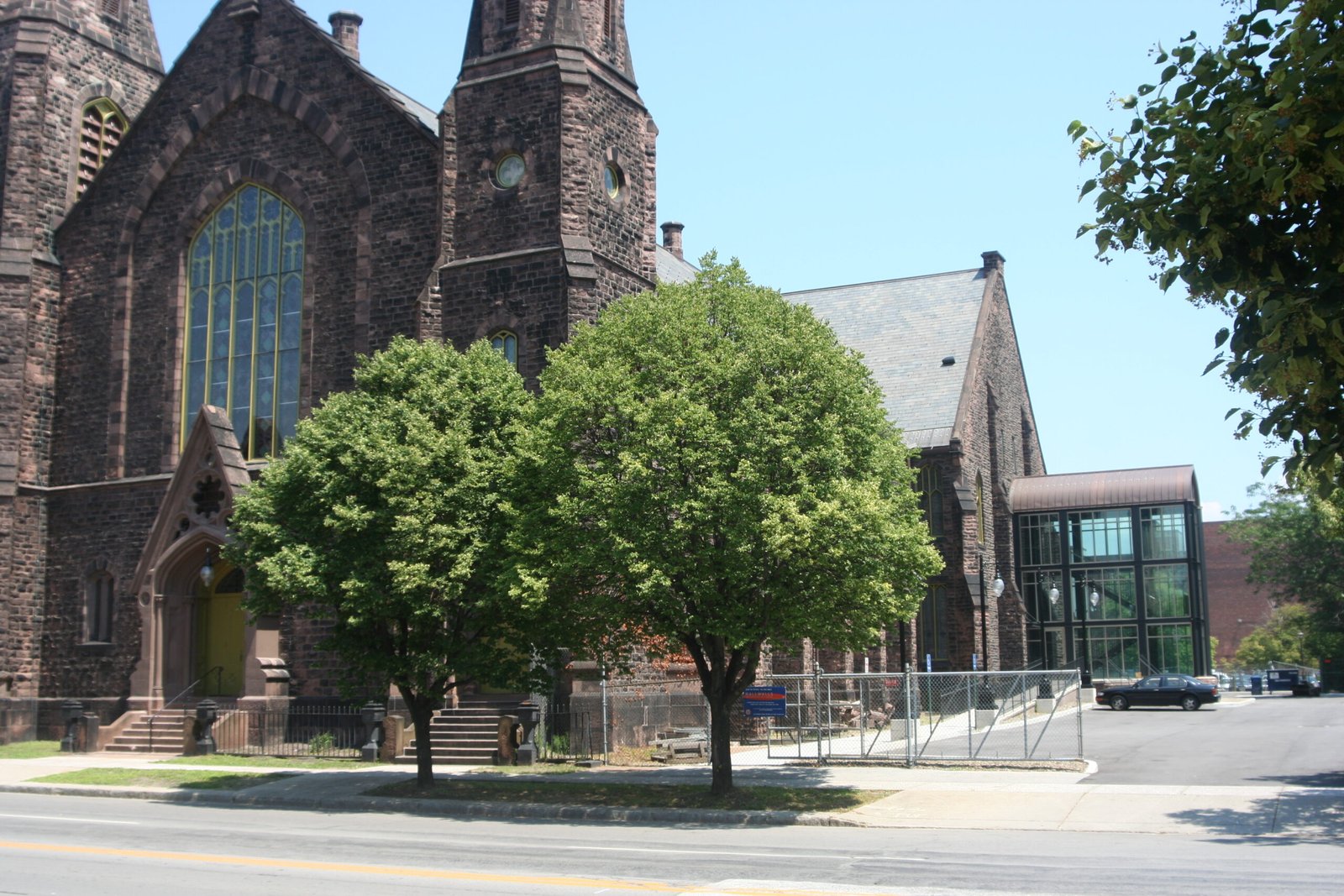
The stained glass is still there. So are the arched trusses, the Medina sandstone walls, and the soaring 45-foot ceilings that once echoed with Methodist hymns. But the congregation at Asbury Hall these days is different — they’re here for Kurt Vile, or St. Vincent, or Vampire Weekend, or whoever else is commanding the stage at one of Buffalo’s most extraordinary performance spaces. This is Babeville, the converted 1874 Gothic Revival church that Ani DiFranco refused to let die, and Asbury Hall is its beating heart.
Saving the Church
The Delaware Avenue Methodist Church opened its doors in 1874, designed by architect John Henry Selkirk in a Gothic Revival style that made it one of Buffalo’s architectural landmarks. For more than a century, the sandstone spire at 341 Delaware Avenue anchored a stretch of the city’s most prominent boulevard. But like many urban congregations, attendance declined through the latter half of the 20th century. The church held its last service in the late 1980s, and years of neglect followed.
By 1995, the building was in crisis. Loose stone was falling from the spire, and the city had moved toward emergency demolition. That’s when DiFranco — Buffalo-born, fiercely local, and by then one of the most successful independent musicians in the country — stepped in alongside her manager, Scot Fisher. What followed was a restoration project that stretched over a decade and cost more than $10 million in combined private and public funding. The result, which DiFranco christened Babeville, opened in September 2007 with a pair of sold-out DiFranco concerts in the newly completed Asbury Hall.
The name “Babeville” is pure DiFranco — playful, irreverent, and insistently her own. The venue complex, which also houses her record label Righteous Babe Records, occupies the full building: Asbury Hall in the main sanctuary, the 150-capacity Ninth Ward in the stone-encased basement, and office and studio space throughout.
The Room
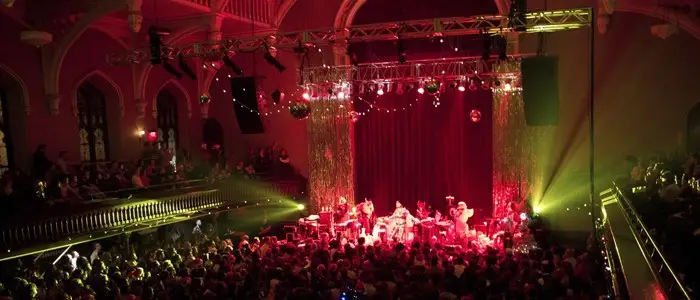
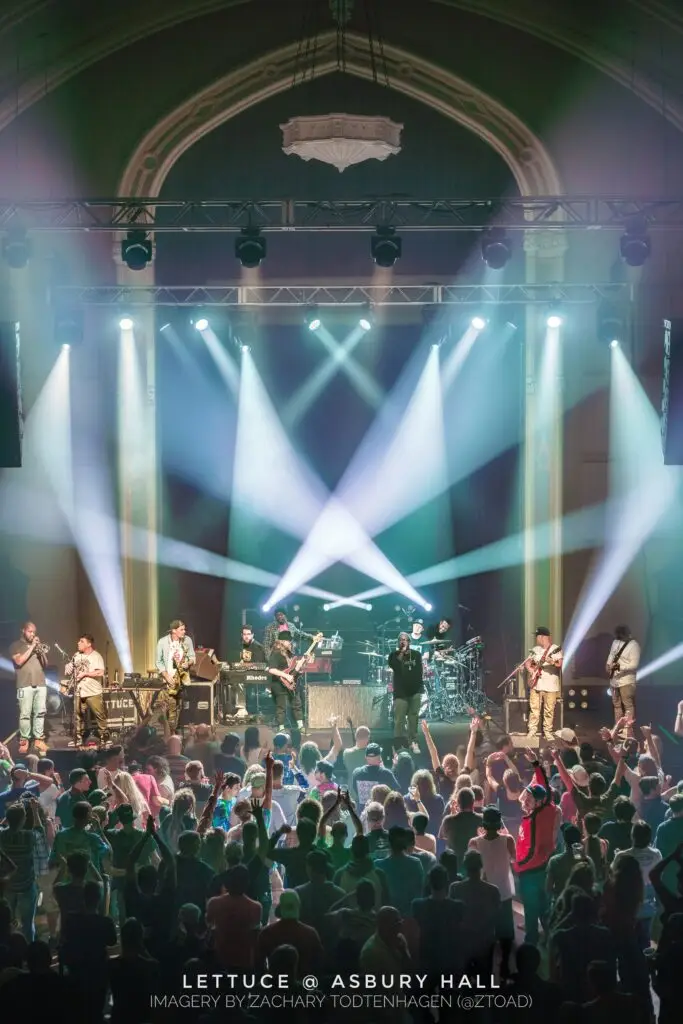
Asbury Hall is a 1,200-capacity open-floor concert space built inside the original sanctuary, and the architecture does something remarkable: it makes a room that holds over a thousand people feel intimate. The U-shaped balcony wraps around three sides of the hall, putting every seat within striking distance of the stage. The original arched trusses frame the room overhead, and the combination of stone walls and wood creates acoustics that are warm without being muddy — a natural advantage that most purpose-built venues spend a fortune trying to engineer.
The floor can be configured for standing general admission (up to 1,200) or theater-style seating (approximately 750), depending on the event. The state-of-the-art sound system was installed with the kind of care you’d expect from a venue founded by a working musician. DiFranco knows what a room should sound like from the stage, and that perspective shaped every technical decision.
The Ninth Ward
Downstairs, the Ninth Ward operates as Babeville’s smaller sibling — a 150-capacity room carved from the original church basement, encased in the same Medina sandstone. If Asbury Hall is the venue you see on the marquee, the Ninth Ward is the one you hear about from the friend who was there. It books the kind of emerging and experimental acts that thrive in a low-ceiling, high-energy room, and it’s become a crucial proving ground for Buffalo’s local music scene.
In the Theater District
Babeville sits in the heart of Buffalo’s Theater District on Delaware Avenue, surrounded by the kind of cultural infrastructure — Shea’s Performing Arts Center, the Irish Classical Theatre, the downtown gallery scene — that has made Buffalo one of the most compelling arts cities in the state. The neighborhood has undergone significant reinvestment in recent years, and the energy around Delaware Avenue on a show night is palpable.
Where to Eat
The blocks surrounding Babeville are loaded with dining options. Toutant, a short walk away, serves Southern-influenced fare — think cast-iron cornbread, fried chicken, and a bourbon list that takes its time — in a space that’s become one of Buffalo’s most talked-about restaurants. Big Ditch Brewing Company pairs its own craft brews with pub food in a converted industrial space that fits the pre-show vibe. And Bacchus Wine Bar on Franklin Street offers a more refined option with a rotating wine list, charcuterie, and small plates in a candlelit setting.
Getting There and Parking
Babeville’s parking lot entrance is on the left just past Tupper Street on Delaware Avenue. If the lot fills up, street parking on Delaware Avenue, Elmwood Avenue, and Franklin Street is free after 5 PM and on weekends. The venue is also easily accessible by rideshare, with drop-offs right on Delaware Avenue.
Know Before You Go
- Address: 341 Delaware Avenue, Buffalo, NY 14202
- Asbury Hall capacity: 1,200 standing / 750 seated
- Ninth Ward capacity: 150
- Parking: On-site lot (enter past Tupper Street); free street parking after 5 PM
- Box office: (716) 852-3835
- Pro tip: If you’re seeing a show in Asbury Hall, get to the balcony early. The U-shaped wrap gives you a completely different perspective on the performance — you’re looking down into a Gothic cathedral filled with sound, and it’s one of the best vantage points at any venue in Western New York.
For upcoming shows and tickets, visit babevillebuffalo.com.