
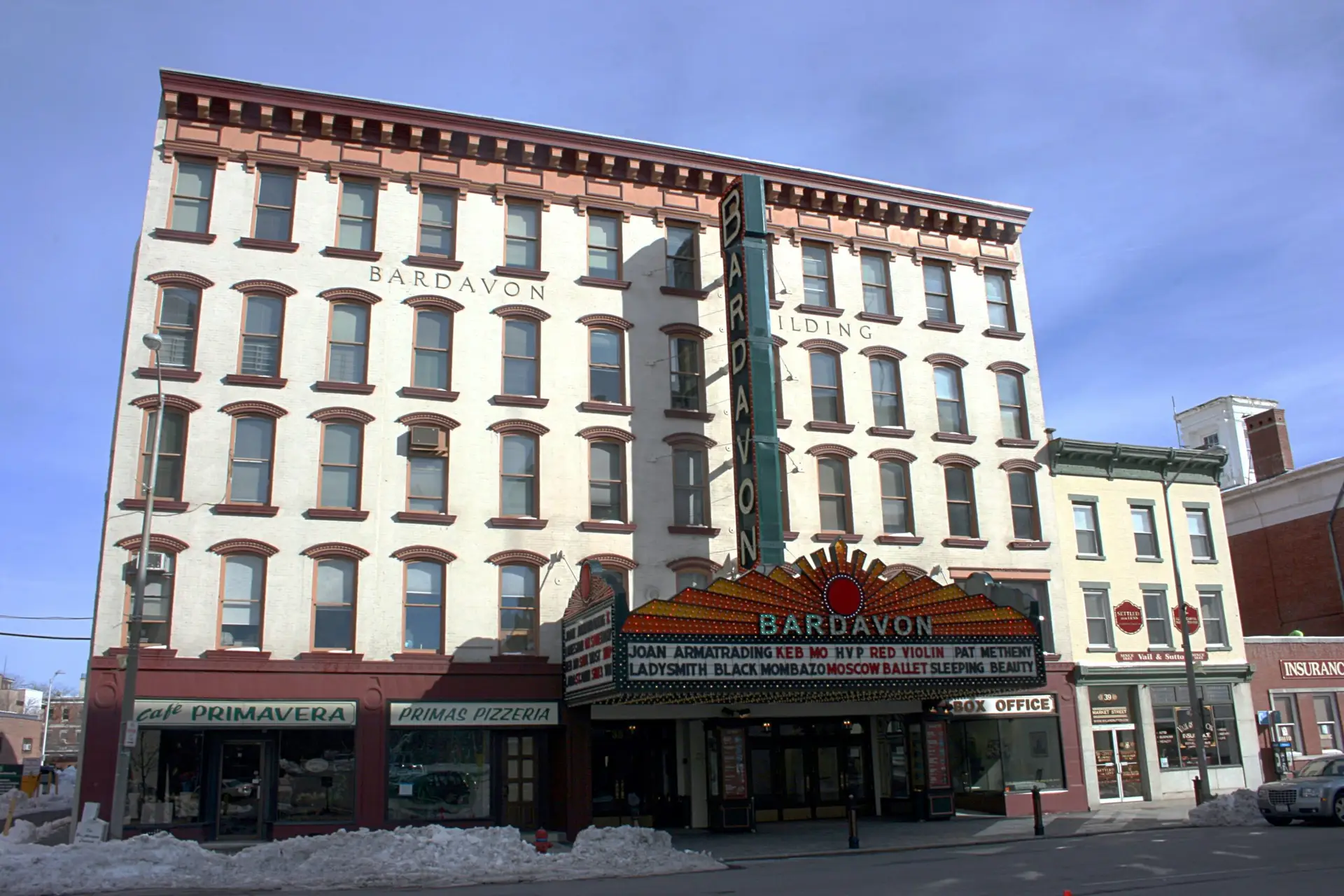
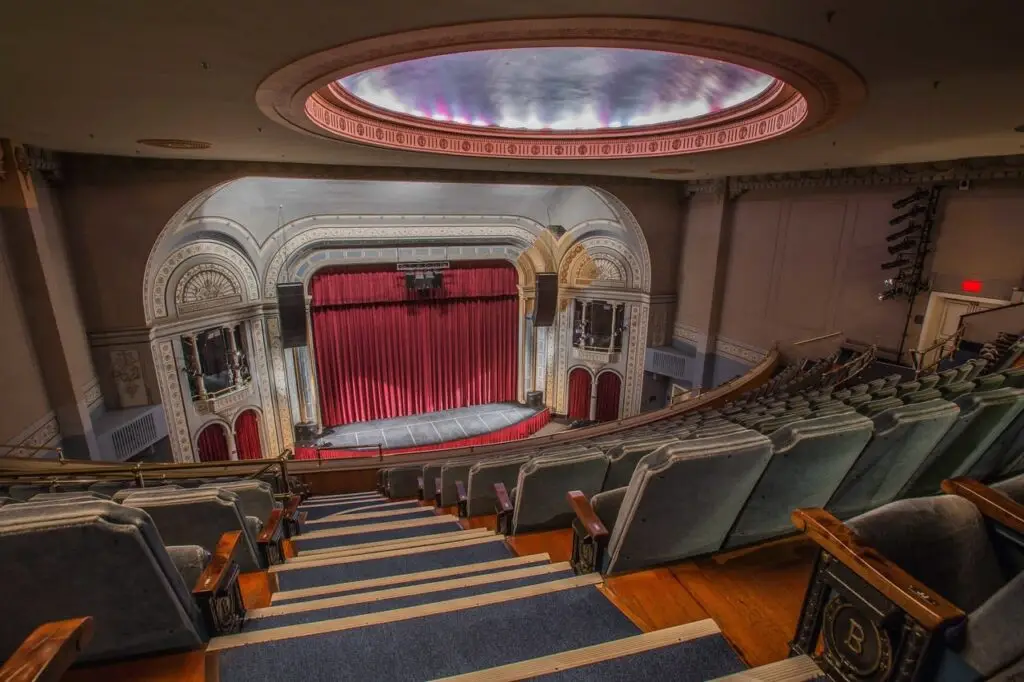
There’s a Wurlitzer pipe organ tucked into a chamber just off the side of the Bardavon’s stage, installed in 1928 and still playable nearly a century later. It shares a building with a 12-person orchestra pit, a two-stage dome ceiling that belongs in a European opera house, and 944 seats that have held everyone from Mark Twain to Bob Dylan to Patti Smith. The Bardavon 1869 Opera House isn’t just old — it’s the oldest continuously operating theater in New York State, and one of the oldest in the country. Walking into the auditorium on Market Street in Poughkeepsie, you’re stepping into a space that has never stopped doing what it was built to do.
A Merchant’s Grand Vision
The Bardavon exists because a British immigrant named James Collingwood believed Poughkeepsie deserved a world-class theater. Collingwood had built a successful coal and lumber business in the city, and in 1868, he broke ground on the site of one of his own commercial lots. Designed by architect J.A. Wood, the building took eight months and half a million bricks to complete. The Collingwood Opera House, as it was originally known, opened on February 1, 1869, with the Citizens Complimentary Concert featuring the Eastman College Band and artists from New York City.
Local reviewers called the new theater “just right” — a phrase that still holds up. Collingwood had managed to build something that felt grand without being ostentatious, intimate without being cramped. The proportions just work.
Between 1869 and 1921, the stage hosted the biggest names of the era. Sarah Bernhardt and John Barrymore performed dramatic roles. John Philip Sousa brought his marching band. Isadora Duncan danced. Mark Twain lectured. Franklin D. Roosevelt, years before the presidency, spoke to community gatherings in the same hall. It was the cultural heart of the Hudson Valley, a place where Poughkeepsie connected to the wider world.
From Cinema Back to the Stage
Like many American theaters, the Bardavon pivoted to film in the 1920s. From 1923 to 1975, it operated primarily as a movie house, though vaudeville acts and occasional live performances kept the stage from going completely cold. In 1905, architect William Beardsley had supervised a major renovation that preserved the building’s character while modernizing its systems, and that work helped the structure survive the decades of reduced use.
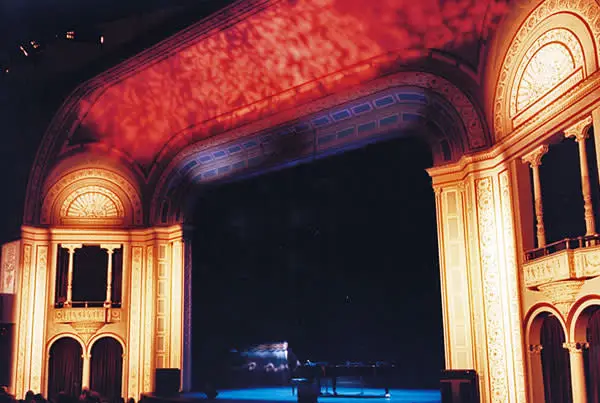
The real turning point came in 1976. The Bardavon was added to the National Register of Historic Places, and a nonprofit organization took over operations with a clear mission: restore the theater to its performing-arts roots. Over $5 million in renovations followed, bringing the building back to life while preserving the architectural details that make it irreplaceable — the plasterwork, the dome, the proscenium arch, the bones of a 19th-century theater that simply can’t be replicated today.
The organization that saved the Bardavon didn’t stop there. Bardavon Presents, the nonprofit that now runs the opera house, also operates the Ulster Performing Arts Center (UPAC) in Kingston and serves as the home of the Hudson Valley Philharmonic. It’s become the region’s most important performing-arts institution, presenting a year-round calendar that spans symphonic music, touring rock and folk acts, dance, theater, Metropolitan Opera Live in HD broadcasts, and classic film screenings.
The Room Itself
At 944 seats, the Bardavon occupies a sweet spot that larger venues can’t touch. It’s big enough to attract nationally touring artists — Aretha Franklin, Carlos Santana, and Bob Dylan have all played the room — but small enough that every seat feels connected to the stage. The acoustics benefit from the original construction: high ceilings, dense materials, and a layout designed in an era when amplification didn’t exist, which means the room itself does the work of projecting and warming the sound.
The orchestra pit accommodates 12 musicians, making the Bardavon one of the few venues in the Hudson Valley that can properly present orchestral and theatrical productions with live accompaniment. The Wurlitzer organ, a relic of the cinema era, still makes appearances for special events — a functioning piece of musical history that most venues would have scrapped decades ago.
For concertgoers, the experience is simply different from seeing the same artist at a modern amphitheater or arena. The sightlines are excellent throughout the house, and the room’s age gives it a gravity that enhances every performance. You’re not just watching a show — you’re watching a show in a place where shows have been happening for over 155 years.
Getting There and Parking
The Bardavon sits at 35 Market Street in downtown Poughkeepsie, accessible from Route 9 or off I-84 via the Route 9 South exit. If you’re coming from the Metro-North train station, the theater is a short walk — one of the advantages of a downtown location in a walkable city center.
City of Poughkeepsie municipal lots are located on Cannon Street — take a right at the light just before the theater. A parking garage at 38 Civic Center Plaza also serves the area. Accessible parking spaces are available in the Cannon Street lots and the Civic Center garage. Street metered parking is available on Market Street and surrounding blocks, though it fills quickly on show nights. Give yourself an extra 10 minutes if you’re arriving close to showtime.
Before and After the Show
Downtown Poughkeepsie has built a real dining scene around the Bardavon corridor. Mill House Brewing Company on Mill Street is a local institution — craft beer brewed on-site, elevated pub food, and a vibe that works for both pre-show dinners and post-show wind-downs. Schatzi’s Pub & Beer Garden on Main Street offers German-inspired fare, a solid beer list, and a casual atmosphere that fills up on event nights. And Cosimo’s Trattoria & Bar on Delafield Street serves dependable Italian in a white-tablecloth setting if you’re looking for something more polished before the curtain goes up.
Insider Tips
The orchestra section offers the most immersive sound, but if you want to appreciate the full visual sweep of the Bardavon’s interior — the dome, the proscenium, the whole architectural experience — grab a seat in the mezzanine. You’ll sacrifice a little proximity to the stage for a view of the room that’s worth the trade.
Check the Bardavon Presents calendar for Metropolitan Opera Live in HD screenings if you’re an opera fan — seeing a Met broadcast in a 19th-century opera house is a different experience entirely from watching it at your local multiplex. The Hudson Valley Philharmonic season is also worth following; their performances in the Bardavon have a warmth and resonance that you simply won’t get in a modern concert hall.
Finally, arrive a few minutes early and take in the lobby and the architectural details before you find your seat. This isn’t a venue you rush into — it rewards a slower look.
Website: bardavon.org