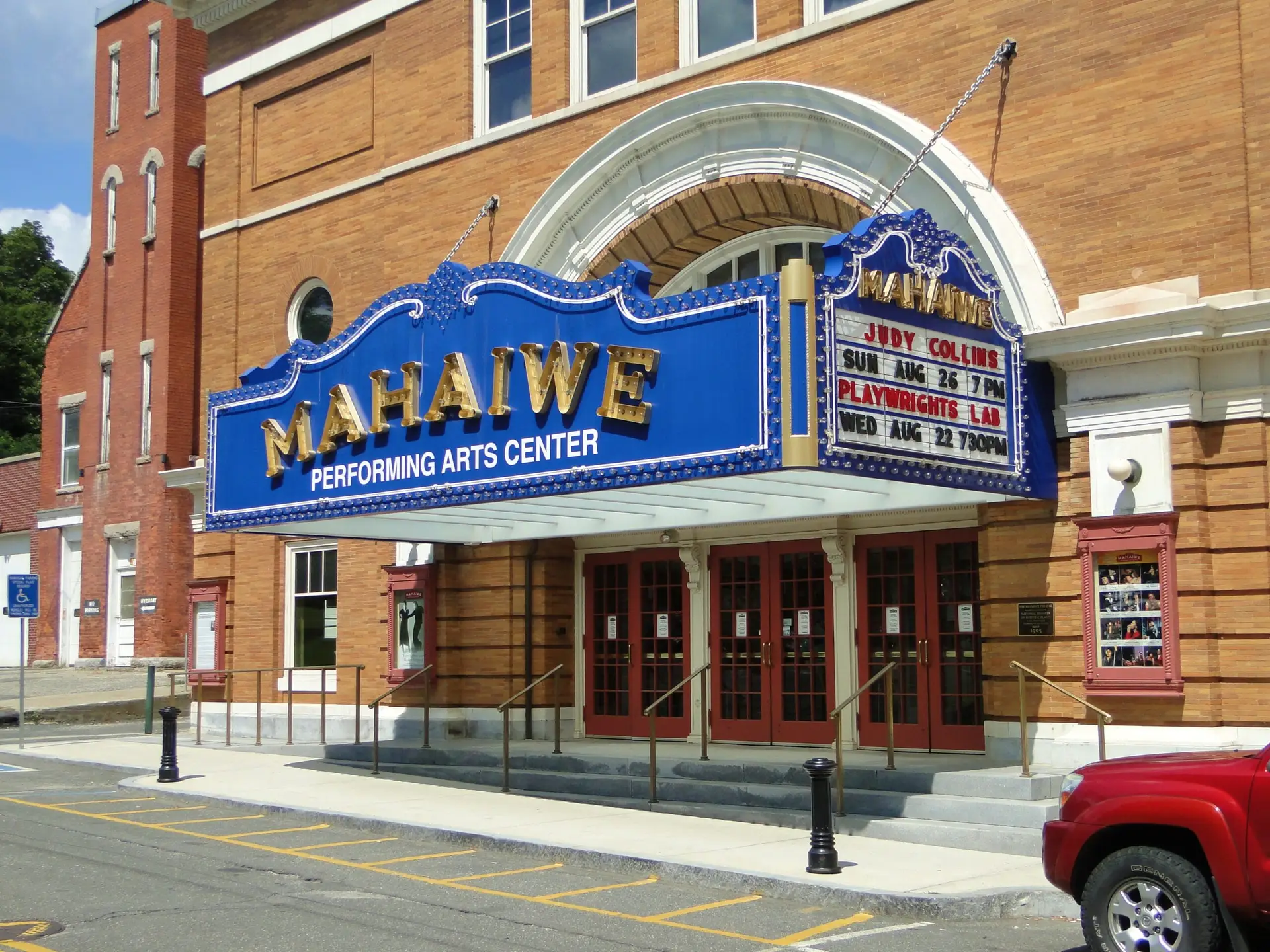
The Mahaiwe Performing Arts Center takes its name from the Mohican word meaning “the place downstream,” a reference to the Housatonic River that flows through Great Barrington, Massachusetts. The theater was built in 1904 and opened in 1905 in a French Renaissance Revival design by architect Joseph McArthur Vance — the same architect behind the Colonial Theatre in nearby Pittsfield. After decades of decline, a nonprofit organization led a $9 million restoration beginning in 2003, and the Mahaiwe reopened in 2005 as a year-round presenting venue. It is listed on the National Register of Historic Places.
The restored auditorium seats just under 700 in an intimate configuration that rewards every seat in the house. The acoustics are exceptional, a product of both the original design and careful restoration work. Programming runs the full calendar — live music, dance, theater, opera, comedy, talks, classic films, Met Opera Live in HD broadcasts, and family events, totaling more than 100 events annually. A newer auxiliary space called the Indigo Room offers flexible seating for up to 150, hosting smaller-scale and developing performances. The Mahaiwe punches well above its size, booking acts and presenting programming that would be impressive in a venue twice its capacity.
The theater sits at the corner of Castle and Main streets in downtown Great Barrington, anchoring the town’s designated Cultural District. The surrounding blocks are packed with restaurants, galleries, and shops — the kind of walkable downtown that makes dinner and a show effortless. Great Barrington draws over 50,000 visitors annually to the Mahaiwe alone, generating an estimated $8.6 million in economic impact for the southern Berkshires. From Albany, it is roughly 90 minutes south via Route 22 or the Taconic State Parkway.
The Mahaiwe is a reminder that venue size and programming quality are unrelated. In a beautifully restored room with world-class acoustics and a curatorial sensibility that spans genres and formats, it delivers an experience that larger venues cannot replicate. For Upstate New York audiences, it is worth the drive to the southern Berkshires — particularly when paired with everything else Great Barrington has to offer.