
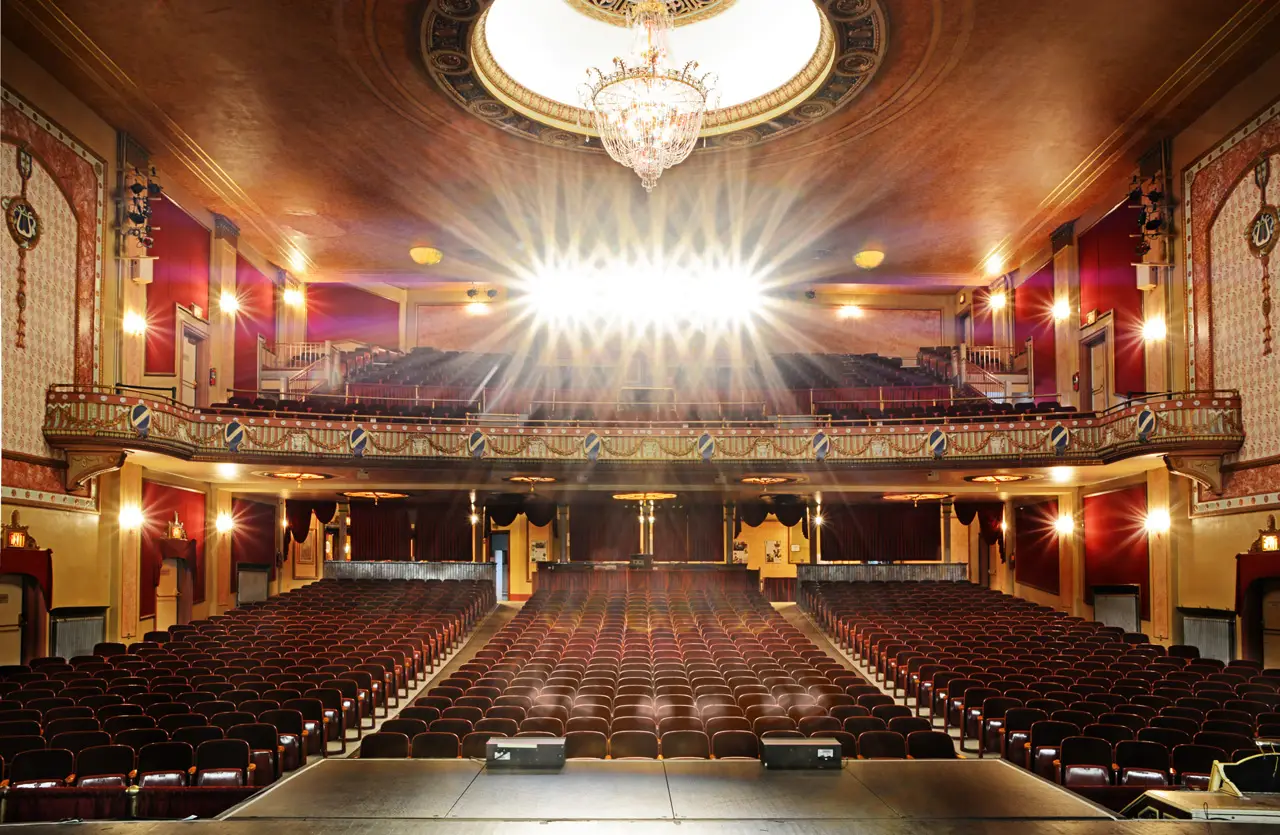
The lights go down at 67 Webster Street, and for a half-second the Riviera Theatre looks exactly the way it did on opening night — December 30, 1926 — when the Mayors of both Tonawandas sat in the front row and congratulatory telegrams arrived from Governor Alfred E. Smith and Cecil B. DeMille. Then the Mighty Wurlitzer fires up, all 3,000 pipes filling a room that was purpose-built to make an instrument like this sound like the voice of God, and you remember that some venues don’t just host shows. They are the show.
The Showplace of the Tonawandas
The Riviera was built by the Yellen Family in 1926 and immediately earned its nickname as the “Showplace of the Tonawandas.” The architecture is classic 1920s movie palace — ornate plasterwork, a sweeping auditorium, the kind of decorative ambition that the Depression would make impossible to replicate just a few years later. Originally named “The New Rivera,” the theatre opened with screenings of Upstage starring Norma Shearer and The Mona Lisa, alongside vaudeville performances that were still drawing crowds in the late ’20s.
During the Depression, the Shea’s Theater company acquired the property, folding it into the regional chain that also operated Shea’s Buffalo. But the Riviera’s real story has always been the organ. The Wurlitzer factory was right there in North Tonawanda — Rudolph Wurlitzer had purchased the North Tonawanda Barrel Organ Factory in 1909 and built it into the most famous theatre organ manufacturer in the world. Opus 1524, the Riviera’s Mighty Wurlitzer, was shipped from the factory on November 19, 1926, just weeks before the theatre opened. It wasn’t just any organ. Wurlitzer used it as an official demonstrator model — prospective customers from across the country would visit the Riviera to hear how a Wurlitzer would sound in a theatre of this size.
The Organ That Survived
When the silent film era ended in the early 1930s, most theatre organs across the country were ripped out, sold for parts, or left to rot. The Riviera’s Wurlitzer went silent too — falling into disuse and disrepair until 1944, when it was refurbished and brought back to life. That early rescue set a pattern. The organ has been maintained, restored, and championed by volunteers and preservationists ever since, and in 2008 it was re-voiced and restored to nearly original condition, delivering a symphonic sound that international organists have traveled from Europe, Australia, and South America to experience firsthand.
The Riviera Theatre and Organ Preservation Society — a 501(c)(3) nonprofit — now owns and operates the theatre, and the Wurlitzer remains the beating heart of the operation. Several prominent organists played their first public concerts here, and the organ concert series continues to draw enthusiasts from well beyond Western New York. The building was added to the National Register of Historic Places in April 1980, recognizing both the architectural and cultural significance of what the Yellen family built nearly a century ago.
Live Music in a Movie Palace
The Riviera seats 1,100 in a room that was designed for a very different era of entertainment — and that’s precisely what makes it special for modern concerts. The acoustics were engineered to carry a full orchestra and a 3,000-pipe organ to every seat in the house. When a touring band plugs into that room, the result is warmer, more resonant, and more enveloping than anything a purpose-built concert hall can typically deliver. The ornate architecture doesn’t hurt either. There’s something about watching a rock show surrounded by 1920s plasterwork and gilded details that elevates the entire experience.
The calendar runs diverse — classic rock tribute acts, touring Americana and folk artists, comedy nights, community events, and the ongoing organ concert series that keeps the Wurlitzer in regular rotation. The Glenn Miller Orchestra has performed here. The room works equally well for a 400-person weeknight show and a packed Saturday — the sight lines are excellent throughout, and the seated format means every ticket is a good ticket.
Downtown North Tonawanda
The Riviera sits at the center of downtown North Tonawanda’s Webster Street, which has been rebuilding itself as a dining and nightlife corridor. Pre-show dinner options are genuinely good and genuinely walkable. Remington Tavern is a neighborhood staple with a strong seafood menu and cocktail program — it’s the kind of place that takes the food seriously without taking itself too seriously. Woodcock Brothers Brewing is a craft brewery right in the downtown core, pouring house-brewed beer in a tap room that doubles as a community gathering spot. And Webster’s Bistro offers French-American cuisine with an impressive wine list if you want to make the evening a proper date night.
Getting There
The Riviera is at 67 Webster Street in downtown North Tonawanda, about 15 minutes north of downtown Buffalo via I-190 and roughly 20 minutes from Niagara Falls. Parking is free — Webster Street has angled parking on both sides, and there’s a large free lot on Manhattan Street, one block west of the theatre. Accessible parking is available near the entrance.
The seated format means you don’t need to arrive an hour early to claim floor position, but the downtown restaurants fill up on show nights, so book dinner reservations if you’re planning to eat on Webster Street beforehand.
Insider tip: If you’ve never heard a Wurlitzer theatre organ played live in the room it was built for, make a point to catch one of the organ concert events. It’s a fundamentally different experience from any amplified show — the sound isn’t coming through speakers, it’s coming through 3,000 pipes tuned to this specific room. North Tonawanda was literally the birthplace of the Wurlitzer theatre organ, and the Riviera is the last place in town where you can hear one exactly the way it was meant to be heard.
For upcoming shows and tickets, visit rivieratheatre.org.