
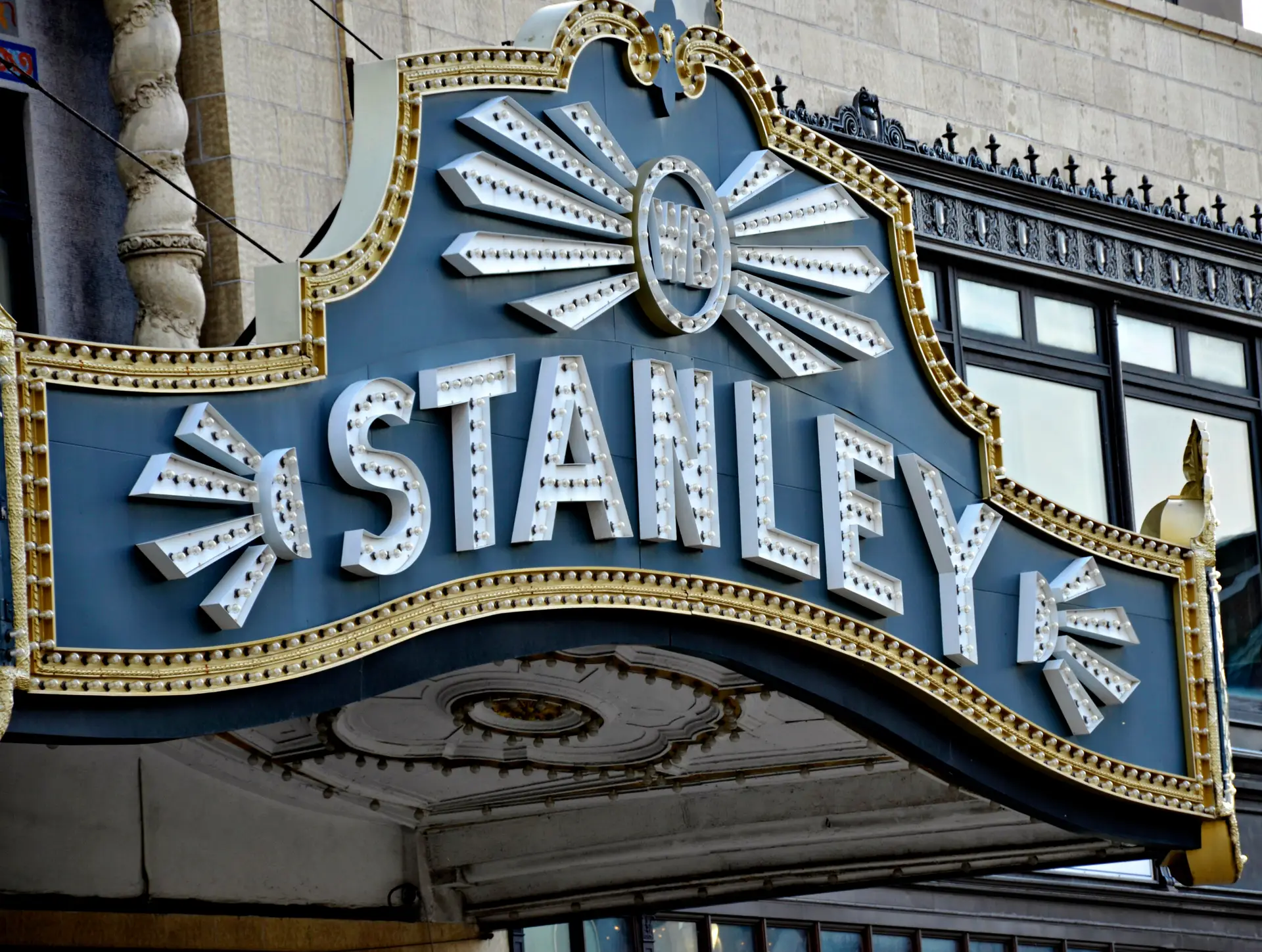
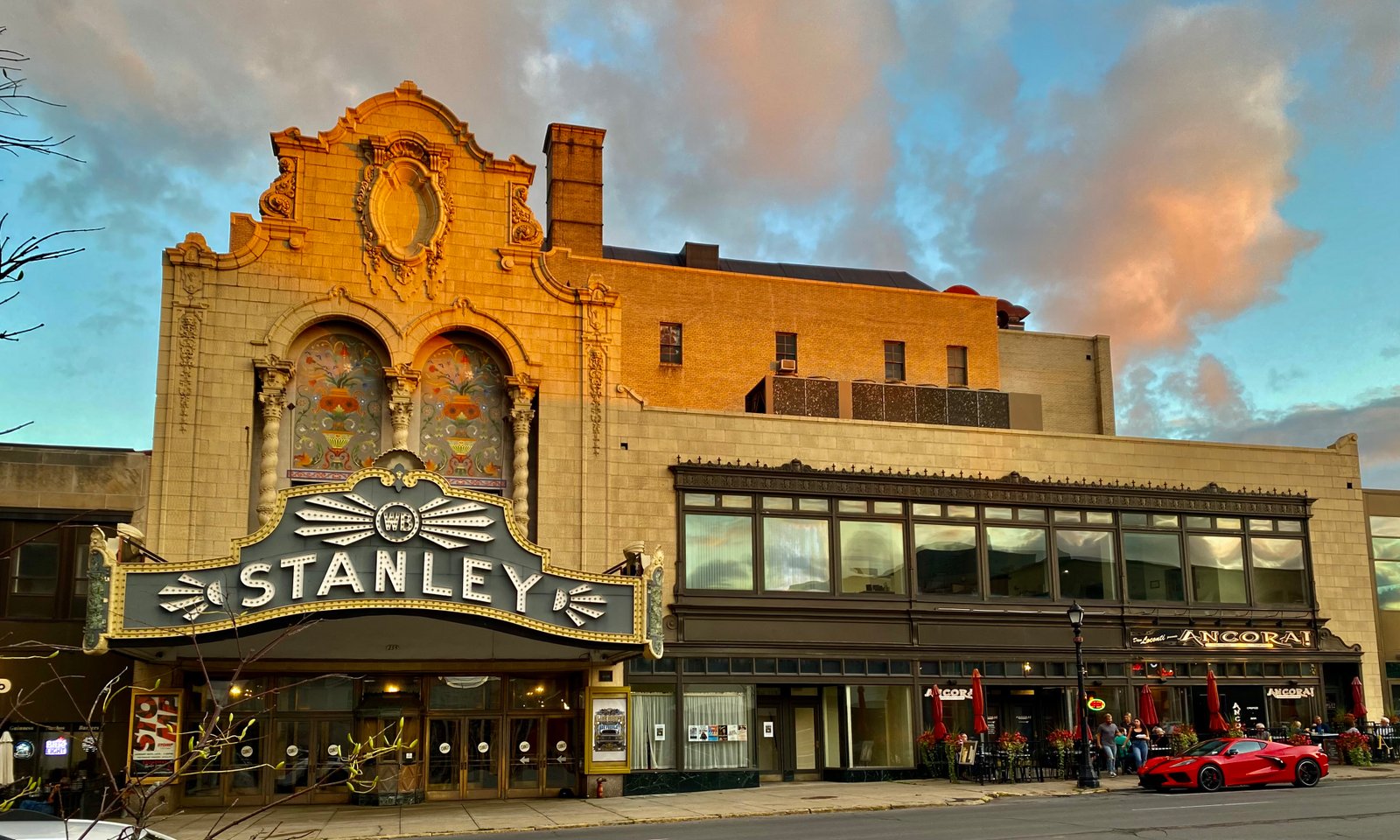
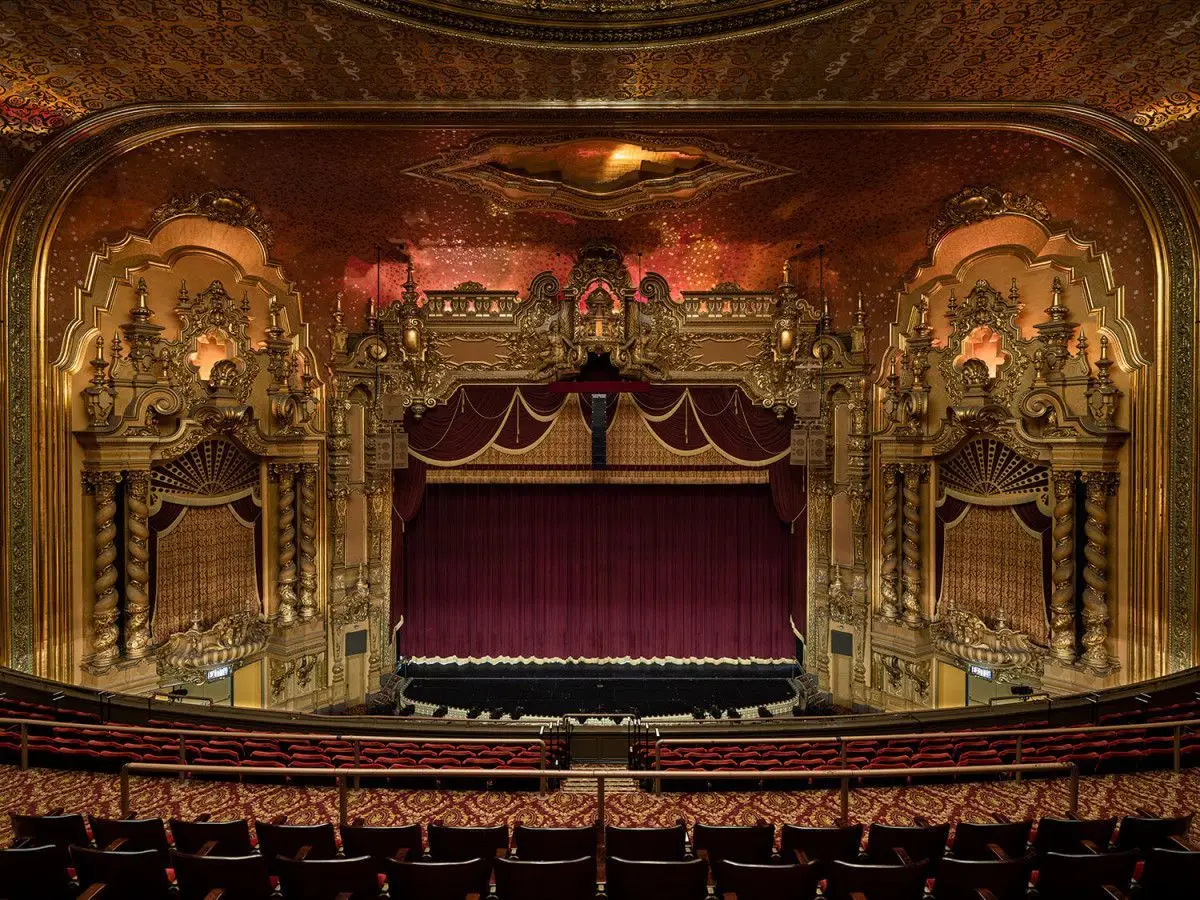
The Stanley Theatre opened on September 10, 1928, at 259 Genesee Street in Utica, and the style it chose to announce itself was Mexican Baroque — a design vocabulary so specific and so extravagantly executed that walking into the auditorium nearly a century later still produces the same disorientation it must have caused on opening night. The walls are covered in hand-painted murals, carved plasterwork, and polychrome detailing that suggests a mission church rebuilt by someone with an unlimited budget and no interest in restraint. The ceiling arches overhead in patterns that draw from Spanish Colonial and Aztec motifs. It is one of the most visually extraordinary theater interiors in the United States.
Thomas Lamb’s Masterpiece
Architect Thomas W. Lamb — the same designer behind Syracuse’s Landmark Theatre — created the Stanley as a movie palace for a city that, in 1928, was one of the most prosperous industrial centers in upstate New York. Utica’s textile mills, Savage Arms, and the burgeoning General Electric presence meant money was flowing, and the Stanley was built to match that confidence. The theater originally seated nearly 3,000 and featured a Wurlitzer pipe organ that filled the auditorium with sound before films.
The Mexican Baroque style was an unusual choice for a northeastern city, but Lamb was working in an era when movie palace architects competed to transport audiences as far from their daily lives as possible. The Stanley’s interior does exactly that. Every surface tells a story — from the ornamental ironwork to the gilded plaster saints to the atmospheric ceiling designed to simulate an open sky.
The Chandelier
The Stanley is home to what is billed as the world’s largest LED free-hanging chandelier. The fixture — 35 feet wide, 17 feet tall, weighing over three tons, and containing 264 individually programmable LEDs — was custom-designed by Meyda Custom Lighting. It dominates the main auditorium and has become one of the theater’s signature features, drawing architecture enthusiasts independent of whatever show is on stage. The LED installation replaced the original chandelier as part of the theater’s modernization, but the scale and drama of the fixture maintain the sense of spectacle that Lamb built into the room from the beginning.
The Room Today
The Stanley seats 2,963 and operates as a presenting theater for concerts, touring Broadway, comedy, and special events. The venue sells tickets directly through its website — there is no Ticketmaster middleman here, which means lower fees and a more direct relationship between the theater and its audience.
The concert bookings lean toward legacy rock, country, comedy, and nostalgia acts that fill a 3,000-seat theater with an audience that appreciates both the artist and the room. The acoustics are strong — Lamb designed for a pre-amplification era, and that attention to natural sound projection carries over to modern shows. The balcony, in particular, benefits from the room’s original acoustic engineering.
Getting There and Parking
The Stanley sits on Genesee Street, Utica’s main commercial corridor. From the New York State Thruway, take Exit 31 and follow Genesee Street into downtown. The theater is well-signed and the marquee is visible from several blocks away.
Parking is available in multiple surface lots and garages within walking distance. The Genesee Street area has plentiful metered parking, and downtown Utica is not a city where parking stress is part of the equation. Evening and weekend meters are generally lenient.
Utica’s Italian Table
Utica has one of the strongest Italian-American food cultures in upstate New York, and a pre-show dinner downtown is one of the genuine pleasures of a Stanley evening. Ancora at 253 Genesee Street — literally next door to the theater — does modern Italian in a polished setting with a strong wine list. Café Canole handles Sicilian-influenced Italian in a family-owned atmosphere. Ocean Blue offers seafood and sushi for those looking beyond Italian. And if you want the old-school Utica experience, Chesterfield’s does steaks and chops in a setting that has not changed much in decades — and does not need to.
Utica greens, chicken riggies, and tomato pie are the local specialties. If you have never tried them, a Stanley show is as good an excuse as any to make the trip.
Why the Stanley Matters
Utica is a small city that has held onto its cultural infrastructure with remarkable tenacity. The Stanley is the crown jewel — a nearly 3,000-seat Mexican Baroque palace on Genesee Street that, in a just world, would be as famous as the Fox Theatre in Detroit or the Orpheum in Los Angeles. It is not, because Utica does not generate that kind of national attention. But anyone who has seen a show inside this room knows the truth: the Stanley is one of the great American theaters, and it rewards every mile of the drive to get there.
Insider Tips
- Buy tickets direct from thestanley.org. No Ticketmaster markup. The box office is your friend.
- Orchestra center, rows 10-20 are the sweet spot. The balcony is also excellent — the room was designed for it.
- Ancora is next door. 253 Genesee Street, literally adjacent to the theater. Italian dinner before a show in a Mexican Baroque palace — that is a Utica evening.
- Look at the ceiling. The atmospheric design means the auditorium itself is part of the show. Give yourself 10 minutes before curtain to absorb the detail.
- Combine with a Utica food crawl. Chicken riggies, Utica greens, tomato pie — the local specialties are worth planning around.
Parking
- Surface lots and garages within walking distance on Genesee Street
- Metered street parking along Genesee and surrounding blocks
- Downtown Utica parking is plentiful and low-stress
Nearby
- Ancora (253 Genesee St) — Modern Italian, next door to the Stanley. The default pre-show dinner.
- Café Canole — Sicilian-influenced Italian, family-owned, generous portions.
- Ocean Blue — Seafood and sushi. The non-Italian option downtown.