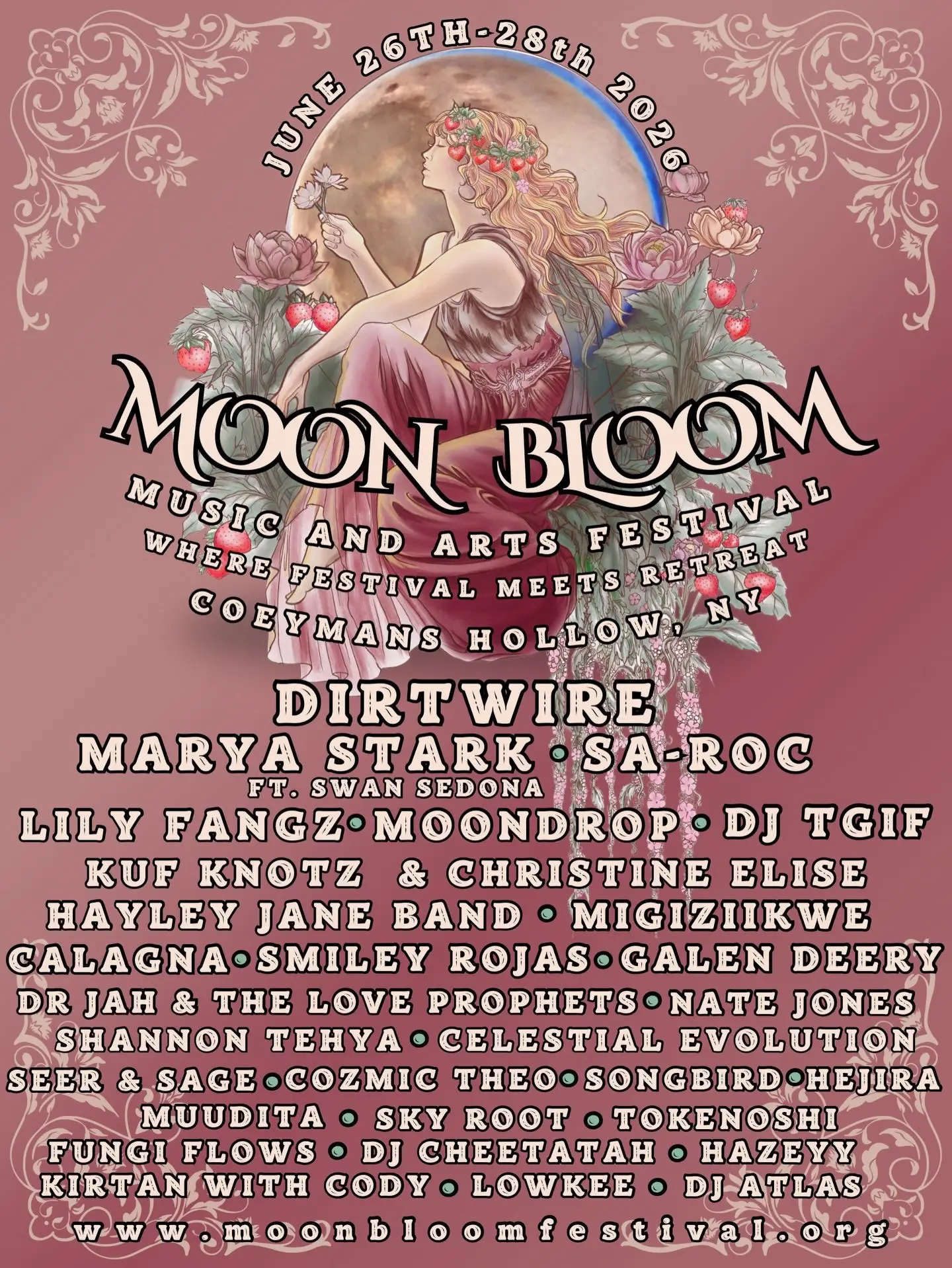
Twenty-five minutes south of Albany, down a rural road in the Coeymans Hollow hills, sits a 225-acre working farm where the Mahony family has been growing food, raising goats, and tapping maple trees since the 1970s. For three days in late June 2026, that farm will become something else: a temporary village of music stages, healing tents, ceremony spaces, and workshop circles. The Moon Bloom Music & Arts Festival runs June 26 through 28 at Magic Forest Farm, and it is — by design — not quite like any other festival on the Capital Region calendar.
This is not a festival that markets itself with bigger-better-louder. The organizers describe Moon Bloom as “A Prayer for Balance” — a three-day ceremonial event built around what they call reciprocity, remembrance, and reverence. Music is part of it, with more than 30 artists across the weekend, but the program also runs to 50-plus workshops, four elemental learning areas, a healing vendor village, a kids’ zone, Indigenous wisdom-sharing, educational speakers, and a roster of live painters working in real time alongside the bands. The whole event is structured less like a concert series and more like a gathering — one where the music is one of several entry points into the experience.
The Music
Moon Bloom’s 2026 musical anchor is Dirtwire, the genre-shapeshifting project of David Satori (Beats Antique) and Evan Fraser, with Mark Reveley contributing to production and songwriting. Dirtwire’s sound — a fusion of Appalachian roots music, electronic production, world instrumentation, and what they call “swamptronica” — is a near-perfect fit for a festival that asks audiences to sit with a piece of music rather than just consume it. Their live show is built for outdoor settings: long, immersive sets that build slowly and reward attention.
Joining Dirtwire on the bill is Sa-Roc, the D.C.-bred lyricist whose 2020 album The Sharecropper’s Daughter placed her among the most technically accomplished MCs working in hip-hop today. Sa-Roc’s catalog moves between sharp social commentary and deeply personal songwriting, and her booking at a festival like Moon Bloom reflects the organizers’ interest in artists whose work intersects with consciousness, community, and lived experience rather than just genre. She is the kind of headliner who can hold a crowd’s attention through a 75-minute set built on lyrics alone.
Marya Stark — a vocalist, composer, and ceremonial performer originally from Phoenix, Arizona — has also been mentioned in connection with the festival. Her work weaves orchestral arrangement, classically trained vocals, and what she describes as “medicine songs,” drawing from the transformational festival circuit that has grown across the country over the past decade. The kind of artist whose set you sit for, not stand for.
Beyond those three confirmed names, Moon Bloom’s website promises more than 30 total artists across the weekend, with the full lineup rolled out in stages through the spring. The organizers have indicated the bill leans toward the transformational and conscious music ecosystem — electronic producers, world music collaborators, ceremonial singers, live-painted improvisational sets — rather than the festival-rock or jam-band roster typical of summer outdoor events in the Northeast. For listeners who follow festivals like Lucidity in California, Lightning in a Bottle, or Symbiosis, Moon Bloom is the closest analogue currently operating in the Capital Region.
The Experience
What separates Moon Bloom from most regional festivals is everything happening between the music. Four elemental workshop areas host more than 50 sessions across the weekend, ranging from movement and breathwork to herbalism, sound work, plant medicine education, ceremonial practice, and skill-building craft instruction. The festival’s organizers describe the workshops as the main programming, with the music supporting and weaving through the schedule rather than dominating it.
A vendor village runs the length of the weekend, hosting crafters and healing-arts practitioners — a structure familiar to anyone who has spent time at transformational gatherings. Live painters work alongside the music stages, producing finished pieces in real time as the sets unfold. A kids’ zone runs parallel programming for families, which makes Moon Bloom one of the few festivals in the region that builds children into its design rather than treating them as an afterthought.
Indigenous Elders are part of the program — sharing wisdom in scheduled circles and ceremony spaces — though the organizers, to their credit, do not advertise specific names or lineage claims on their public marketing materials. Educational speakers are also part of the lineup, presenting on topics ranging from ecological restoration to community organizing to natural healing modalities. The whole structure reflects what the organizers call the festival’s intention: a temporary community built around shared learning, music, and ceremony rather than a stage-and-audience setup.
Magic Forest Farm itself is the right setting for it. The 225-acre property, owned by the Mahony family since the 1970s, has hosted festivals before — Magic Forest Fest (2021), Diggin Roots Festival (2021), and an upcoming New York PawPaw Festival have all used the land as their staging ground. The farm operates as a working regenerative sanctuary, cultivating pawpaws, persimmons, lotus flowers, garden crops, and wildcrafted herbs alongside hand-spun goat yarn and maple syrup. Structures on the property are built from hand-harvested lumber. The land was once tended by the Mohican and Mohawk peoples, a history the property’s current stewards acknowledge in their own materials. With sweeping views toward Thacher Park to the west, the setting is genuinely beautiful — wooded, rolling, intimate in scale, and quiet in a way that festival sites near major population centers rarely are.
The Charity Model
One element of Moon Bloom worth noting: the festival is structured around supporting specific community partners rather than just operating as a for-profit production. The 2026 edition supports three nonprofits. Eden’s Rose Foundation, based in Albany’s West Hill neighborhood, distributes more than 250,000 pounds of free produce annually, rehabilitates vacant properties into dignified housing, and mentors youth in bike mechanics and environmental stewardship. Founded by Greg Sheldon as a response to personal loss, Eden’s Rose has become one of the most effective grassroots organizations in the Capital Region — and the kind of local partner that gives a festival’s charity framing real weight.
The other two beneficiaries — Project Bread, a Massachusetts-based food security organization, and Restoration Creatorship, a newer nationwide nonprofit focused on natural healing access — extend the festival’s reach beyond the immediate region. It is the kind of programmatic detail that distinguishes Moon Bloom from festivals that treat philanthropy as a marketing layer. Here, the partnerships are visible, named, and tied directly to the festival’s stated mission.
Getting There and Know Before You Go
Magic Forest Farm is located at 134 Bucks Ranch Road in Coeymans Hollow, NY — about 25 minutes south of Albany via Route 9W and a short series of county roads. From the Capital Region, it is the closest major rural festival site, sitting in the Catskill foothills with easy access from I-87 (the New York State Thruway) at Exit 21B. From New York City, it is roughly a 2.5-hour drive. From Boston, about 3 hours.
Weekend passes are sold through TheTicketing.co, with tent camping included in the base ticket price and car camping available as an upgrade. The festival’s organizers offer a payment plan for attendees who prefer to spread the cost across several months, which is uncommon at this scale and reflects the community-first framing of the event. Tickets are on sale now.
Late June in the Hudson Valley is generally warm — daytime temperatures in the 70s and 80s, cooler evenings, with the possibility of summer thunderstorms. Pack layers, rain gear, sturdy shoes for wooded terrain, and water bottles you can refill on-site. The festival runs as a primarily outdoor event on working farmland; come prepared for the realities of that environment.
Why This Festival Matters
The transformational festival format has grown into a significant subculture across the United States over the past 20 years — events like Lucidity, Lightning in a Bottle, Symbiosis, and Beloved have built dedicated audiences around the same model Moon Bloom is working with: music as one element of a larger experiential gathering, with workshops, healing arts, ceremony, and intentional community structure as the actual core programming. Festivals fitting cleanly into that lineage have historically been rare in the Capital Region.
Moon Bloom is filling that gap, and doing so with notable care. The booking — Dirtwire and Sa-Roc anchoring more than 30 artists — is serious. The partner nonprofits are real, named organizations doing measurable community work. The venue is a working farm with deep roots in the land and a track record of hosting events well. The programming is built around participation rather than passive consumption. None of that guarantees a great festival, but all of it suggests an organization thinking carefully about what kind of event they want to put on and who they want to serve.
For Capital Region concertgoers who have been driving to California or the Pacific Northwest to access this kind of programming, Moon Bloom represents something new: a local entry point into a festival tradition that has, until now, been largely a West Coast and Southwest phenomenon. Whether the format takes root in upstate New York will become clearer over the next few editions. The 2026 weekend is the test.
Moon Bloom Music & Arts Festival runs June 26 through 28, 2026, at Magic Forest Farm in Coeymans Hollow, NY. Lineup and tickets at moonbloomfestival.org.