
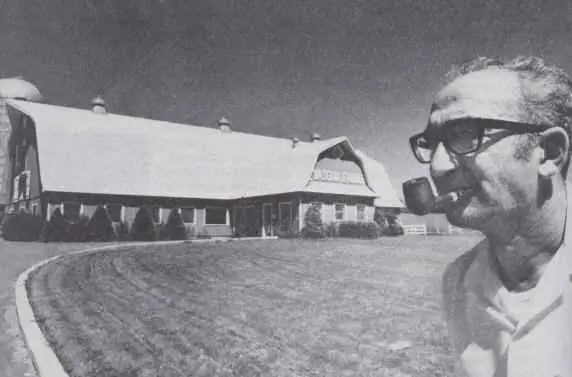
Max Yasgur never played a note of music in his life. He was a dairy farmer — the largest milk producer in Sullivan County, New York — and a registered Republican who supported the Vietnam War. But in August 1969, he made a decision that altered the course of American cultural history: he leased his 600-acre farm in Bethel, New York, to four young promoters who needed a place to hold a music festival. Three days later, nearly half a million people had gathered on his land for what became Woodstock.
The Farmer
Born December 15, 1919, in New York City to Russian Jewish immigrants, Yasgur grew up on his family’s dairy farm in Maplewood, New York, which doubled as a boarding house for summer guests. He attended New York University and earned a degree in real estate law before returning to farming. By the late 1960s, he had built a vertically integrated dairy empire: ten farms comprising 2,000 acres, a peak herd of 650 cattle, a pasteurization plant, a bottling facility, and door-to-door delivery routes. His operation achieved 24,023 pounds of milk production per cow annually — matching the national average with 1960s technology.
The Deal
After the villages of Saugerties and Wallkill had rejected the festival, promoters including Artie Kornfeld reached Yasgur through a chain of family connections. Yasgur agreed to lease his just-harvested alfalfa field for $75,000 — roughly $580,000 in today’s dollars. He expected about 40,000 attendees. Approximately 460,000 showed up instead. The sloping terrain of his property formed a natural amphitheater that became one of the most photographed landscapes in rock history.
Generosity and Aftermath
When Yasgur learned that local residents were selling water to festival-goers, he hung a sign on his barn reading “FREE WATER” and ordered his children to fill every empty milk bottle at the dairy plant and give them away along with all available milk, cheese, and butter. He never wavered in his belief that the attendees were peaceful and that he’d made the right decision. His neighbors sued him for property damage; he settled for $50,000. Less than two years later, he sold the farm. Max Yasgur died of a heart attack on February 9, 1973, at age 53. Rolling Stone gave him a full-page obituary — one of the few non-musicians ever to receive the honor.