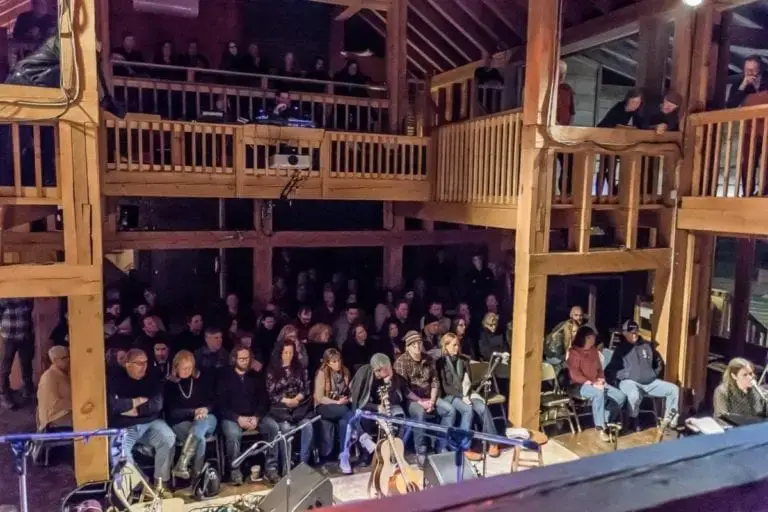
A snare roll cracks the room open a little after eight on a Saturday night in Woodstock, and the first thing you understand is how close you are. Not arena-close. Not theater-close. Living-room close. The kit sits maybe forty feet from the back of the audience, and the audience itself is a hundred and some people on folding chairs and church pews and a strip of standing room along the back wall. Boards on the windows. The mail still sitting on a side table by the door, addressed to whoever happens to live here. The ceiling vaults up into dark-stained pine and locally quarried bluestone, and when the band leans into the first chorus, the whole structure breathes with them. People near the front start to dance — not performatively, the way they do at amphitheaters when the camera pans past. They dance because the music is right there, and there is nowhere else to put what it makes you feel.
This is Levon Helm Studios. The Barn. One-sixty Plochmann Lane, a half-mile up a residential road outside Woodstock, New York, in a building most people would drive past without a second glance. It has hosted Elvis Costello, Phil Lesh, Norah Jones, Emmylou Harris, John Prine, Donald Fagen, My Morning Jacket, Allen Toussaint, and Dr. John — most of them within arm’s reach of a few hundred people seated on chairs that came out of a church basement. Levon Helm built it. His daughter keeps it running. And twenty-two years into the Midnight Ramble, fourteen of them after Levon’s passing, it remains the most intimate room in American music.
The Barn Itself
The building does not announce itself. It is a wood-frame studio set into a wooded hillside, low and long, with a peaked roof and a small parking lot that fills up two hours before doors. The first time you arrive you are not entirely sure you are in the right place. No marquee. No signage worth the name. The neighbors’ houses are visible through the trees. You park where someone in a fleece vest tells you to park, walk a short path to a side door, and that is the entrance.
Inside, the room is the room. Vaulted ceilings of dark-stained wood, beams running the length of the building, walls of bluestone quarried within a few miles of where you are standing. A small stage with a drum riser, a Hammond off to the side, a couple of vintage amps that have been there longer than the people setting up the show. Folding chairs and pews arranged in a loose semicircle, tight enough to the stage that the front row is essentially on it. The acoustics are the acoustics of a working studio, which is to say warm, woody, and unflattering to anything that isn’t real. You cannot fake a vocal in this room. You cannot hide a sloppy fill. The Barn rewards craft and exposes everything else.
That was always the point. Levon Helm built the studio in the mid-1970s, when The Band was still a working unit and he wanted a place near home where he could record without flying to Los Angeles or chasing studio time in New York. The building burned in a fire in 1991, and Levon rebuilt it almost exactly as it had been, with help from neighbors and friends — the old structure lost, the new one rising on the same footprint, scaled and shaped for music. The room you sit in tonight is, in a meaningful sense, the same room he sat in for forty years. The architecture is the instrument. The instrument is the architecture.
Why It Exists
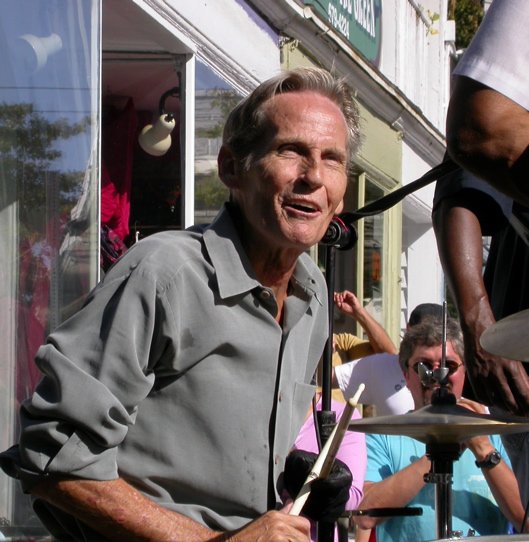
The Midnight Ramble was not, in its first iteration, a concert series. It was a rent party.
By the early 2000s, Levon was in serious financial trouble. He had been diagnosed with throat cancer in the late 1990s, lost his voice for a stretch, and watched the medical bills mount while the income from a long career in music dwindled into the structural inequities of the rock-era publishing system. The Barn — the building itself — was at risk. Friends and neighbors knew it. So in 2004, Levon and his daughter Amy and a small circle of musicians started inviting people to the studio on Saturday nights for what they called the Midnight Ramble. Pay what you could. Bring a few friends. Hear some music. Help keep the lights on.
The name came from his Arkansas childhood. Levon grew up in Turkey Scratch, a cotton-country crossroads in the Mississippi Delta, where traveling minstrel and medicine shows would set up in town for a night or two and play a clean program for families until about ten o’clock. Then, after the families had gone home and the sponsors had been satisfied, the musicians would play the Midnight Ramble — a looser, bluer, more uncensored set for whoever was still around. The show after the show. Levon had been chasing the spirit of it his whole adult life. In a barn in Woodstock, with a fresh tracheotomy scar and a mortgage payment due, he finally built a room where it could happen every Saturday.
What started as a survival mechanism became a sacrament. Word traveled. Musicians who had known Levon for decades began showing up unannounced, just to sit in. Strangers from California booked plane tickets the day single shows went on sale. The financial necessity that birthed the Ramble receded; the ritual it created stayed.
Who Played Here
Any list is incomplete and slightly unfair to the ones it leaves out, but the list is the evidence. Elvis Costello has played the Barn. So have Phil Lesh, Norah Jones, Emmylou Harris, John Prine, Donald Fagen, Allen Toussaint, Dr. John, Little Sammy Davis, Hubert Sumlin, Mavis Staples, My Morning Jacket, the Black Crowes, Steely Dan’s rhythm section in various configurations, and a parade of session players whose names you would only recognize from the back of your favorite records.
The drop-in tradition is the one most worth understanding. Because the Ramble is small, because the room is famous among musicians long before it became famous among audiences, players passing through the Hudson Valley on tour have a way of finding their way to Plochmann Lane on a Saturday night. They come because Levon was there. They come because Levon’s friends are still there. They come because the Barn is one of the last rooms in American music where you can sit in with people you respect and the audience will know exactly what they are watching. Joe Henry, on stage in 2016 with Billy Bragg, told the room flatly that he didn’t think of a stop at the Barn as a tour stop. He compared it to walking into a church. The word he used was reverence.
Keep It Going
Levon Helm died on April 19, 2012, of complications from the throat cancer that had nearly taken him a decade earlier. He was seventy-one. His last words, given to his daughter Amy and his longtime manager Barbara O’Brien, were three: “Keep it going.”
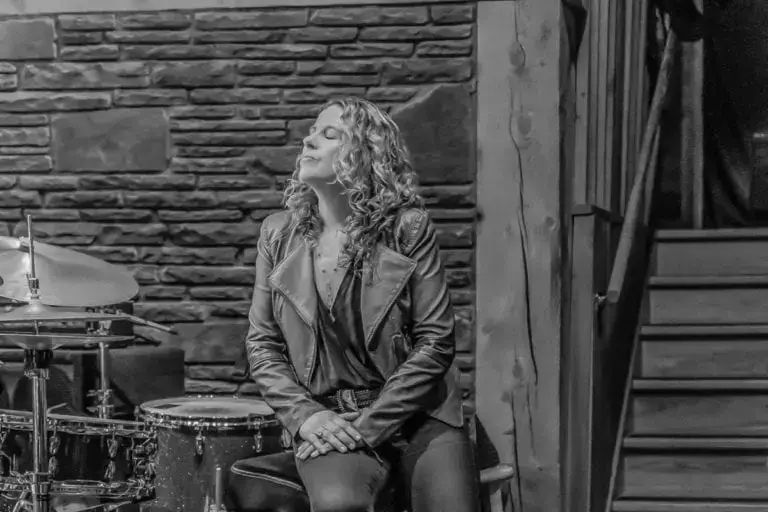
They did. They have. Amy Helm — a singer in her own right, a songwriter with a steadily building catalog, a Woodstock fixture — took on the stewardship of the Barn and the Ramble after her father’s death, and fourteen years on, she is still hosting most of the Helm Family Midnight Rambles personally. The resident family around her includes Larry Campbell and Teresa Williams, the husband-and-wife team who anchored Levon’s late-career band and now anchor Amy’s, and Jimmy Vivino, the guitar polymath best known for his years on late-night television and his deep roots in the Hudson Valley scene.
The economics of running a two-hundred-capacity room in 2026 are punishing. The Barn does not have a corporate parent. There is no Live Nation cushion underneath it, no naming-rights partner subsidizing the sightlines. Tickets are sold exclusively through Tixr, the venue’s ticketing partner, and the policy is firm: buy from a third-party reseller and you will be denied entry. That stance — refusing to feed the bot economy that has gutted ticketing across the rest of the live-music business — is itself a form of stewardship. Amy and the Helm family have made decisions about how this room operates that more or less every other room of comparable cultural weight has refused to make.
“Keep it going” is a directive about the music. It is also a directive about how to behave.
The Recent Calendar
The 2025–2026 calendar at Levon Helm Studios reads like a regional roots-music summit, with the Helm Family Midnight Rambles continuing to anchor the schedule on selected Saturdays.
Recent and upcoming highlights include the Helm Family Midnight Ramble featuring Jay Collins & Gravy Train on New Year’s Eve; Josh Ritter on January 23 (sold out before the new year); Tyler Ramsey and Carl Broemel of My Morning Jacket touring their Celestun project on February 20; two nights of Max Creek at the end of February; Maya Hawke on April 10 (sold out); Soul Asylum’s acoustic configuration on April 17 (sold out); Dave Alvin and Jimmie Dale Gilmore on May 2; the annual Levon Helm Birthday Weekend Rambles on May 23 and 24; two nights of NRBQ at the end of May; Charlie Parr on July 9; two nights of Richard Thompson on July 10 and 11; Alejandro Escovedo on July 12; and Shovels & Rope on July 23. Eilen Jewell closes out 2026 on November 20.
The Birthday Weekend Rambles in late May, marking what would be Levon’s eighty-sixth birthday, are the closest thing the Barn has to a high holy day. Two nights, two configurations of the Helm Family Midnight Ramble band, a rotating cast of guests built around a tribute to whatever piece of Levon’s catalog or musical heritage Amy is leaning into that year. Tickets for both nights tend to disappear within hours of going on sale.
The Pilgrimage Around It
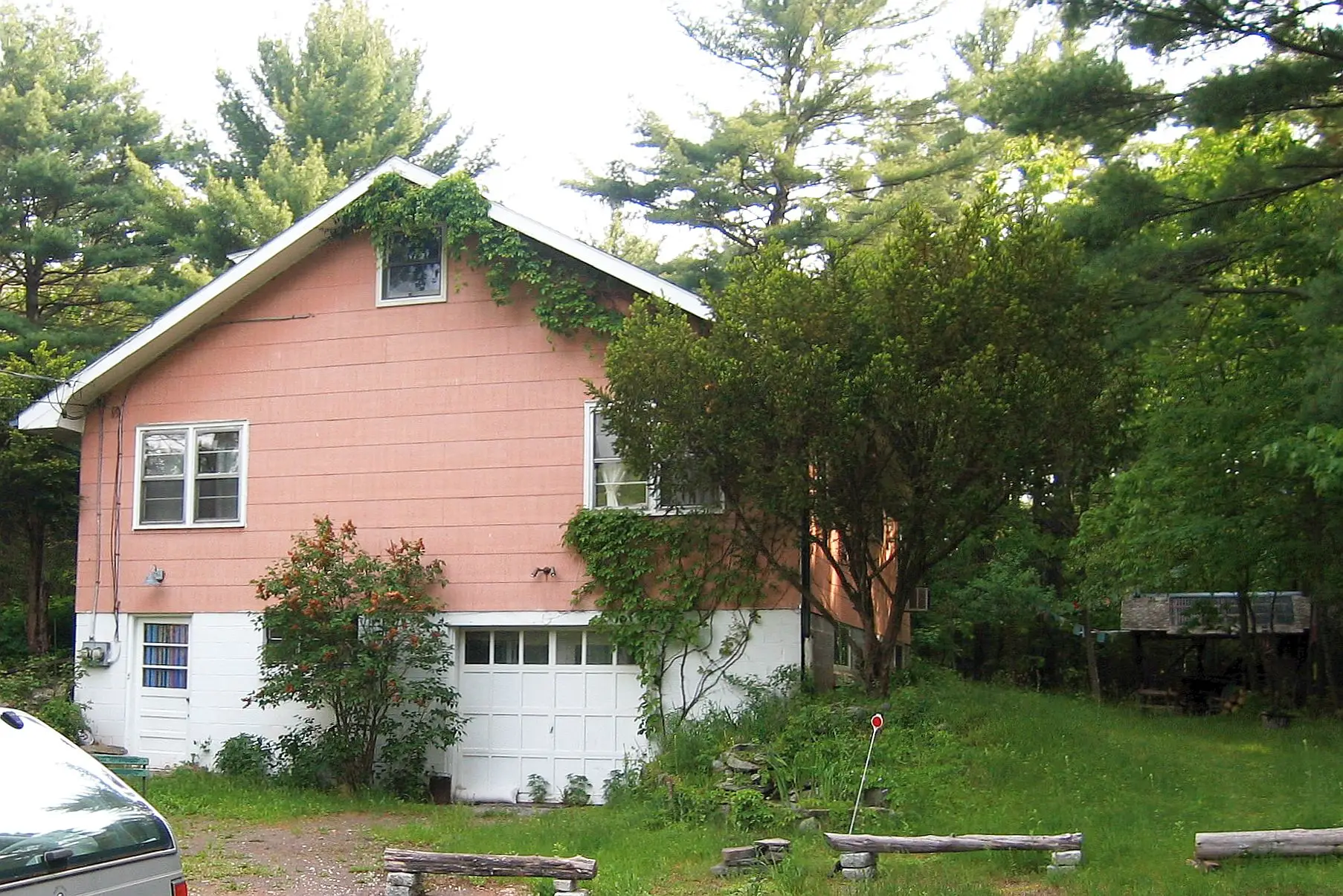
If you are coming to the Barn for the first time, plan a day around it. Woodstock is the geography of an entire chapter of American music history, and the Barn is one stop on a pilgrimage that maps the rest of it.
Big Pink — the salmon-colored Saugerties farmhouse where The Band lived and recorded Music from Big Pink with Bob Dylan in 1967 and 1968 — is a twenty-minute drive from Plochmann Lane. The house is privately owned and not open for general tours; the right approach is to drive past, pay your respects, and keep moving. Bearsville Studios, four miles west of Woodstock proper, was Albert Grossman’s compound and the birthplace of recordings by everyone from Todd Rundgren to R.E.M. to Bonnie Raitt; it has been recently restored and is hosting concerts again. Catskill Mountain Pizza Company on Mill Hill Road is the standard pre-Ramble stop for those in the know. The town itself is small enough to walk in an hour, and worth doing on a clear afternoon before the show.
We will have a longer piece on the Bearsville comeback in the coming weeks. For now, treat the Hudson Valley as the through-composed setting that it is. The Barn does not exist in a vacuum. It exists at one specific node in a musical geography that goes back sixty years.
The Closer
Doors open at the Barn at 7:30. The show starts at 8:00. On arrival you receive a wristband, which corresponds to your ticket type and dictates where you can sit; you are expected to wear it for the duration of the night. The room fills slowly, then all at once. Musicians wander in and out of the green room. The lights come down. Someone counts off, the snare cracks, and the wood and the bluestone start to breathe.
Sometime after the second set, the band stops playing, the merch table at the back of the room goes live, and — in a tradition that has held since the early days — the artists themselves come out to sell their records, shake hands, and sign whatever you put in front of them. There is no crew member in between. The person whose voice you have been listening to for the last ninety minutes is the person ringing up your CD.
In an age of personal seat licenses, dynamic pricing, surge fees, third-party resellers, and stadium PA systems louder than the songs they are amplifying, the Barn is a working argument that the old way still wins. That a room built for music, run by people who love the music, hosting artists who respect the room, can sustain itself across two and a half decades and one death and a global pandemic and a live-music economy that has tilted increasingly against everything the Barn stands for. Mike Kohli, writing about the Barn at 315 Music several years ago, called it the Church of Levon. The phrase has stuck because it is the right one. There is no other name for what happens up there on Plochmann Lane.
Keep it going.
Photographs by the late Brian Cornish. With thanks to Mike Kohli at 315 Music, whose own writing on the Barn first called it the Church of Levon.
Disclosure: Some links in this article are affiliate links. Upstate Concerts may earn a commission on ticket purchases at no additional cost to you.