
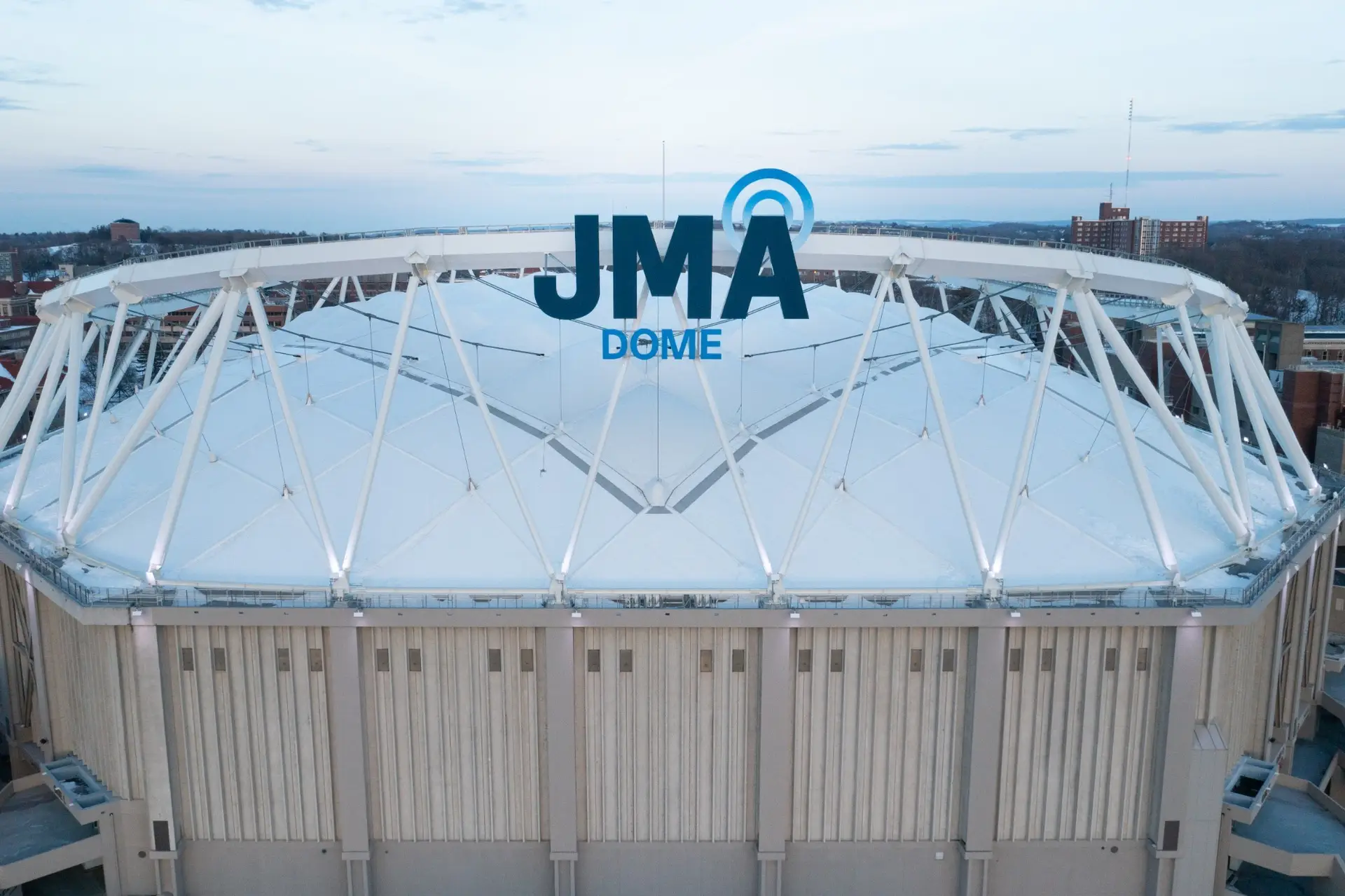
There is no subtle way to describe the JMA Wireless Dome. It is the largest domed stadium on a college campus in the United States — 570 feet long, 497 feet wide, 165 feet high at the crown — and when it fills with 47,000 people for a concert, the sound does not escape. It bounces. It builds. It earns the nickname that has followed this building since 1980: The Loud House.
For most of its life, the Dome was a football and basketball cathedral. But the concert history runs just as deep, from the Rolling Stones drawing 45,000 in 1982 to Metallica packing 47,319 for the M72 World Tour in 2025. When a tour needs a building big enough to justify Central New York as a stop, this is where it lands.
From Carrier Dome to JMA
Construction began in April 1979 on a $27 million project to replace the aging Archbold Stadium, which had served Syracuse University since 1907. The new dome opened on September 20, 1980, with Carrier Corporation’s $2.75 million naming gift securing the “Carrier Dome” identity that would stick for over four decades.
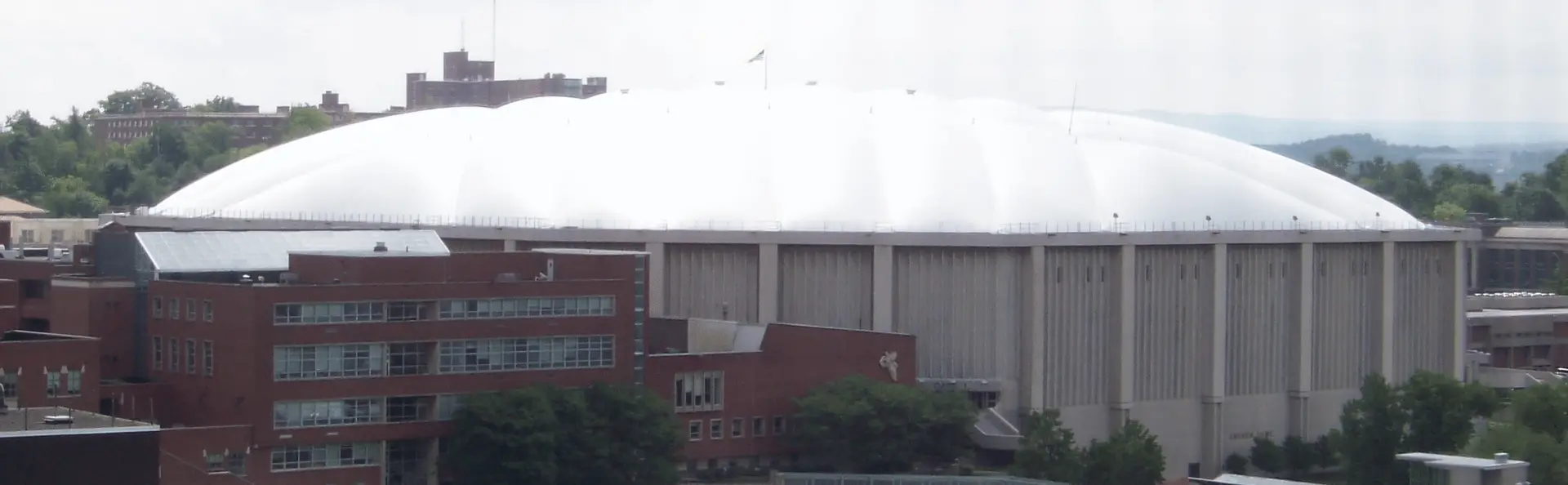
The original inflatable roof — a fabric membrane held up by air pressure — gave the building its distinctive look and its acoustic quirks. Every sound rattled around inside that pressurized bubble. When Willie Nelson played in 1983, the combination of the crowd, the enclosed air system, and a Syracuse summer earned the show the nickname “Syracuse Sauna.” Air conditioning would not arrive for another 37 years.
In 1999, a new Teflon-coated fiberglass roof replaced the original inflatable membrane — 287,000 square feet of material across 64 panels, at a cost of roughly $14 million. The reverb calmed down. The building stopped needing air locks at every entrance. But the fundamental character remained: this was a loud, enclosed room that rewarded big shows.
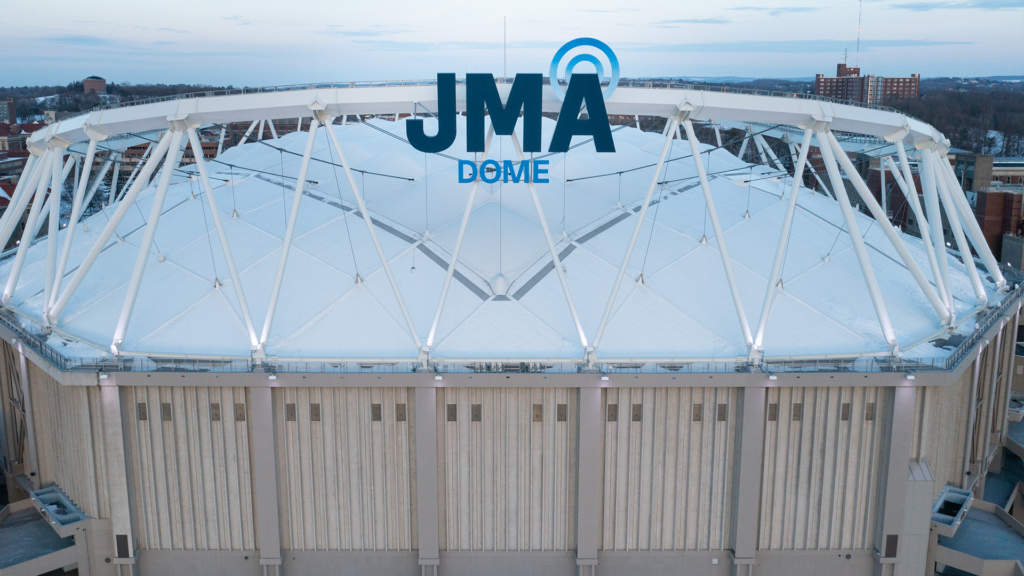
The transformation came between 2018 and 2020, when a $163 million renovation gutted the building’s infrastructure. The roof became a fixed, translucent structure with natural light. Air conditioning finally arrived. A massive center-hung HD videoboard went in. Every chairback seat was replaced. The concourse got murals highlighting Syracuse athletics history, and the concession stands caught up to modern expectations. The building reopened on September 26, 2020, and when JMA Wireless signed a 10-year naming rights deal in May 2022, the rebrand felt like a fresh start rather than just a logo swap.
The Concert Setup
For concerts, the stage typically sits at one end zone. Up to 7,000 temporary seats go down on the field, putting floor-level fans close to the stage. The fixed chairback seating — 42,784 seats in total — wraps around the floor on all sides, rising steeply enough that even upper-level seats maintain sightlines to the stage.
The post-renovation layout makes a real difference for concertgoers. The old air-lock entrance system — a necessary evil of the inflatable roof — is gone. You walk in through 32 revolving doors like a normal building. Equipment load-in and production staging improved dramatically, which means bigger, more complex shows are easier to book. And the air conditioning means summer concerts no longer require the kind of endurance test that Willie Nelson accidentally invented.
The acoustics are the defining feature. The Dome is not an acoustically tuned concert hall — it is a massive enclosed space that amplifies everything. For rock, metal, and hip-hop, that raw energy is a feature, not a bug. The crowd feeds the sound, the sound feeds the crowd, and by the second song you understand why they call it The Loud House. For acts that rely on nuance and dynamic range, the experience is different — the room favors volume over subtlety. Know what kind of show you are walking into and set your expectations accordingly.
Shows That Made the Building
The concert ledger reads like a hall-of-fame ballot. Santana played the first rock show at the Dome in 1981. The Rolling Stones came through in December 1982 and drew 45,000 — the largest indoor rock audience in Northeast history at that point. Pink Floyd brought the Division Bell Tour in June 1994 to 38,951 people. Genesis played three different decades inside the building. Billy Joel has been coming back for 25 years. Paul McCartney sold 35,000 seats in 2017.
The modern era has kept up. Bruce Springsteen, P!NK, Def Leppard and Mötley Crüe, and Luke Bryan have all filled the building in recent years. Metallica’s 2025 show set the concert attendance record at 47,319 — proof that the Dome still draws at the highest level when the right act comes through.
Getting There and Parking
The Dome sits on the Syracuse University campus at 900 Irving Avenue — a 10-minute drive from downtown Syracuse and right off I-81. The surrounding streets are campus roads, so traffic management on event nights is well-practiced if not always fast.
All parking is cashless — credit card, Apple Pay, or Google Pay only. The main options:
- Skytop Lot (1600 Jamesville Ave) — $30 per car, with a free shuttle running every 15 minutes to the Dome
- Comstock/Colvin Lots (South Campus) — $30 per car, also served by the free shuttle
- University Avenue Garage (1101 E. Adams St) — $35 per car, closes two hours after the event
- Comstock Avenue Garage — $35 per car, same two-hour post-event window
Lots open at 2:00 PM for events. The free shuttle drops off at College Place before the show and picks up at Gate A after. Budget at least an hour of lead time for parking and security on sold-out nights — the campus roads handle 47,000 people about as well as you would expect.
The Syracuse Scene
The Dome’s location on the university campus puts you within walking distance of the Marshall Street bar and restaurant strip, and a short drive from downtown Syracuse’s growing food scene.
Faegan’s Cafe & Pub is the classic campus bar — a four-minute walk from the Dome with a deep beer selection and the kind of pub food that has fueled pre-game crowds for decades. Their vanilla porter and the mango crush ale are worth trying. Varsity Coffee Shop, barely a block farther, is the nostalgic play — pizza and Italian-American staples at prices that remind you this is still a college neighborhood. It has been on Marshall Street forever and plans to stay.
If you want something more polished, drive five minutes to Phoebe’s Restaurant & Coffee Lounge for French-American cuisine and risotto in a contemporary setting, or Abbiocco by A Mano for handmade pasta that ranks among the best Italian in the city.
Insider Tips
- Earplugs are not optional. The Loud House earns its name. For amplified rock and metal shows, the enclosed dome pushes volume levels well past comfortable. Bring protection.
- Floor seats get you close but not quiet. The field-level temporary seating puts you near the stage, but the dome’s acoustics mean sound reflects from every direction. Lower bowl reserved seats often deliver a better overall mix.
- Take the shuttle. The $5 savings from the satellite lots is not the point — the shuttle avoids the post-show campus gridlock that can trap garage parkers for 45 minutes.
- The building has AC now. If your last Dome concert was before 2020, you are in for a different experience. The renovation was not cosmetic — it was a gut job. Come expecting a modern arena, not the echo chamber you remember.
- 5G connectivity. JMA Wireless installed the most advanced 5G network in any college stadium. Your phone will actually work inside the building, which is not something you could say about the old Carrier Dome.
Check the full event schedule and purchase tickets at cuse.com.