
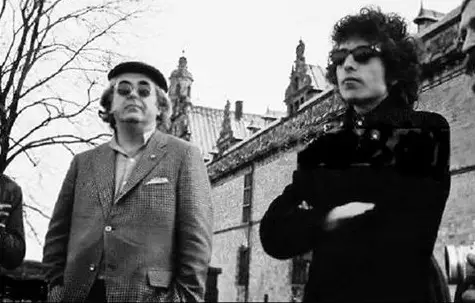
Albert Grossman did not play an instrument, sing a note, or write a lyric. What he did was arguably more consequential: he built the infrastructure that turned Woodstock, New York, from a quiet artists’ colony into the most mythologized music town in American history. Born on May 21, 1926, in Chicago, Grossman earned an economics degree from Roosevelt University, worked for the Chicago Housing Authority, and then opened the Gate of Horn — one of the first dedicated folk music clubs in America — in the mid-1950s.
Assembling an Empire
In 1959, Grossman co-founded the Newport Folk Festival with George Wein, establishing himself as the most connected figure in the folk world. Two years later, he assembled Peter, Paul and Mary from three solo performers — Peter Yarrow, Noel Paul Stookey, and Mary Travers — and their debut album reached the Billboard Top Ten in 1962. He managed Bob Dylan beginning in the early 1960s, a partnership that would define both men’s legacies. It was Grossman who arranged for Peter, Paul and Mary to record Dylan’s “Blowin’ in the Wind,” turning an obscure folk song into a civil rights anthem.
His client roster expanded to include Janis Joplin (signed in 1967, along with Big Brother and the Holding Company), The Band, Odetta, Gordon Lightfoot, and Ian & Sylvia. Grossman managed Joplin with characteristic pragmatism: he stipulated no intravenous drugs in her contract, and in June 1969, took out a $200,000 life insurance policy on her after discovering the extent of her habit.
The Woodstock Magnet
After marrying Sally Buehler in 1964, Grossman settled in Woodstock, establishing his home on a 72-acre Bearsville estate in a four-bedroom bluestone house built in 1914. His presence acted as a gravitational force. Dylan followed, spending time at Grossman’s home as early as late 1964 and eventually settling nearby. The cover of Dylan’s 1965 album Bringing It All Back Home was shot in Grossman’s living room. After Dylan’s 1966 motorcycle accident near Grossman’s property, he and The Band recorded the legendary Basement Tapes sessions at a nearby house called Big Pink.
Van Morrison, Jimi Hendrix, and a growing colony of musicians gravitated to the area through the mid-1960s, drawn by Grossman’s network and the creative refuge the Catskills offered. Woodstock became, in effect, the first American music industry town built by a single manager’s vision.
Bearsville Records and Studios
In 1969, Grossman established Bearsville Recording Studio near Woodstock. The following year, he founded Bearsville Records — initially partnered with Ampex, later distributed by Warner Bros. The label’s first notable release was Todd Rundgren’s Runt. Bearsville became a working studio that attracted artists for decades.
Grossman died of a heart attack on January 25, 1986, at age 59, aboard a Concorde flight over the North Atlantic en route to a London music convention. He is buried behind his Bearsville Theater near Woodstock — fittingly, in the community he built.