
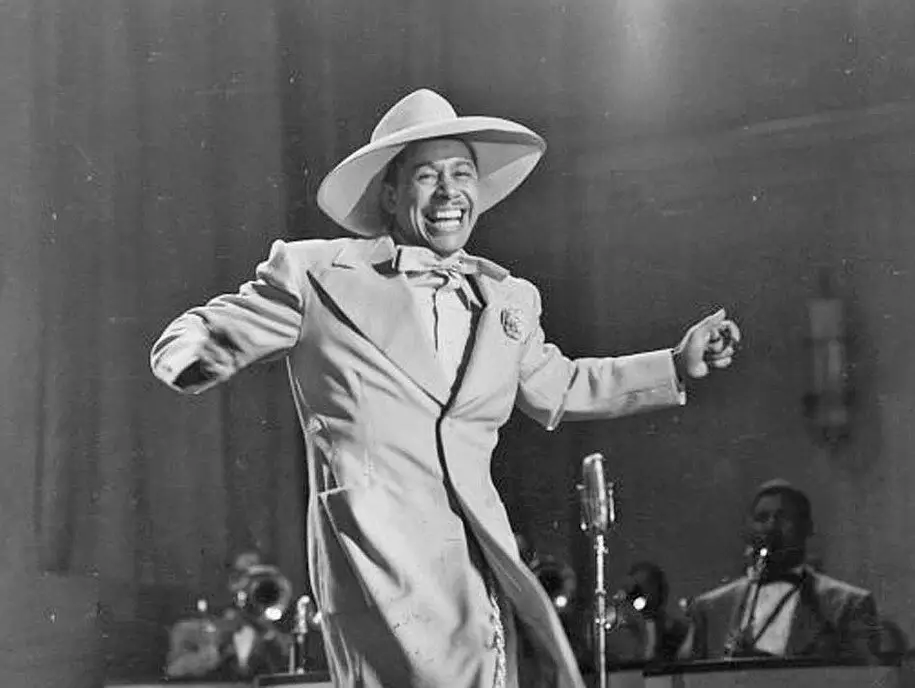
Cab Calloway was born on Christmas Day in Rochester, New York, and went on to become one of the most charismatic entertainers in American history. Born Cabell Calloway III on December 25, 1907, at the family home on 153 South Washington Street in Rochester’s Third Ward, Calloway spent his first eleven years in the city before his family relocated to Baltimore in 1919.
Early Years
Calloway’s parents set the stage for his future. His father, Cabell Calloway Jr., was a Lincoln University graduate and lawyer. His mother, Martha Eulalia Reed, was a teacher and church organist whose musical influence was unmistakable. In Baltimore, Calloway attended Frederick Douglass High School, where he received classical music training — though his extracurricular interests were notably diverse.
Despite his parents’ aspirations for a legal career, Calloway was pulled toward the stage. He performed in local clubs under the mentorship of musicians like Chick Webb and Johnny Jones. After graduating in 1927, he joined his sister Blanche in a Black music revue in Chicago, where he briefly attended law school before the nightclub scene won out entirely. At Chicago’s Sunset Cafe, Louis Armstrong himself taught Calloway the art of scat singing.
The King of Hi-De-Ho
Calloway first led a band called the Alabamians, then took over the Missourians. In 1931, Cab and the Missourians were hired to perform at Harlem’s Cotton Club — replacing the Duke Ellington Orchestra while Ellington was on tour. The gig became a residency, and the residency made Calloway a star. That same year, he recorded “Minnie the Moocher,” which became his signature song and earned him the title “The King of Hi-De-Ho,” after the call-and-response refrain that audiences across the country learned to sing back to him.
Calloway’s energy was volcanic. His athletic stage presence, zoot-suited flamboyance, and virtuosic scat singing made him one of the most popular bandleaders of the Swing Era. He led one of the most popular big bands in America throughout the 1930s and 1940s, performing alongside the greatest musicians of the era.
Cultural Pioneer
Beyond music, Calloway left lasting cultural marks. In 1938, he published The Hepster’s Dictionary: Language of Jive — one of the first slang dictionaries to document jazz-age vernacular, documenting the slang of the jazz age. His film career included a memorable role in The Blues Brothers (1980). He received the Grammy Hall of Fame Award in 1999 and the Grammy Lifetime Achievement Award posthumously in 2008. Calloway died in 1994 at age 86, but his Rochester birthplace remains the starting point of one of the great entertainment careers of the twentieth century.