
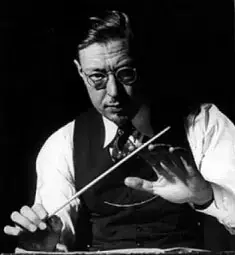
Howard Hanson did more to shape the sound and structure of American classical music than perhaps any figure of the twentieth century — and he did it from Rochester. As director of the Eastman School of Music for 40 years, Hanson transformed a promising regional conservatory into one of the world’s premier music institutions while simultaneously championing the work of American composers at a time when European traditions dominated the concert hall.
The Eastman Years: 1924–1964
George Eastman personally appointed Hanson as director of the Eastman School in 1924, when Hanson was just 27 years old. Over the next four decades, Hanson rebuilt the school from the ground up: recruiting world-class faculty, refining the curriculum to balance performance with composition, and building orchestras that rivaled professional ensembles. His most revolutionary initiative was the American Composers Concerts and the annual Festival of American Music, through which he premiered over 2,000 works by more than 500 American composers — an unparalleled commitment to homegrown talent at a time when American orchestras programmed almost exclusively European repertoire.
The Compositions
Hanson was no mere administrator. His own compositions defined the “American Romantic” school of classical music. His Symphony No. 1 (“Nordic”) premiered in Rochester in 1924, establishing his voice. Symphony No. 2 (“Romantic”), completed in 1930, became his most recognized work — later featured prominently in Ridley Scott’s 1979 film Alien. His Symphony No. 4 won the Pulitzer Prize in 1944. His opera Merry Mount, staged at the Metropolitan Opera in 1934, was considered among the first fully American operas. And his Chorale and Alleluia (1954) became a cornerstone of American wind band literature, still required at New York State high school competitions decades later.
Honors and Legacy
Hanson received the Pulitzer Prize, the George Foster Peabody Award (1946), 36 honorary doctorates, and election to the National Institute of Arts and Letters. He served as president of the Music Teachers National Association and the National Association of Schools of Music. After retiring from Eastman in 1964, he directed the University of Rochester’s Institute of American Music until his death in 1981. Rochester’s identity as a city of music — not just a city with a music school — is Hanson’s doing. He was inducted into the Rochester Music Hall of Fame in 2016.