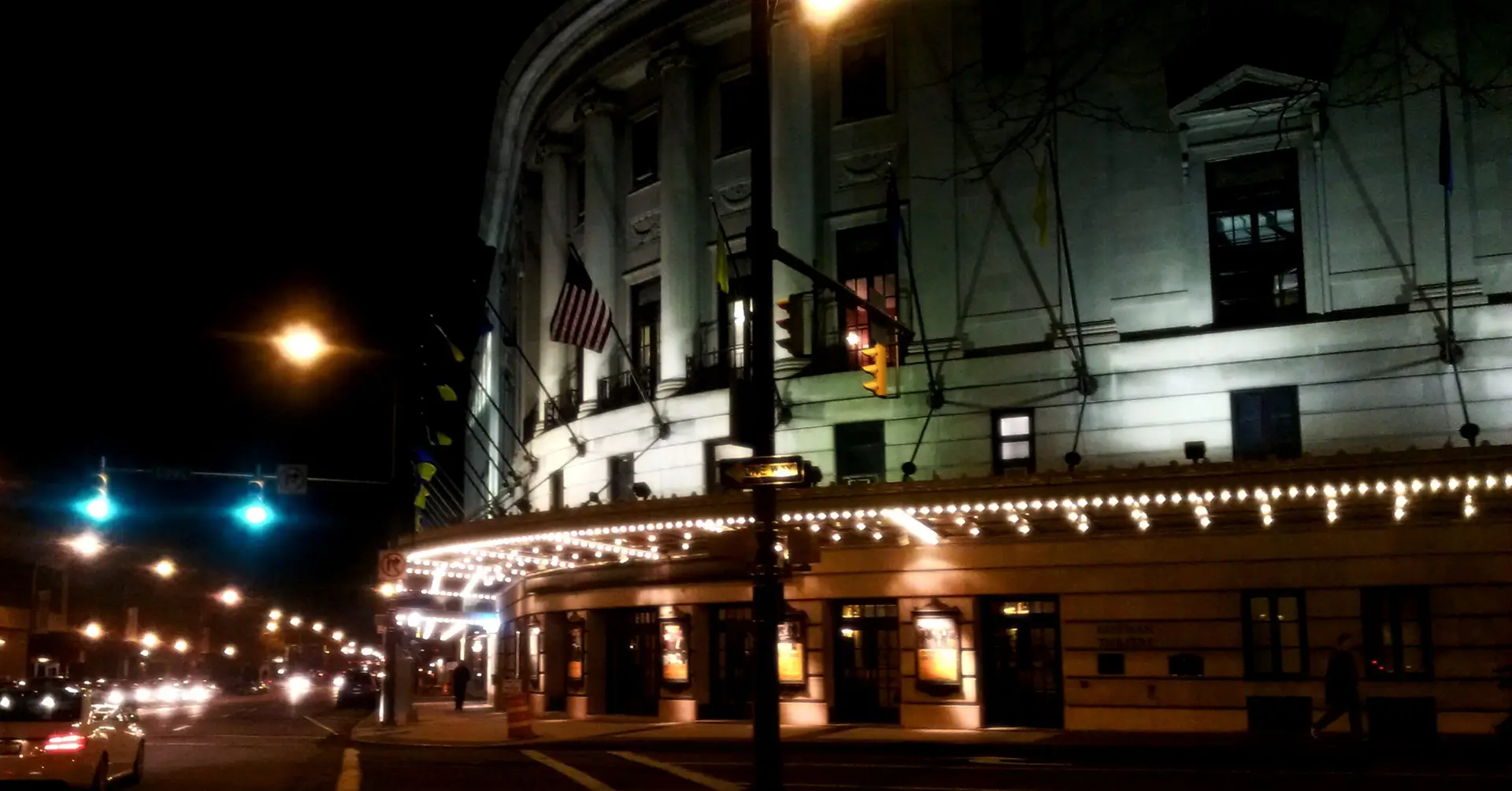
Carved into the limestone above the entrance at 26 Gibbs Street, a single line reads: “For the enrichment of community life.” George Eastman — the Kodak founder who bankrolled this entire operation — could have inscribed anything on his $4 million theater in 1922. He chose a mission statement. A century later, the Eastman Theatre still delivers on it, night after night, in a 2,326-seat hall that ranks among the finest acoustic spaces in the northeastern United States.
This is Rochester’s cathedral of sound. Home to the Rochester Philharmonic Orchestra since 1930, training ground for the Eastman School of Music’s conservatory students, and a touring stop for everything from jazz legends to indie rock acts who want to play a room with actual resonance — the Eastman Theatre is the rare venue where the building itself is part of the performance.
George Eastman’s Grand Experiment
When the Eastman Theatre opened on September 4, 1922, it wasn’t just a concert hall — it was a movie palace. George Eastman, ever the industrialist-philanthropist, envisioned a hybrid venue where silent films would be accompanied by a full 70-piece orchestra. The Eastman Theatre Orchestra, under conductor Victor Wagner, played live scores nightly to packed houses during the roaring twenties. Eastman believed that exposing Rochester’s working population to orchestral music — even as background to a Charlie Chaplin picture — would elevate the entire community.
He was right, in a way he probably didn’t anticipate. When sound film killed the silent-movie model around 1930, the theater pivoted entirely to concert use. Eastman had already founded the Rochester Philharmonic Orchestra in 1922 and established the Eastman School of Music as a conservatory within the University of Rochester. The theater became the anchor for all of it — a purpose-built performance hall that happened to have been designed by McKim, Mead & White, the same firm behind Pennsylvania Station, the Brooklyn Museum, and Columbia University’s campus.
The Room
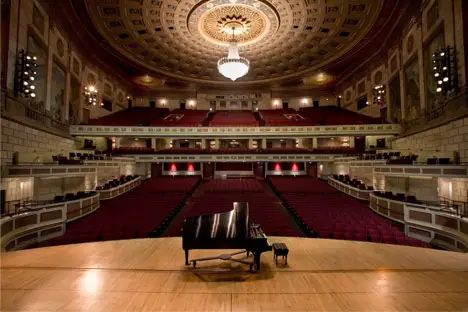
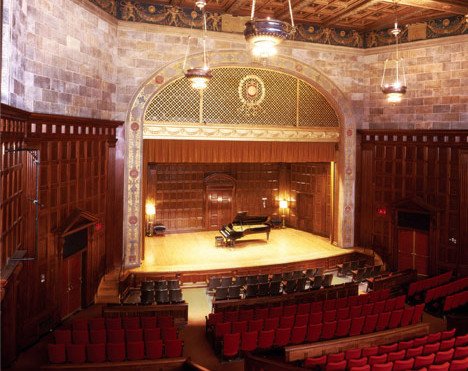
The main auditorium — officially renamed Kodak Hall at Eastman Theatre in 2009, following a $10 million gift from Eastman Kodak — is a study in Italian Renaissance grandeur adapted for acoustics. The interior follows a blue and gold color scheme, with an extensive program of murals, bas-reliefs, and ornamental plasterwork that makes the ceiling feel like something you’d find in a European opera house. It originally seated over 3,300. Today, after a historically sensitive two-phase renovation, the count sits at 2,326 — a deliberate reduction that improved both sightlines and sound.
That renovation tells the story of a venue that takes its acoustics seriously. In 2004, a $14 million project installed a new concert shell — 50 feet tall, 60,000 pounds — designed by acoustic consultants Akustiks specifically for orchestral and amplified performance. The 2009 phase widened aisles, added box seats, expanded the lobby, and replaced or restored more than 2,100 individual seats. The result is a hall that feels intimate despite its size, where the RPO’s string section reaches the back row with startling clarity and a touring amplified act doesn’t have to fight the room.
What Happens Here
The Rochester Philharmonic Orchestra is the headliner — their classical series, pops concerts, and holiday programming fill the calendar from September through May. But the Eastman Theatre’s identity extends well beyond the RPO. The Eastman School of Music stages faculty and student recitals, visiting artist series, and ensemble concerts that draw from one of the most competitive conservatory programs in the country. Jazz at Eastman brings heavyweight improvisers to a hall that can handle the dynamic range. And the theater books touring acts — rock, folk, world music — that benefit from the room’s natural warmth.
The Eastman School and RPO were jointly inducted into the Rochester Music Hall of Fame in 2022, coinciding with the centennial of both institutions. That recognition underscored something Rochester locals already knew: this building has shaped the musical identity of the entire region for over a hundred years. Generations of professional musicians trained in its practice rooms, performed their senior recitals on its stage, and then went on to orchestras, recording studios, and teaching positions worldwide.
Getting There and Making a Night of It
The Eastman Theatre sits in the heart of Rochester’s East End, the city’s culture-and-dining corridor. Street parking is available on Gibbs Street and surrounding blocks, and several pay garages operate within a two-block radius. The Gibbs Street garage, directly adjacent to the theater, is the most convenient option for evening performances.
The East End dining scene practically exists to serve the pre-show crowd. Max of Eastman Place, located in the Miller Center directly across the street, is the obvious choice for a high-end dinner — it’s visually stunning and timed for curtain calls. Blu Wolf Bistro handles the casual end with gourmet burgers, wings, and a solid craft beer selection, plus outdoor patio seating in warmer months. Redd, a few blocks away on East Avenue, serves modern American cuisine with an emphasis on seasonal ingredients and is a local favorite for date-night dining before performances.
Know Before You Go
RPO concerts and most Eastman School events are ticketed through the Eastman Theatre Box Office or online at rpo.org. Seating in Kodak Hall is divided between orchestra, first balcony, and second balcony levels, with box seats flanking the stage. For orchestral performances, the first balcony center offers the best acoustic sweet spot — you’re at the focal point of the concert shell’s projection. For amplified shows, orchestra-level center seats within the first twenty rows deliver the most balanced mix.
A note on the organ: the Eastman Theatre originally housed a massive pipe organ that accompanied silent films and served as a teaching instrument. It fell into disrepair and public use was discontinued in 2004. The Eastman Rochester Organ Initiative is working toward restoration, but for now, the organ chambers remain silent — a project-in-waiting that could add yet another dimension to an already extraordinary hall.
Dress code is come-as-you-are for most events, though RPO classical series audiences tend to dress business casual to semi-formal. Student recitals are free and open to the public — arguably the best-kept secret in Rochester’s cultural calendar.