
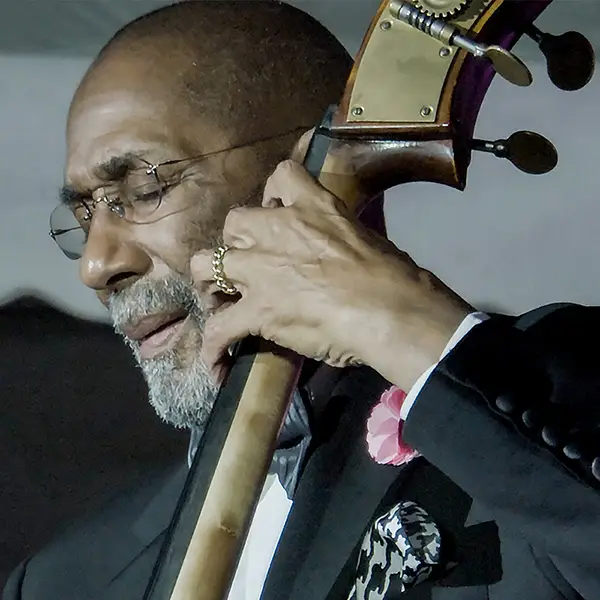
Ron Carter is the most recorded bassist in the history of jazz — a distinction verified by the Guinness Book of World Records, with over 2,200 recording sessions to his name. His path to that extraordinary career began at the Eastman School of Music in Rochester, New York, where he earned his bachelor’s degree in 1959 on a full scholarship and became the first African American to perform with the Rochester Philharmonic Orchestra. That groundbreaking moment in Rochester foreshadowed a career that would reshape the role of the bass in American music.
Eastman and the Classical Foundation
Born May 4, 1937, in Ferndale, Michigan, Carter grew up in Detroit playing classical cello before switching to double bass. The transition proved transformative. He earned a full scholarship to the Eastman School of Music, where his classical training gave him the technical command, tonal sophistication, and musical discipline that would distinguish his jazz playing for decades to come. His performances with the Rochester Philharmonic broke a significant racial barrier in a major American orchestra. After Eastman, he completed a master’s degree at the Manhattan School of Music in 1961, and his career in jazz began almost immediately.
Miles Davis and the Second Great Quintet
Carter’s career-defining role came as the anchor of Miles Davis’s Second Great Quintet (1963-1968), alongside Herbie Hancock, Wayne Shorter, and Tony Williams. The group recorded landmark albums including E.S.P., Miles Smiles, Sorcerer, and Nefertiti — recordings that fundamentally changed the direction of jazz and established a new vocabulary for rhythm section interaction. Carter’s bass lines on these records — melodic, propulsive, harmonically inventive — are studied by every serious jazz musician to this day. His ability to provide both foundation and forward motion simultaneously redefined what was possible on the instrument.
Three Grammy Awards and an Unmatched Legacy
Carter won Grammy Awards in 1987 (for the Round Midnight film score), 1994 (Best Jazz Instrumental Group for a Miles Davis tribute album), and 2022 (Best Jazz Instrumental Album for Skyline with the Ron Carter Trio). He is a fixture of the legendary Blue Note Records catalog from the 1960s, appearing on sessions with Herbie Hancock, Wayne Shorter, McCoy Tyner, Eric Dolphy, and virtually every other major artist of the era.
In 2002, Eastman honored him with the prestigious Hutchinson Award. He was named an NEA Jazz Master and served as Distinguished Professor Emeritus at City College of New York and on the faculty of Juilliard. Rochester gave Ron Carter his classical foundation and his first opportunity to break barriers, and he built upon both to become the most prolific bassist in the history of recorded music. At 89, Carter continues to perform and record, his tone and time as authoritative as ever. His Eastman years were the beginning of an unparalleled journey in American music.