
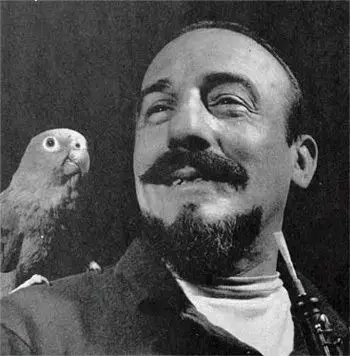
Mitchell William Miller was born on July 4, 1911, in Rochester, New York, in a modest home on Sheridan Street near the Bausch & Lomb factory. The son of a Russian immigrant wrought iron worker and a former seamstress, Miller would rise from Rochester’s working-class neighborhoods to become one of the most powerful figures in the American music industry.
Eastman and Beyond
Miller began studying oboe at age 12 at the Eastman School of Music’s community program, eventually graduating from Eastman in 1932 with a Bachelor of Music with Distinction. He performed with the Rochester Philharmonic Orchestra before moving to New York City, where he joined the CBS radio network symphony and played in the pit orchestra for George Gershwin’s Porgy and Bess in 1935 — and was even part of Orson Welles’ legendary 1938 “War of the Worlds” broadcast.
The Columbia Records Revolution
In the late 1940s, Miller directed Mercury Records’ popular division, producing hits for Frankie Laine including “Mule Train,” “That Lucky Old Sun,” and “Jezebel.” In 1950, Columbia Records hired him as head of A&R, where he transformed the label from fourth place to first. Miller discovered and promoted Tony Bennett, Johnny Mathis, Rosemary Clooney, and Mahalia Jackson. He pioneered overdubbing techniques alongside Les Paul and engineered crossover hits that blurred the lines between country and pop.
Sing Along with Mitch
Miller’s NBC television series Sing Along with Mitch, launched in 1961, became a cultural phenomenon. Featuring his orchestra, chorus, and the iconic “follow the bouncing ball” sing-along format, the show made Miller a household name. It was preceded by more than 20 best-selling Columbia albums of choral sing-along standards.
Legacy
Miller received a Lifetime Achievement Grammy in 2000 and was inducted into the Rochester Music Hall of Fame in 2013. He died on July 31, 2010, at 99 — a Rochester kid who bent the entire music industry to his vision.