
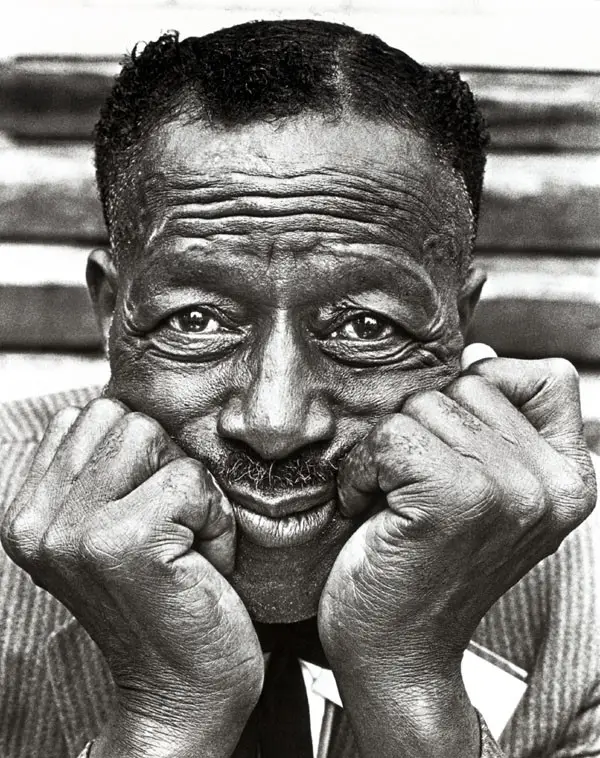
Son House is one of the founding voices of the Delta blues, and for the final four decades of his life, he was a Rochester man. Born Eddie James House Jr. on March 21, 1902, in Lyon, Mississippi, near Clarksdale, House spent his early years as a preacher before picking up the guitar at age twenty-five. He brought a preacher’s fire to the blues — his slide guitar style was raw, percussive, and almost violent in its emotional directness.
Delta Origins
House recorded his first sessions for Paramount Records in 1930 in Grafton, Wisconsin, alongside Charley Patton and Willie Brown. Those recordings — primitive, intense, and commercially unsuccessful during the Depression — are now considered among the most important documents in American music. His influence on the next generation was incalculable: both Robert Johnson and Muddy Waters cited Son House as a primary inspiration. Waters later said House was the musician who first made him want to play.
In 1941 and 1942, House recorded for the Library of Congress and Fisk University — historic field recordings that would not be issued until 1962, when they surfaced as crucial evidence of the Delta blues tradition.
Rochester Years
In 1943, Son House moved to Rochester, New York, and largely abandoned music. His musical partner Willie Brown had died, and House settled into a working life far removed from the Delta juke joints. He took jobs as a foundry worker, railroad porter, and chef for the New York Central Railroad. He lived with his wife Evie in an apartment at 61 Greig Street, without a guitar or a telephone, existing on Social Security.
For over two decades, one of the most important blues musicians in American history was living in obscurity in Rochester.
Rediscovery
On June 23, 1964, three young blues enthusiasts — Phil Spiro, Dick Waterman, and Nick Perls — tracked Son House to his Greig Street apartment. They found him sitting on the front steps. The rediscovery made national news and launched a second act that no one had thought possible. Under Waterman’s management, House returned to performing, playing the blues revival circuit and appearing at festivals and concert halls.
His later performances had a raw, haunted quality — the voice was older, the hands less steady, but the spiritual intensity remained undiminished. Songs like “Death Letter” and “Preachin’ Blues” became touchstones of the revival, introducing a new generation to the source of the blues.
Legacy
Son House was inducted into the Blues Hall of Fame in 1980, its inaugural year. He died on October 19, 1988. In 2013, he was inducted into the Rochester Hall of Fame. His Rochester years are a remarkable chapter in the city’s cultural history — a reminder that the roots of American music can surface in the most unexpected places.