
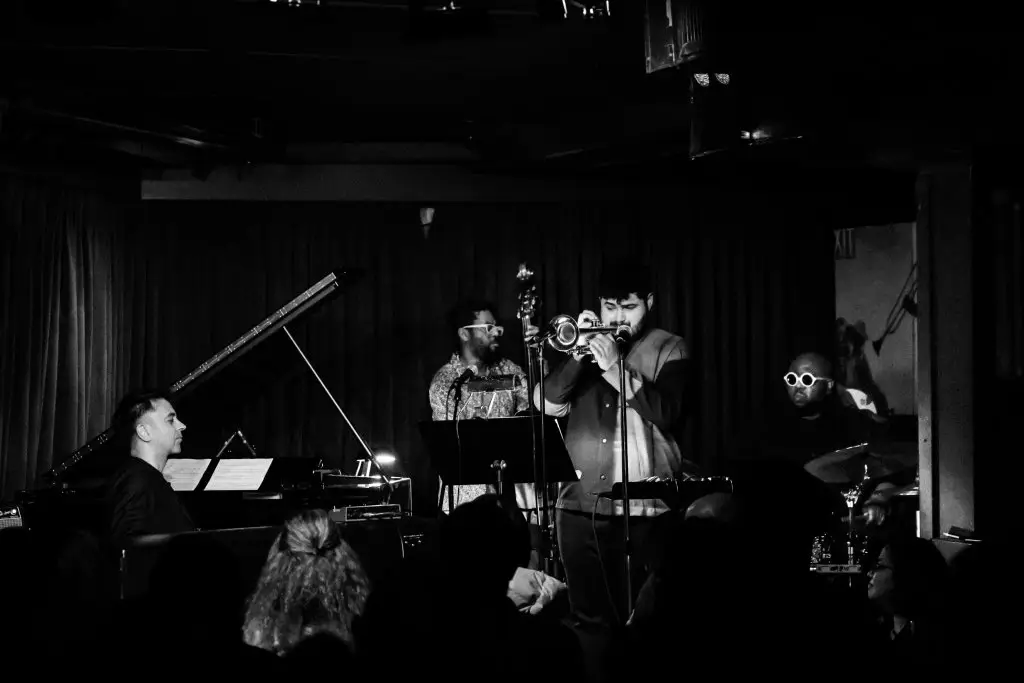
Vijay Iyer was born in Albany, New York, in 1971 and raised in Fairport, a suburb of Rochester — a geography that placed him squarely within the creative corridor of Upstate New York from the very beginning. The son of Tamil Indian immigrants, Iyer began violin training at age three under the Western classical tradition and picked up piano by ear as a child, largely teaching himself the instrument that would define one of the most decorated careers in contemporary jazz.
From Yale to Berkeley to the World Stage
Iyer completed an undergraduate degree in mathematics and physics at Yale University by age 20, then moved to the University of California, Berkeley, where he initially pursued a doctorate in physics before pivoting to earn an interdisciplinary PhD in the cognitive science of music. That fusion of scientific rigor and artistic exploration became his signature — a pianist who thinks in systems, patterns, and rhythmic complexity while playing with deep emotional immediacy. His academic work examined how the human body processes musical rhythm, research that directly informed his approach to performance and composition.
His recording career spans more than two dozen albums as a leader, including landmark releases on ACT, Pi Recordings, and ECM. Albums like Historicity (2009), Accelerando (2012), and Break Stuff (2015) earned him three Grammy nominations and established him as one of the most important voices in 21st-century jazz. His trio with bassist Stephan Crump and drummer Marcus Gilmore became one of the defining small groups of its era, praised for its rhythmic sophistication and intellectual daring. DownBeat magazine named him Jazz Artist of the Year four times — a distinction shared with only a handful of musicians in the publication’s eight-decade history.
Honors and Academic Legacy
The accolades are staggering in both breadth and prestige: a MacArthur Fellowship (the so-called “genius grant”), a Doris Duke Performing Artist Award, a United States Artist Fellowship, the Alpert Award in the Arts, the Greenfield Prize, a Dutch Edison Prize, and two German Echo Awards. In 2014, Harvard University appointed him the Franklin D. and Florence Rosenblatt Professor of the Arts, a joint tenured position in the departments of music and African American studies — one of the most prestigious academic appointments in the arts.
The New York Times has described Iyer as a “social conscience, multimedia collaborator, system builder, rhapsodist, historical thinker and multicultural gateway.” His work extends beyond the piano into multimedia installations, film scoring, and interdisciplinary collaborations. But before all of that, he was a kid from Albany who heard something in the piano that nobody else could hear — and spent a lifetime translating it for the rest of us. His Upstate New York roots remain a point of pride in a career that has taken him to every major concert hall and festival on earth.