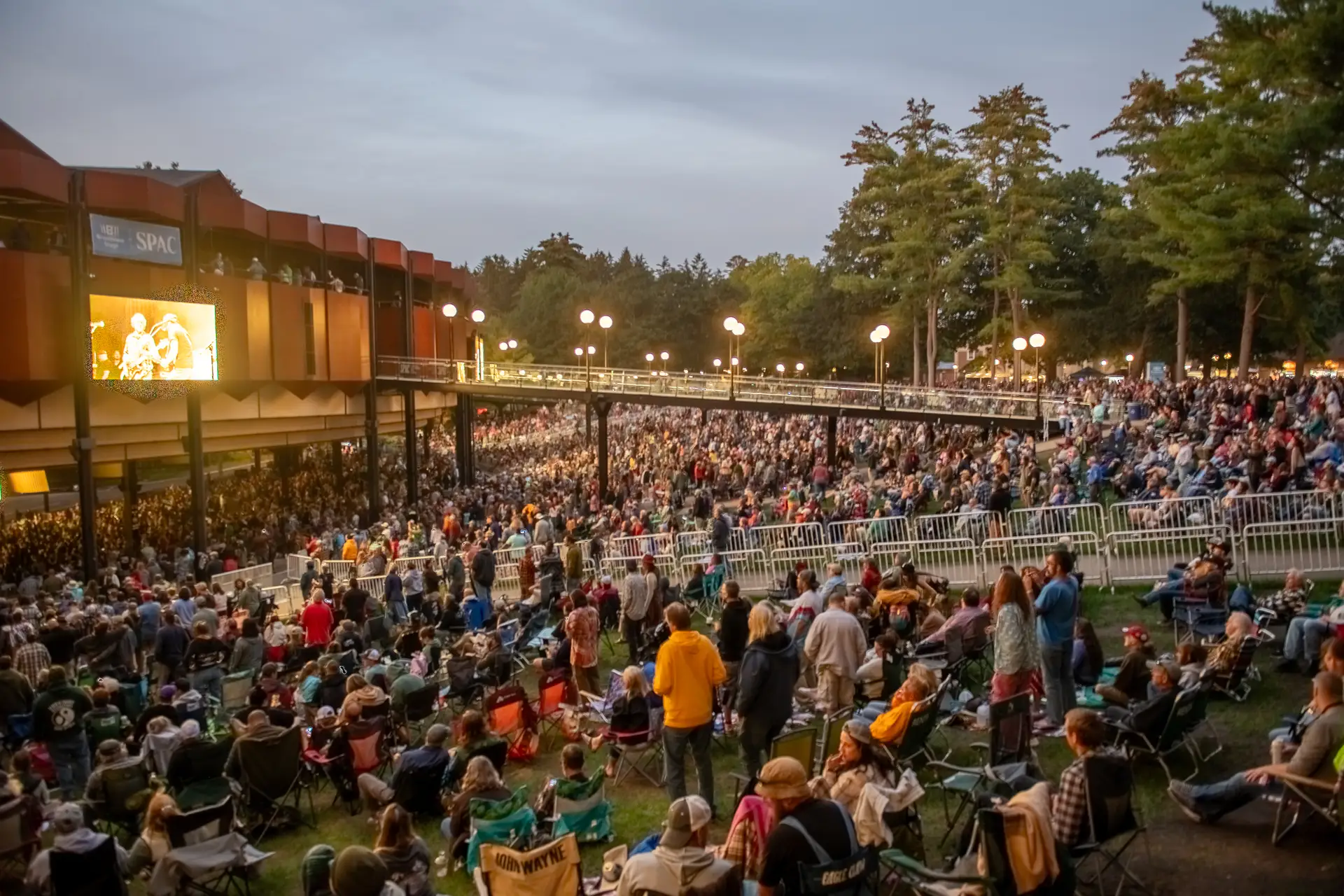
The lawn at the Saratoga Performing Arts Center makes its case for you somewhere around 8:15 on a Friday night in July. The headliner hasn’t gone on yet. The opener is doing a polite job in front of a crowd that isn’t quite paying attention. The sun has just dropped low enough behind the pines that the light comes in flat and orange across the slope, catching the underside of the cantilevered roof and turning the whole pavilion into something that looks less like a concert venue and more like a piece of mid-century optimism that somebody actually built. Twenty thousand people are settling onto blankets that are not quite where they want them, opening coolers, finding their friends, finishing the long walk back from the porta-johns. The breeze is doing what breezes do in Saratoga in July, which is moving but not hurrying. Then somebody two blankets over says something to somebody else and laughs, and you realize the lawn has gone quiet in the particular way it goes quiet right before the lights come down. That moment — the orange light, the pines, the cantilever — is what people who have been coming to SPAC for forty years are talking about when they say they cannot quit it.
I have been writing about live music in this region for more than twenty-five years, and I have spent more nights on that lawn than anywhere else on earth. I have also spent enough nights at other amphitheaters to know what the competition looks like. So I am going to make a claim, and then I am going to argue it.
The Saratoga Performing Arts Center is the best outdoor music venue in America. Not the most photogenic. Not the loudest. Not the most acoustically perfect on a per-decibel basis. The best — taking everything an outdoor venue is supposed to be and do, and weighing it against everything we have built in the seventy years since amphitheaters became a category. No other venue carries all four of the pillars I am about to lay down. SPAC does. Quietly, durably, and with the kind of regional matter-of-factness that makes the case harder to mount, because the people who know SPAC best tend to assume everybody already knows.
The Contenders
Any honest version of this argument has to start with the room SPAC is in. There is a small, real list of outdoor venues that get mentioned when American music critics get into this conversation, and each of them brings something undeniable.
Red Rocks Amphitheatre, outside Denver, has the geology — two 300-foot sandstone monoliths flanking a stage that exists, in some essential way, because a glacier put it there. There is no roof, no shell, no real argument with the natural acoustics. Red Rocks is the venue you put on the cover of the book.
The Hollywood Bowl has the history — a hundred-plus years of it, the LA Phil residency, the band shell recognizable from a quarter-mile away, and a public-private trust model that has kept the bookings serious. It is also a Los Angeles venue, with all the parking, freeway, and audience-attentiveness costs that implies.
The Gorge Amphitheatre in central Washington has the view — a curving lawn that drops toward a stage perched above the Columbia River, with cliffs in the middle distance that turn pink at sundown. It is the most cinematic outdoor venue in North America. It is also four hours from anywhere people live.
Tanglewood, in the Berkshires, is the closest thing to SPAC’s twin: a parkland setting, a classical residency (the Boston Symphony), a covered shed and a lawn, a serious institutional pedigree. It does not, however, host the touring rock and jam economy at scale.
Wolf Trap, outside DC, is the only national park in the country dedicated to the performing arts, and the Filene Center is a beautiful covered amphitheater. Bookings tilt heritage and acoustic; the parkland setting is genuinely wonderful. But the venue lives in the shadow of the capital, and the cultural footprint is regional rather than national.
Merriweather Post Pavilion, in Columbia, Maryland, has been quietly running one of the best mid-Atlantic booking sheets in the country for sixty years. The renovations of the last decade brought it back into the front rank. It is a serious, serious venue. It is also a venue people drive to on purpose, not one they travel to.
Each of these does one thing, sometimes two, at the highest level. SPAC does four. That is the argument.
Pillar One — The Setting
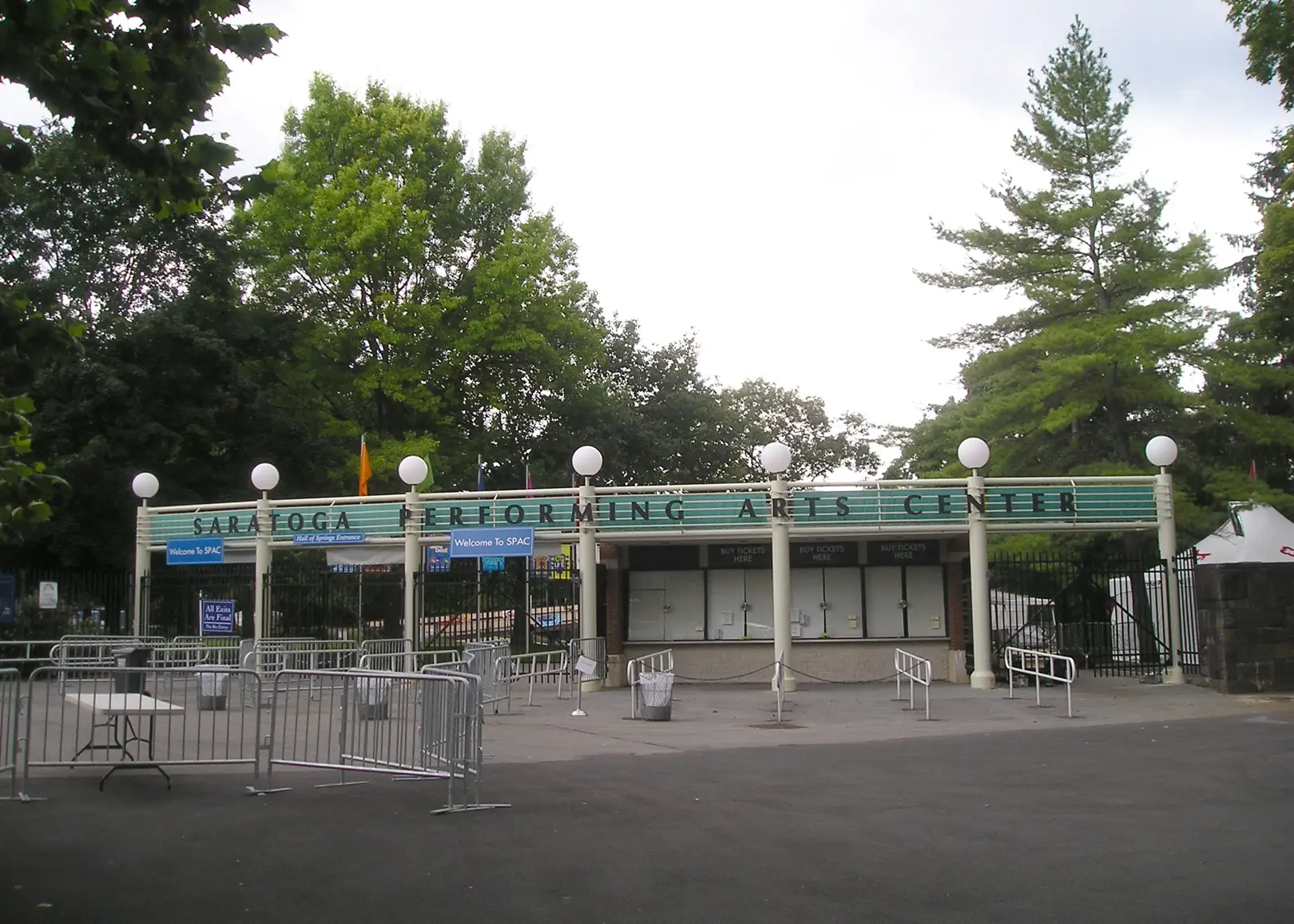
Saratoga Spa State Park is 2,400 acres of designed landscape — pines, hardwoods, hiking trails, picnic groves, the natural carbonated mineral springs that gave Saratoga Springs its name and its reputation, the Roosevelt Baths, the Gideon Putnam hotel, the Hall of Springs. SPAC is not next to the park. SPAC is inside the park. The amphitheater roof rises from a clearing surrounded by mature trees, and you cannot see it from any of the major approaches until you are most of the way to the entrance gate. Coming up Avenue of the Pines for the first time on a show night is a small revelation: the road bends, the trees thin, and the venue is suddenly, improbably, there.
No other major amphitheater in the country sits inside a state park of this scale. None has mineral springs on the grounds. None is across the road from a 1930s spa hotel built in the WPA era. The Hollywood Bowl is in a canyon next to a freeway. Red Rocks is in a county park with parking lots tiered up the hillside. The Gorge is at a winery. Wolf Trap, to its credit, is the closest comparison — but Wolf Trap is 130 acres against SPAC’s 2,400, and the Filene Center sits at the edge of the property rather than inside it. SPAC’s setting is unduplicable. You cannot replicate a 2,400-acre WPA-era state park with mineral springs by writing a check.
Pillar Two — The Roof
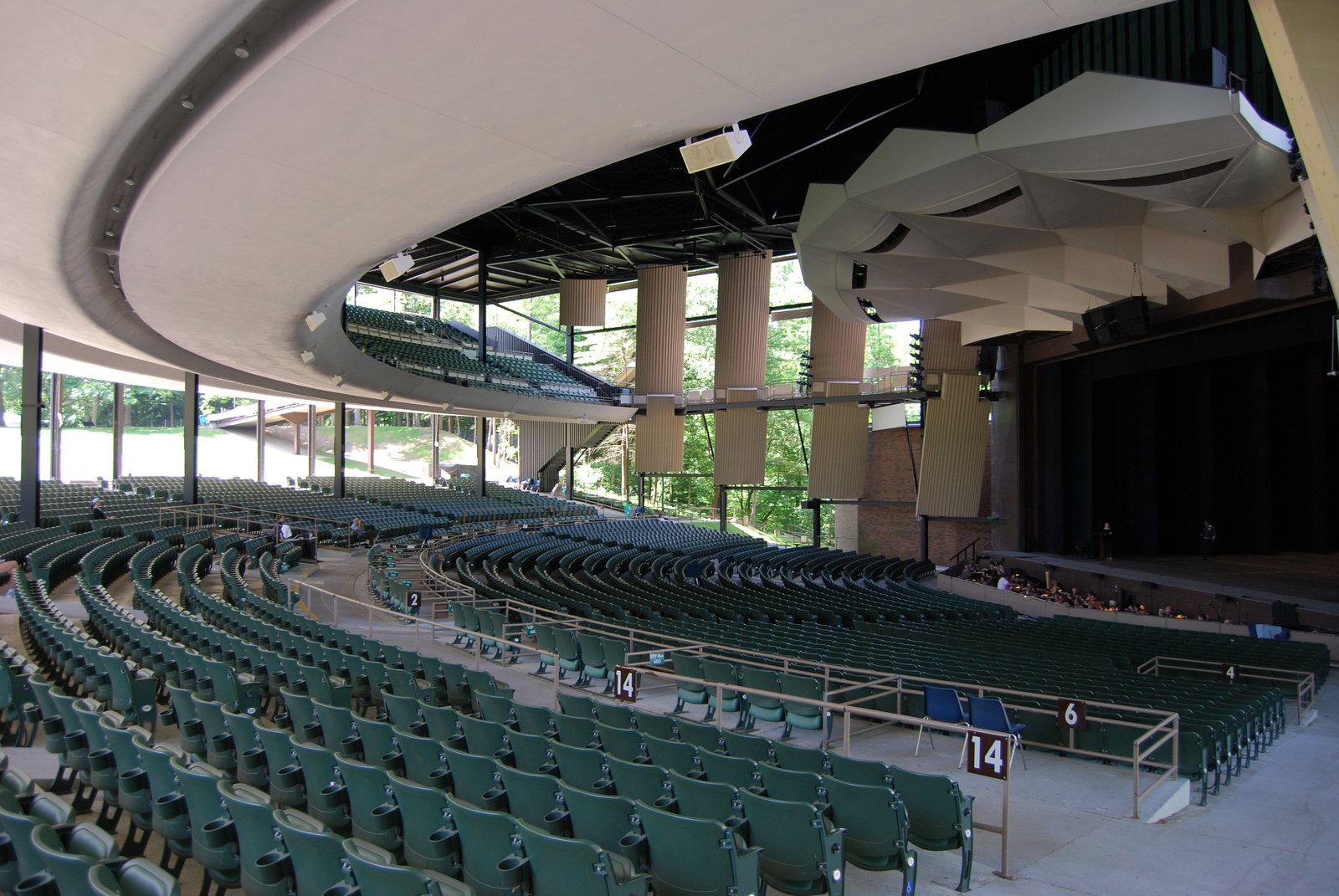
SPAC opened on July 9, 1966, with the New York City Ballet performing George Balanchine’s A Midsummer Night’s Dream. The original design seated 5,103 reserved beneath one of the most distinctive cantilevered shells in American performance architecture — a long, low pavilion that reads as a single bold gesture from any angle, with the sightlines and acoustic depth necessary to host orchestral and ballet repertoire. The lawn was added later. Current capacity is 25,103.
That number — 25,103 — is not a marketing number. It is the number SPAC settled on after the night when too many people came. We will get to that night.
What matters for the architectural argument is this: the pavilion was engineered for classical music first and rock-and-roll second. Most outdoor amphitheaters in America were built the other way around — designed for amplified touring product and asked, occasionally, to host an orchestra. SPAC was designed for Balanchine and the Philadelphia Orchestra, and it survived rock and roll, which turns out to be a different and harder problem. The cantilevered roof gives the pavilion a degree of acoustic continuity from the stage out to the front lawn that very few amphitheaters of this size manage. The distributed lawn speaker system, upgraded multiple times across the decades, picks up the rest of the slope without bouncing the mix off a wall of trees. You can stand at the back fence on the lawn at SPAC and hear a mix that holds together — not as well as inside the pavilion, but well enough that the lawn is not the consolation prize. The lawn is the experience. That distinction is part of why the venue still works.
Pillar Three — The Range
This is the pillar that decides the argument.
The New York City Ballet has been in residence at SPAC every summer since the venue opened. The Philadelphia Orchestra has been in residence every August. The Saratoga Jazz Festival has been an annual fixture for more than four decades, anchoring the venue’s late-June calendar with bookings that stand against any jazz festival in the country. That is the institutional layer.
On top of that institutional layer sits the touring rock economy, and the numbers tell the story.
The Doors played SPAC on September 1, 1968 — the first major rock booking on the property, and one of the last U.S. dates Jim Morrison played before the band’s European tour. The Grateful Dead drew 40,231 people on June 27, 1985 — the highest attendance figure in the venue’s history, the show that produced the modern capacity rules, and the show that got the band banned from SPAC for three years. (They came back on June 28, 1988, and were welcomed.) Dave Matthews Band played its 50th show at SPAC in 2025, with more shows sold out than any other artist in the venue’s history. Phish played SPAC for the 27th time in 2025 — a relationship that has now produced three-night runs in 2012, 2013, 2014, 2016, and again last summer. The 2025 three-night run drew the kind of crowds that turn the entire downtown into a Phish town for a week.
There is no other outdoor venue in America that anchors world-class ballet, a major orchestra residency, a heritage jazz festival, and a 27-show jam-band relationship that includes multiple sold-out three-night runs. Tanglewood comes closest on the classical side and does not engage the touring rock economy in any serious way. The Hollywood Bowl runs the LA Phil and books pop at the highest tier, but does not host a multi-decade jam-band residency on Phish’s scale. Wolf Trap covers the heritage end well and the rock end occasionally. Red Rocks runs through the touring rock economy at volume but does not maintain a ballet company or an orchestra residency. The Gorge is festivals and rock.
SPAC is the only outdoor venue in America where a 75-year-old subscriber to the New York City Ballet and a 25-year-old who drove up from Brooklyn for night two of Phish are sitting in the same parking field on consecutive evenings, eating from the same food trucks, drinking from the same mineral springs. That is not a marketing tagline. That is what an actual program looks like when it is built to last.
Pillar Four — The Weight
There is a kind of cultural weight a venue accumulates only by staying in one place, doing essentially the same job, for a very long time.
For a Capital Region kid, SPAC is the venue where you see your first show, your hundredth show, and the show you take your grandkids to. It is the venue your parents told stories about. It is where you spent the night you remember from the summer of 1996, and where you spent the night last August that you will remember in 2056. The local relationship is dense in a way bigger-market venues rarely manage. The Bowl is everybody’s venue and nobody’s. SPAC belongs to the people who keep showing up.
That accumulated weight is part of why a lawn ticket at SPAC means something different from a lawn ticket somewhere else. You are not just buying a place to sit for three hours. You are buying into a continuous cultural project that began before most of us were born and will, with luck, outlast all of us. Some venues are buildings. SPAC is closer to an institution.
The 1985 Dead Show as Origin Myth
Every great venue has the night it almost broke, and SPAC’s was June 27, 1985. The Grateful Dead were the band, and the official attendance figure was 40,231 — somewhere on the order of 17,000 over the venue’s intended capacity. Traffic in and around Saratoga Springs resembled, if you squint, the footage from Woodstock; the surrounding state park was overrun with fans who had no tickets and assumed they would simply walk in (a not-unreasonable assumption based on Dead-show etiquette of the era). The pavilion balcony was breached. The band, to its credit, played a serious show. Garcia and company turned in a set that fans still trade. And then SPAC banned the Dead for three years.
The interesting thing about that night is not that it was chaos — plenty of venues have had chaos nights. The interesting thing is what the venue did with it. SPAC did not pretend it had not happened. SPAC also did not let it become an excuse to dial back its ambitions. What it did was set a hard capacity (25,103) and enforce it. Then, when three years had passed and the Dead were ready to come back, it let them come back. The ban proved SPAC took itself seriously enough to police its own rules. The return proved the venue was not interested in punishing its audience for loving the band.
That two-step — the seriousness and the welcome — is essentially the SPAC operating philosophy. It is how the venue has held its standards across sixty years of cultural shifts. It is also how it manages to host the New York City Ballet in July and Phish on the lawn in August without either constituency feeling like the venue has compromised on its account.
Why “Best in America” Isn’t Even the Most Interesting Claim
I started this piece with a claim — that SPAC is the best outdoor music venue in America — and I have spent twenty-five hundred words arguing it. The case is sound. But I want to close with something more interesting than the case itself.
The more interesting claim is that SPAC is the venue we would build if we were starting over. Imagine a clean sheet of paper. You have unlimited budget, unlimited acreage, no zoning constraints, and the cooperation of every booking agent in the country. You sit down to design the perfect outdoor venue from scratch.
You would put it inside a state park. You would build a covered pavilion seating roughly 5,000 with a long sloping lawn behind it for another 20,000. You would engineer the roof for orchestra first and rock second. You would partner with a major ballet company and a major orchestra to anchor a serious institutional calendar. You would book the biggest rock and jam acts in the country on top of that calendar. You would let the venue earn the kind of trust from its audience that only happens when you do the same thing well, in the same place, for sixty years.
Then you would step back and realize you had just designed SPAC.
The 2026 season opens late May with the annual season-kickoff fundraiser, with the first major outdoor weekend stacked behind it: Jack Johnson on June 24, James Taylor on June 29, Santana and the Doobie Brothers on July 1. Goose plays a two-night run on July 3 and 4, the unofficial start of the holiday weekend. Dave Matthews Band returns July 17 and 18 for what will be the band’s 51st and 52nd performances on the property. Guns N’ Roses plays July 26. Mötley Crüe — with Tesla and Extreme on the Carnival of Sin tour — closes July on the 29th. The Philadelphia Orchestra residency runs through August, and the New York City Ballet opens its summer residency with A Midsummer Night’s Dream on opening night, the same Balanchine ballet that opened the entire venue back in July of 1966. Sixty years on, the same first piece. Almost nobody else is built to do that.
For the service-side details — parking, lawn-chair rules, the pre-show walk through downtown, the right place to eat before a show — see the SPAC venue guide we published earlier this year. This piece is the argument. That piece is the manual.
Get a lawn ticket. Bring a blanket. Get there before the gates open if you are choosy about the slope. And take the long way home through the park afterward, with the pines on either side and the roof receding behind you. You will understand, by then, why the people who know this venue best stop arguing about whether it is the best outdoor venue in America. They just keep coming back.
Disclosure: Some links in this article are affiliate links. Upstate Concerts may earn a commission on ticket purchases at no additional cost to you.