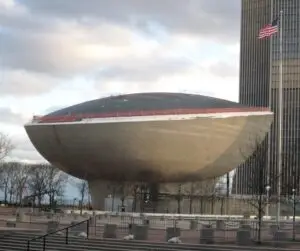
Nelson Rockefeller was looking at his breakfast. That, at least, is how the story has been told around Albany for decades: the governor at the table with his chief architect, Wallace Harrison, hunting for a way to break up the relentless verticality of the eleven towers and slabs he’d commissioned for his Empire State Plaza, and landing on the grapefruit in front of him, topped with an overturned coffee cup. Some tellings swap in an egg standing on end in a cup instead — the details shift depending on who’s telling it — but every version ends the same way: a request for a building that looked like *that* (All Over Albany). What the state built was officially named the Meeting Center, intended for the kind of town-hall gatherings the sixties imagined state government might want. The public looked at it and called it something else immediately, and Rockefeller — who reportedly hated the nickname at first — eventually gave in (All Over Albany). Albany has called it the Egg ever since, and forty-eight years after it finally opened, it remains one of Upstate New York’s strangest, most durable rooms to see a show.
Twelve Years to Build a Building Nobody Planned to Take This Long
“Empire State Plaza Rededication Ceremonies, 1978,” via the New York State Archives (NYSA_13700-83a).
Construction on the Egg began in 1966, as part of Rockefeller’s massive Empire State Plaza urban-renewal project — a wholesale reconstruction of downtown Albany’s South Mall into a modernist complex of government towers (theegg.org, Wikipedia). The Plaza’s other buildings went up on something closer to a normal schedule — the Legislative Office Building was finished in 1972 — but the Egg, with its exposed, self-supporting concrete shell, was a genuinely novel engineering problem, and it became the last piece of the Plaza to open, not finished until 1978 (Wikipedia — Empire State Plaza). Twelve years from groundbreaking to opening night, for a building the state had once hoped to complete in a fraction of that time.
The opening itself is where the record gets genuinely tangled, and it’s worth being straightforward about that rather than picking a date that merely sounds authoritative. The Egg’s own history page and its Wikipedia entry agree that it “debuted to the public on Memorial Day” in May 1978, with the Empire State Youth Theatre Institute’s staging of “Peter Pan” as the building’s inaugural performance (theegg.org, Wikipedia). The New York Times covered it in real time: an April 19, 1978 preview noted that “Peter Pan” would “mark the inaugural performance in the Egg during the opening ceremonies over Memorial Day weekend,” and a follow-up on May 28, 1978 reported that “on Friday, the final structure, the uniquely designed inverted oval Meeting Center commonly referred to as ‘the egg,’ was officially inaugurated” — which lines up with Friday, May 26, 1978, inside that same Memorial Day weekend (New York Times, April 19, 1978, New York Times, May 28, 1978). A handful of secondary listings float a different date, May 12, 1978, with no primary source attached to it; given the two contemporaneous Times pieces and the venue’s own account all pointing to that Memorial Day weekend, that’s the version this piece is built on. A separate, larger ceremony rededicating the entire completed Plaza — with Rockefeller himself, Governor Hugh Carey, Lieutenant Governor Mary Anne Krupsak, and Kitty Carlisle Hart on hand — followed months later, on October 6, 1978 (New York State Archives).
A Building That Floats on a Six-Story Stem
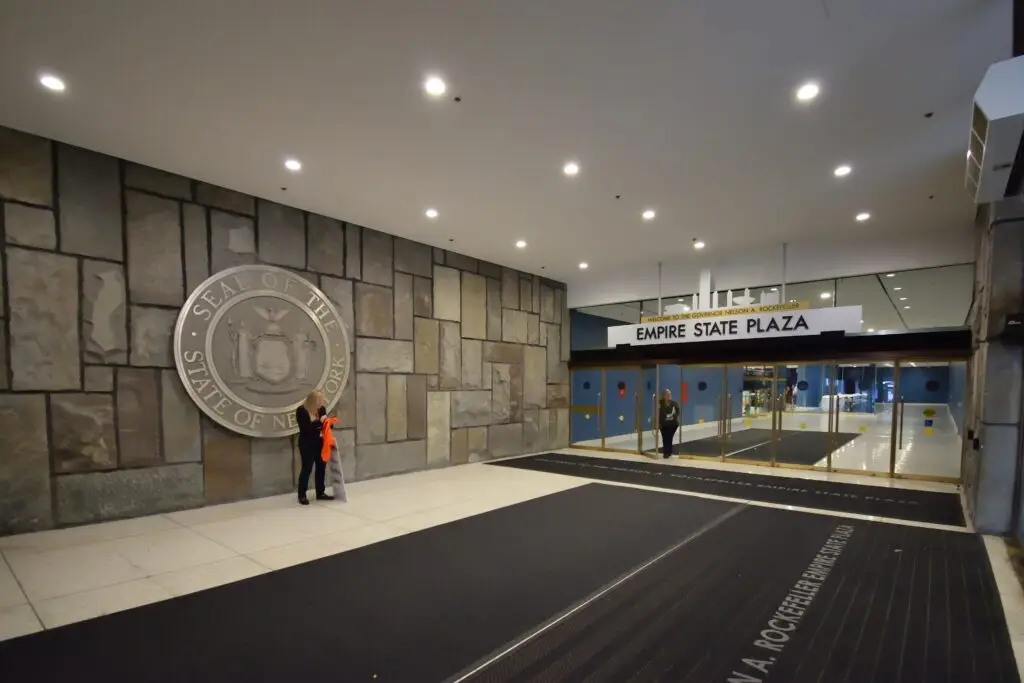
However murky the calendar, the engineering is not in dispute, and it’s the reason the Egg still stops people on the plaza forty-eight years on. The entire concrete shell rests on a single stem that runs six stories straight down into the earth, with a heavily reinforced concrete “girdle” beam wrapped around the widest point of the shape, distributing the building’s full weight down onto that narrow pedestal — the structural trick that lets an enormous concrete egg appear to hover just above the plaza floor (theegg.org, The Clio). It’s also the only building on the entire Empire State Plaza left in exposed concrete rather than clad in stone, and the only one built in the rounded Brutalism of the Egg rather than the rigid International Style of the towers around it — a deliberate architectural outlier inside Rockefeller’s own showpiece (Wikipedia — Empire State Plaza).
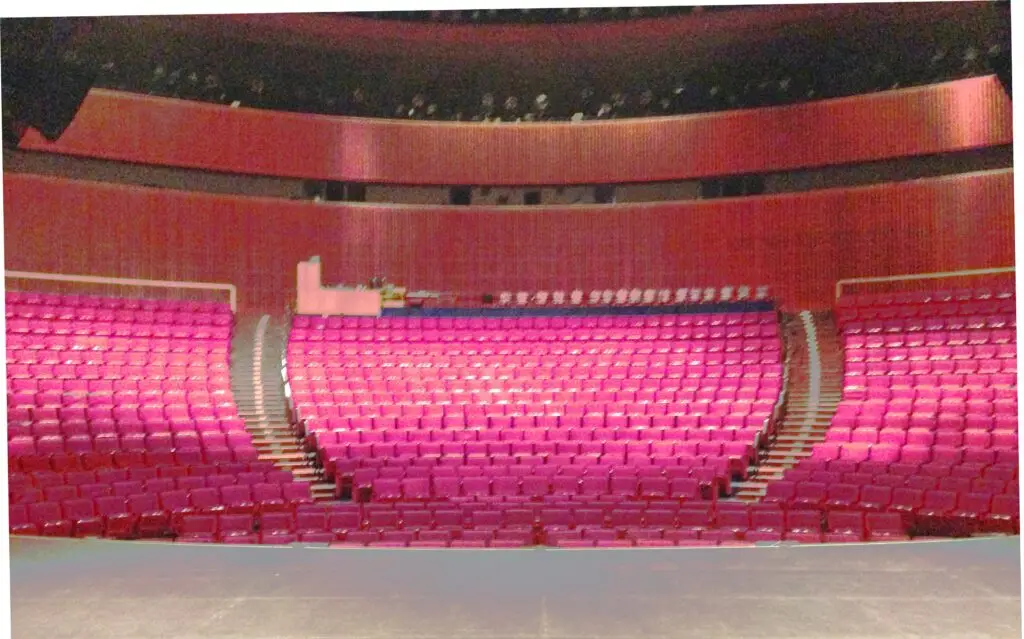
Inside, the curve never lets up. There are no hard corners anywhere in the building — walls, hallways, and theater interiors all follow the shell’s continuous arc, finished in Swiss pearwood veneer chosen as much for warmth as for acoustics (theegg.org). The two performance spaces carved into that shell are the 450-seat Lewis A. Swyer Theatre, built for chamber music, cabaret, and intimate solo shows, and the 982-seat Kitty Carlisle Hart Theatre, sized for full bands, comedy headliners, dance, and touring musicals (theegg.org, Wikipedia). Both rooms were built with fan-shaped, curved seating rows rather than a traditional straight-on proscenium layout — a choice the building’s construction supervisor, John Byron, has said was meant to pull an audience physically closer together than a conventional theater does (Wikipedia). The Hart Theatre is named for Kitty Carlisle Hart, the Broadway and television performer who chaired the New York State Council on the Arts and stood on stage for the building’s opening; the Swyer for Lewis A. Swyer, the Albany-area builder and civic figure who championed the Plaza’s arts programming.
Legends on a Concrete Stage
For a room the size of a mid-sized theater, the Egg’s guest list reads improbably large. Buddy Guy played the Hart Theatre on November 11, 2015 (setlist.fm). Gordon Lightfoot, Chaka Khan, David Byrne, Leon Russell, Marty Stuart, Eric Burdon, WAR, and the Byrds’ Roger McGuinn have all worked the room over the decades, alongside comedians Margaret Cho and Brian Regan and dance companies including the Mark Morris Dance Group (Wikipedia). Dave Chappelle, Whitney Cummings, Louis C.K., and Nate Bargatze have all done stand-up there, and the music side has ranged from Gregg Allman and Cheap Trick to Sharon Jones, the Barenaked Ladies, Tedeschi Trucks Band, Kris Kristofferson, and the Tragically Hip (NYS Music, 1045 The Team, WPDH).
The single strangest, best-documented chapter belongs to King Crimson. Robert Fripp’s notoriously particular band, which almost never plays American rooms this size, booked the Egg in September 2014 and again in August 2021 (setlist.fm, 2014, setlist.fm, 2021). The August 22, 2021 show turned out to be King Crimson’s final North American performance, and the band’s own label released it on the live album “Music Is Our Friend: Live in Washington and Albany,” which devotes four of its tracks specifically to that Albany night (Wikipedia). Phish bassist Mike Gordon left the Egg with a souvenir of his own: after playing the room repeatedly between 2011 and 2018, he named an entire live album after it, recorded there on December 11, 2011 and released simply as “The Egg” (Wikipedia, NYS Music).
Home to a Youth Theater, a Rep Company, and a Dance Troupe
Music has never been the whole story here. The Empire State Youth Theatre Institute was the Egg’s first resident company, staging that inaugural “Peter Pan” in the opening week of 1978, and Capital Repertory Theatre — years before it moved into its own downtown building — made its debut on the Egg’s stage in March 1980 with George M. Cohan’s “The Tavern” (Wikipedia). The Ellen Sinopoli Dance Company became the Egg’s resident dance troupe in 1990 and has kept performing there for decades since, and the Ajkun Ballet Theatre has held a summer residency since 2000 (Wikipedia). It’s a resume that captures what the building’s shape was always arguing for: one room, reconfigured constantly, for whatever New York’s artists needed it to be that week.
The Room Today
The Egg is managed today by the nonprofit Nelson A. Rockefeller Empire State Plaza Performing Arts Center Corporation, which has run it since 1979 (Wikipedia). It closed in the summer of 2025 for its first major overhaul since it opened — a $19.5 million renovation, led by Fred Basch Architect, that replaced seating in both theaters, installed new carpeting and a fully automated LED lighting system, added induction-loop assistive listening in both rooms, and expanded accessible seating and restrooms (ArchDaily, Spectrum News). It reopened on January 8, 2026 with a free public “hatching” celebration — live music, an aerial performer, and a ribbon-cutting that morning before the doors opened to everyone (Chronogram). Today’s Egg still runs on the same premise it opened with in 1978 — two curved, corner-less rooms inside a building that was never supposed to look like anything else on the Plaza, hosting whatever the Capital Region wants to put on its stage next. The grapefruit worked out fine.
Photo & Video Credits
- Photo: Beyond My Ken / Wikimedia Commons (CC BY-SA 4.0)
- The Hart Theatre house, seen from the stage. Photo: Beyond My Ken / Wikimedia Commons (CC BY-SA 4.0).
- The stem the whole building rests on. Photo: Schvaxet / Wikimedia Commons (CC BY-SA 4.0).
- “Empire State Plaza Rededication Ceremonies, 1978,” via the New York State Archives (NYSA_13700-83a).