On the afternoon of July 27, 1973, Robbie Robertson asked Bill Graham if The Band could run a soundcheck.
This was the day before the show. The promoters — Shelly Finkel and Jim Koplik, two kids out of Connecticut who had recently put on a Grateful Dead show in Hartford that gave them ideas — had booked a one-day festival at the Watkins Glen Grand Prix Raceway in the Finger Lakes for the following afternoon. Three bands: the Dead, the Allman Brothers, The Band. They had sold roughly 150,000 advance tickets at ten dollars each. They were ready for a big crowd.
The crowd that arrived was 600,000 people, and most of them were already there a day early.
Bill Graham looked at the field. The field looked back. He shrugged and let the soundcheck happen. The Dead played what amounted to a full second show — including an unannounced nineteen-minute jam that landed on the band’s So Many Roads box set in 1999. The Allmans played. The Band played. Half a million people watched a soundcheck that wasn’t supposed to be a concert and is now one of the most famous unbilled performances in American music history.
That is the day Upstate New York’s festival culture got fully formed. Not Woodstock — Woodstock was the prologue. Watkins Glen was the proof. By the next afternoon, when the actual festival happened, the Summer Jam at Watkins Glen had become the largest single-day pop festival audience the world had ever assembled, holding the Guinness Book of World Records entry for “largest audience at a pop festival” for years afterward. (It was eventually eclipsed by Rod Stewart’s free 1994 New Year’s Eve show on Copacabana Beach in Rio, which drew an estimated 3.5 million — but that was a beach concert, and Watkins Glen was a ticketed pop festival, and the comparison isn’t really the same animal.)
That is what Upstate festival culture is. It is the place where the ceiling on what a music gathering could be got lifted past everyone’s expectations, twice in four years, and where the template for the modern American festival got written into the landscape.
It hasn’t stopped happening since.
Why Here
Pull up a map. Drag your finger from New York City northwest along the Thruway. You’re in Sullivan County in two hours, the Catskills in three. Boston is four. Philadelphia is four. The northeastern population corridor — the densest concentration of people in North America — drains toward Upstate New York along a handful of highways that point exactly the right direction.
The geology itself is the thing. The Catskills are a dissected plateau — rivers cut deep valleys into a high tableland and what’s left is a series of natural bowls. Stand on a Hunter Mountain ski slope or look at the topographic map of Bethel and you see what they are: amphitheaters. The land does the acoustic work. The Adirondacks add the other ingredient — remoteness. The kind of drive that makes getting to a festival feel like a pilgrimage rather than an errand. By the time you’ve cleared the last gas station and started seeing campsite signs, you’re emotionally invested. The journey is part of the show.
There is one more layer that doesn’t get enough credit, and it’s the one I want to argue for: the Borscht Belt. From the late nineteenth century through the 1960s, Sullivan County and the western Catskills hosted what at peak amounted to more than a thousand resort hotels and bungalow colonies serving Jewish New Yorkers who were largely shut out of the rest of upstate’s hospitality industry. Grossinger’s, the Concord, Kutsher’s, the Nevele — resorts with nightclubs, ballrooms, and outdoor stages running a constant calendar of comedians and singers. The most-cited cultural inheritance is comedy. Less remarked is the physical infrastructure: a region that had, for fifty years before rock and roll showed up, normalized the idea of building stages in the Catskills and putting people in front of them. By the 1960s the resorts were dying off, but the venues and the regional muscle memory of “Catskills + stage + crowd” were already there for the next thing to use. (To be clear: I have not seen a music historian draw a direct line from the Borscht Belt resort stages to the festivals that came after. Take this as argument, not received history.)
Put it together: a population funnel from three of the largest cities in America, road infrastructure pointing the right direction, geological bowls that work as natural amphitheaters, remote enough to feel like a destination, and a half-century head start on entertainment infrastructure. The conditions for festivals existed before festivals did. When the late-1960s counterculture went looking for somewhere to put 100,000 people in front of live rock, Upstate New York was structurally inevitable.
Woodstock ’69 — The Origin Myth
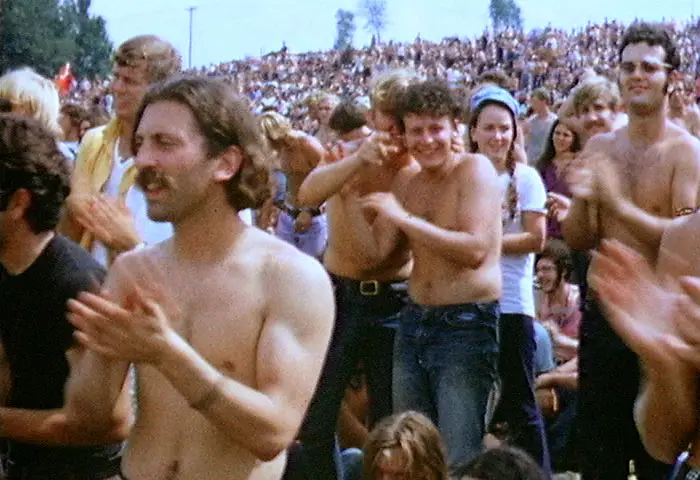
The Woodstock Music and Art Fair ran August 15 to 18, 1969, on Max Yasgur’s dairy farm in Bethel — about sixty miles southwest of the actual town of Woodstock, which had denied permits, as had nearby Wallkill. Roughly 460,000 people showed up. The fences came down. The festival became a free concert. The food and medical infrastructure failed. The music — Hendrix, Joplin, The Who, Sly, the Dead, Santana, CSNY, Joe Cocker, Richie Havens, Janis Joplin again because we should say her name twice — overcame all of it. Michael Wadleigh’s 1970 documentary turned a logistically catastrophic weekend into permanent cultural mythology.
Upstate Concerts has covered the Woodstock-to-Bethel-Woods arc in detail elsewhere — the half-century from Yasgur’s field to the modern Bethel Woods Center for the Arts, which now sits on the original site as a year-round performing arts campus. What matters for this piece is what Woodstock did to the cultural template, not what it did to one venue. It established two things at once: that Upstate New York could absorb half a million people for a weekend without coming apart at the seams, and that the dominant story afterward could be one of community rather than chaos. Both lessons mattered for what came next.
Watkins Glen ’73 — The Sequel No One Talks About
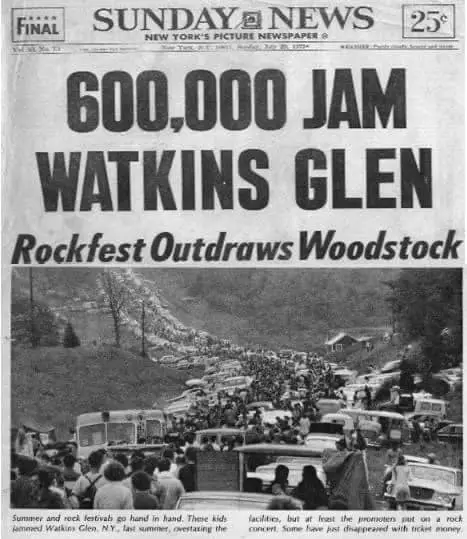
Four years and eleven months after Woodstock, the same lesson got tested again at scale, and this time it produced a record that stood for two decades.
Finkel and Koplik had a relationship with the Grateful Dead that traced back to a 1972 show they had promoted in Hartford. They wanted to do something bigger. They convinced the Dead, the Allman Brothers, and The Band to share a single bill on July 28, 1973, at the Watkins Glen Grand Prix Raceway — a Formula One circuit in the Finger Lakes that had hosted the United States Grand Prix and was therefore set up for moving large numbers of vehicles in and out, which turned out to matter.
Tickets were $10. Advance sales were 150,000. The total crowd, when the gates effectively gave way to the inevitable, was 600,000 — about a third larger than Woodstock. The Guinness Book of World Records called it the largest audience ever assembled for a pop festival, an entry it held for years.
The setlist itself is a footnote next to the soundcheck story. The Dead played long, the Allmans played hot, The Band played tight. A thunderstorm broke during the Allmans’ set. Willard Smith, a 35-year-old skydiver from Syracuse, was killed when a flare ignited his jumpsuit. Two teenagers from Brooklyn — Mitchel Weiser and Bonnie Bickwit — disappeared hitchhiking to the festival in a case that has never been solved. These darker notes belong in the record.
The reason the Summer Jam never reached the cultural permanence of Woodstock comes down to one absence and one presence. The absence is a documentary. There was no Wadleigh-style theatrical film of Watkins Glen. The recordings exist — most famously the Dead’s soundcheck, released decades later — but no movie played in art-house theaters in 1974 and 1975 that turned the festival into something an entire generation could watch and re-watch. The presence, by contrast, was Woodstock itself: a four-year-old myth that any subsequent festival was inevitably going to be measured against, and that no festival was ever going to surpass in pure cultural-event terms, regardless of attendance numbers. Watkins Glen drew more people than Woodstock and is a tenth as famous. That is what mythology does to history.
The Revival Years — Woodstock ’94 and ’99
The temptation to redo Woodstock was always going to be irresistible, and the two attempts both ended up proving why it shouldn’t have been done.
Woodstock ’94 ran August 12 to 14 at Winston Farm in Saugerties, about an hour from the original site. Estimates put the crowd at around 350,000. It rained. It rained a lot. The festival became a mud event — the photos look like a Civil War battlefield with a stage. The lineup was strong (Nine Inch Nails covered in Saugerties mud is one of the durable visual moments of ’90s music), the chaos was relatively contained, and the dominant memory is muddy peace rather than disaster. Saugerties, in the Hudson Valley, fit the geographic logic. The festival worked, basically.
Woodstock ’99 did not work. Held July 22 to 25 at the former Griffiss Air Force Base in Rome, in central New York — about a hundred miles northwest of the original Bethel site — it drew somewhere between 220,000 and 400,000, with most reliable counts in the low 300,000s. The location was a tarmac. There was no shade. The water situation was catastrophic. The Limp Bizkit set on Saturday night turned violent. The Sunday-night closing — meant to be a Columbine candlelight vigil — became the fuel for bonfires that consumed audio towers and vendor booths. Three people died over the weekend (heat exhaustion, hyperthermia, and a vehicle strike on the way out). Five sexual assaults were officially reported, with the actual number understood to be significantly higher. HBO and Netflix have both since produced documentaries that walked through the failure in detail.
The lesson from the ’90s revivals is the one Bethel Woods, when it eventually opened, took most seriously: you cannot recreate a moment, but you can build a permanent place. If the original was lightning, the revival attempts were people standing on a rooftop in a thunderstorm holding a metal pole. The festival template Upstate New York invented in 1969 and confirmed in 1973 was not something you could just stage again. It needed to evolve.
The Modern Catskills Era — Mountain Jam, Camp Bisco, and the Festival-as-Vacation Model
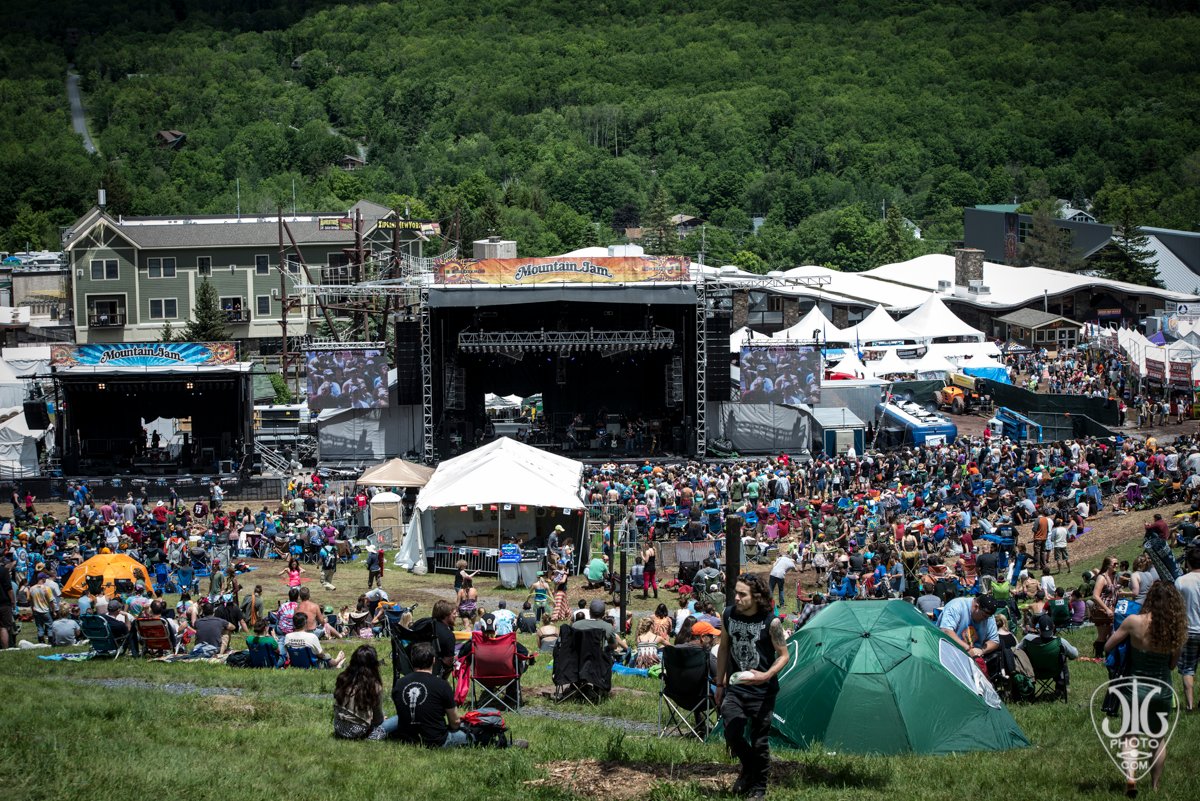
The modern era starts in 2005, when Gary Chetkof, the principal owner of the independent Hudson Valley radio station WDST (Radio Woodstock 100.1), founded a festival on the slopes of Hunter Mountain Ski Resort in Greene County. He called it Mountain Jam.
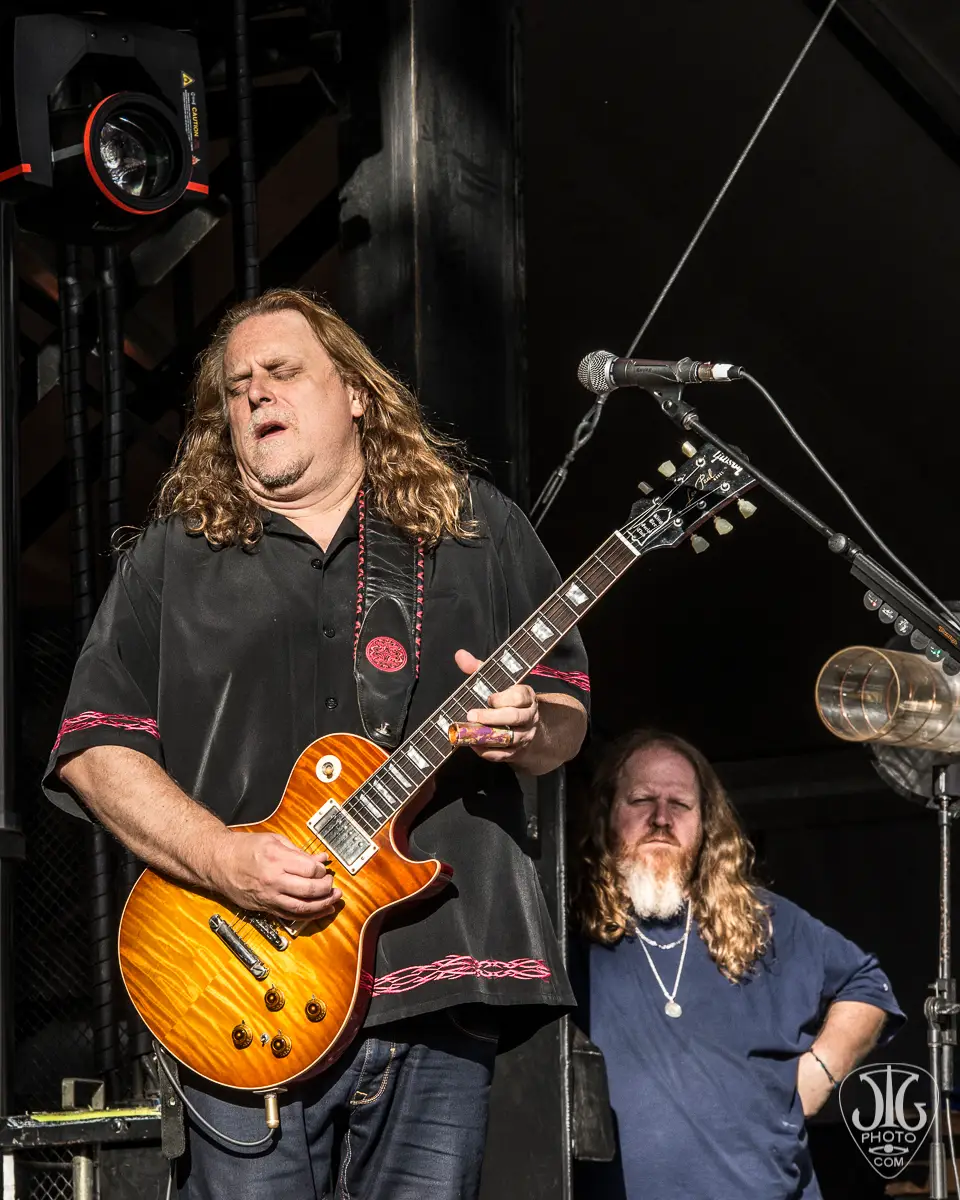
Mountain Jam was the blueprint for the second-generation Upstate festival: medium-scale (low five figures, not six), geographically anchored to a specific ski mountain, multi-day, camping-friendly, jam-leaning but musically broad. Chetkof founded it, but the festival’s musical center of gravity for most of its run was Warren Haynes — whose tenure with the Allman Brothers, Gov’t Mule, and Phil Lesh and Friends made him the unofficial patron saint of the modern jam scene. Gov’t Mule played the mountain year after year. Haynes anchored sets with Phil Lesh and Friends, with his own Warren Haynes Band, and with the rotating cast of guests that defined Mountain Jam’s curatorial DNA. He wasn’t the founder, but for most of the people standing on the slope at Hunter year after year, he was the festival — the through-line you came for, the bandleader whose presence told you what kind of weekend you were going to get. Mountain Jam ran at Hunter Mountain from 2005 through 2018, moved to Bethel Woods for the 2019 fiftieth-anniversary year, and then went into a six-year hiatus — partly COVID, partly the slow shifts in the festival economy that were squeezing mid-sized fests across the country.
It came back. Mountain Jam returned June 20 to 22, 2025, at Belleayre Mountain Ski Resort in Highmount, with Chetkof back as full owner. As of late 2025, Chetkof announced the festival would skip 2026, with eyes on a 2027 return. That cadence — return, recalibrate, sit out a year — is becoming common in the post-pandemic festival economy, and Mountain Jam is far from alone in working it out in real time.
Camp Bisco, the Disco Biscuits’ annual three-day convocation, is the parallel jam-festival institution. Founded in 1999, it has moved venues repeatedly — Indian Lookout Country Club in Mariaville, Bethel Woods, Pennsylvania, back to New York. The most recent iteration, branded Biscoland 2024, was held July 4 to 6, 2024, at Wonderland Forest in Lafayette, in Onondaga County. Whatever it’s called and wherever it lands in a given summer, Camp Bisco has stayed continuously active, which in the festival business since 2020 is itself an achievement.
Disc Jam Music Festival runs at Gardner’s Farm in Stephentown, on the Berkshires-facing eastern edge of Rensselaer County — a smaller, scrappier jam-and-electronic event that’s been a reliable fixture on the regional festival calendar through the 2010s and into the present.
What all of these share, beyond the music, is the festival-as-vacation model. You drive to a mountain, set up a tent, stay for three or four days. The festival isn’t a stop on a tour route — it is the destination. That model defined late-2000s American festival culture nationally, but it was an Upstate invention, refined on Catskill slopes by promoters who had Watkins Glen and Bethel in the cultural water supply.
Bethel Woods — The Permanent Festival
Bethel Woods Center for the Arts, which opened in 2006 on the original 1969 Woodstock site under cable executive Alan Gerry’s $150 million development, solved a problem the ’94 and ’99 revivals couldn’t: how to honor the original without trying to repeat it. The answer was a year-round venue with a 15,000-seat outdoor pavilion, a 1,000-seat terrace stage, an indoor hall, and the Museum at Bethel Woods. Programming runs the full calendar — symphonies, country tours, classic rock, jam runs, contemporary headliners.
The festival expression of all that infrastructure is Catbird Music Festival, which has run multi-day editions on the Bethel Woods grounds with lineups that lean Americana, indie, and jam-friendly — the 2025 edition, August 19 to 20, drew on Tyler Childers, the Trey Anastasio Band, Dispatch, the Lumineers, the War on Drugs, Charley Crockett, and a deep undercard. Catbird is the closest thing the modern era has to a “Bethel festival” — a multi-day, multi-stage event on the original Woodstock land — and the fact that it works without having to be Woodstock is the proof the venue’s curatorial approach has matured. (For the broader story of how the field became the venue, our piece on the Woodstock-to-Bethel-Woods evolution goes deep.)
The Contemporary Scene
The most interesting thing happening in Upstate festival culture right now is what’s replacing the mega-festival.
Phish at SPAC for a multi-night summer run is, in any meaningful sense, a festival. So is a four-night Dead & Company run when those happen. So are the multi-day jam weekends Hunter still books outside the Mountain Jam framework. So is a Bethel Woods Catbird weekend. The shift away from a single-weekend, 100,000-capacity event toward multi-night residencies at established venues is the third generation of Upstate festival culture: same instincts, smaller footprint, less risk, more sustainable.
This is good. The mega-festival model has been brittle since the early 2010s — see Woodstock 50, see the long list of national festivals that have folded. The residency model leans into what Upstate already has: world-class venues at SPAC, Bethel Woods, and Hunter; a concentrated audience that will travel across state lines for the right weekend; and a regional hospitality industry that knows how to handle three days of music tourism. (For how that scene has built itself into a continuous touring circuit, our Upstate jam band trail piece maps the venues.)
The summer 2026 calendar is the proof point. Catbird is expected back on the Bethel Woods grounds. Disc Jam will run in Stephentown. Camp Bisco will land somewhere — that’s part of its identity. Mountain Jam will sit it out, with a 2027 plan in the works. SPAC will host its usual run of multi-night residencies. None of these will draw 600,000 people. Together, they’ll move more music tourists through Upstate in a single summer than Watkins Glen did in a day — across a calendar that runs Memorial Day through October.
The Geography Hasn’t Changed
Why does Upstate keep being the place this happens?
Because the structural conditions that made it inevitable in 1969 and 1973 are still here. The Thruway hasn’t moved. The natural amphitheaters of the Catskills haven’t filled in. The population density of the northeastern megalopolis still drains north and west on summer weekends. The Borscht Belt architecture is mostly gone, but the regional muscle memory it created — the assumption that Upstate is a place where you build a stage and fill it — is permanent.
What’s changed is the scale. The 600,000-person ticketed pop festival is probably not coming back. What’s replaced it is a steadier, smaller, more durable festival culture that runs five months a year across a half-dozen sites, with multi-night residencies at flagship venues filling the gaps.
The template Upstate invented at Woodstock and Watkins Glen is now the template every state copies. Coachella, Bonnaroo, Lollapalooza in its destination-festival form, Outside Lands — all of them are, structurally, descendants of what Yasgur’s field and the Watkins Glen Grand Prix Raceway proved was possible. The fact that Upstate is no longer the biggest festival region in America is mostly a function of everywhere else finally catching up.
But the first festival region? The one that built the model, took the casualties, set the records, learned the lessons, evolved the form, and is still, in 2026, doing it across a half-dozen mountains and one extremely historic field?
That’s still Upstate.
The geography hasn’t changed. The Thruway hasn’t moved. Bill Graham would still let the Dead soundcheck for any 150,000 people who showed up early. And somewhere on a Catskill ski slope or a Finger Lakes raceway, somebody is right now figuring out what the next version of all this looks like.
I’m going. You should too.
Disclosure: Some links in this article are affiliate links. Upstate Concerts may earn a commission on ticket purchases at no additional cost to you.