The first time I found the spot, it was a Steve Winwood show at SPAC, second week of August, around 2003. I had been going to SPAC for nearly a decade and had spent every one of those summers parked in the wrong places — dead-center back, far house-right by the picnic tables, once almost directly behind the soundboard. That night, for whatever reason, I drifted forty feet up the slope from the front fence and twenty feet to the house-left of center, set my chair under a particular pine, and listened.
The cantilever roof was doing what it does — bouncing sound off its underside and out across the lawn in a way that cleans up the high end before it reaches you. The distributed lawn speakers were filling the back half of the slope without overpowering the front. The pine canopy broke up the late-afternoon glare. And for the first time in a decade of summers I understood that the lawn at SPAC is not one experience. It is dozens. Most are mediocre. A few are better than any pavilion seat in the building.
I have not sat anywhere else since.
The Premise
Lawn seating is not the consolation prize. At the right venue, with the right setup, in the right weather, the lawn is the better seat — cheaper, more air, and at the four venues this piece is concerned with, spots that pavilion subscribers would quietly trade for if they knew where they were. That is the part the first-timer’s primer cannot tell you. You only get it by being on these lawns for a long time, by sitting in the wrong places, and by paying enough attention afterward to figure out why.
I have been on these lawns for twenty-five years. Here is what I know.
SPAC — The Cantilever Sweet Spot
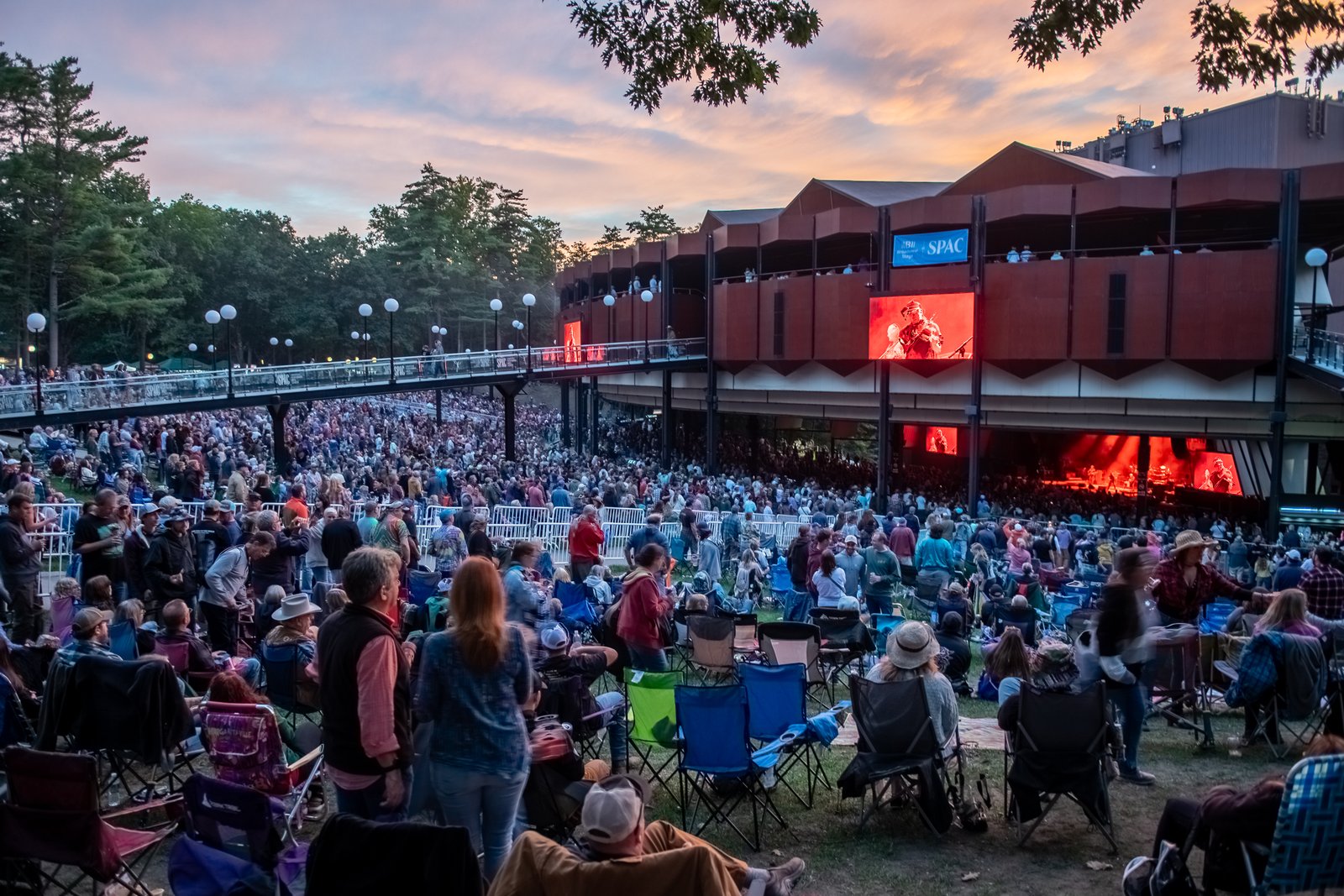
Start with the geometry. The cantilevered roof is the most consequential acoustic feature of any outdoor venue in Upstate New York, and almost nobody on the lawn thinks about it. They should. The roof angles sound downward and outward, and the first thirty or forty feet of slope sit inside the acoustic shadow of that overhang. Stage sound arrives there clean and direct, before the distributed lawn speakers — which fill the back half of the slope — ever fire.
The sweet spot is about fifty feet up from the front fence, slightly house-left of center, under the pine canopy. You get the roof’s direct sound, a clean sightline through the open back of the pavilion, and tree cover until the sun drops behind the pines around 8 p.m. on a July show — which matters more than people admit when they have been baking for two hours.
What to avoid: the area directly behind and slightly up-slope from the soundboard tower. There is a meaningful dead zone there — the speaker arrays are aimed past the mixer, not at him — and the symmetry-loving instinct that puts you there is the wrong instinct. I lost a Wilco show to this position in 2007 and have warned people off it ever since. Avoid the deep back fence too, unless you are genuinely there for the picnic-and-conversation experience; the speakers handle it well enough, but you will feel removed from any show with a real visual component.
The chair situation has changed materially, and every veteran needs to know this. For Live Nation–produced shows — most of the rock and pop calendar — outside chairs are no longer permitted. You either rent one of SPAC’s chairs through your Live Nation upgrade (27.6 inches square, 30.5 tall) or you sit on a blanket. For SPAC-produced events — the New York City Ballet, The Philadelphia Orchestra, SPAC’s own classical and jazz programming — your own chair is fine, with a 43-inch overall height limit and a stricter 26-inch limit on the center lawn. If you have not been in two seasons and you are still planning to bring your old camp chair to a Phish show, you are about to have a bad time at the gate.
A Phish night and a Philadelphia Orchestra night are different physics problems on the same lawn. The Phish lawn fills early and rewards arriving at gates. The orchestra lawn fills slowly, never to capacity, and a 6:30 arrival for an 8:00 downbeat gets you any spot you want.
Bethel Woods — The Slope and the Field You Cannot Sit On
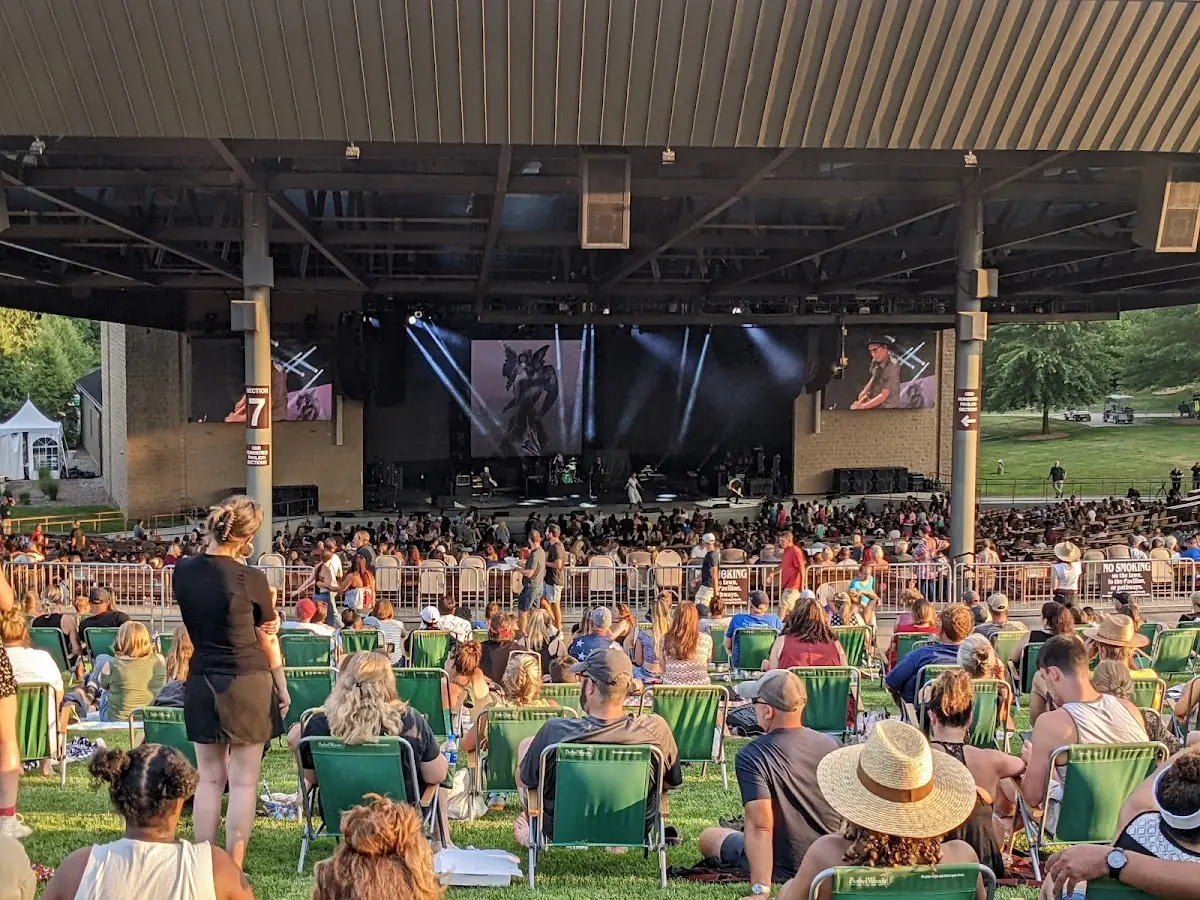
Bethel Woods’s lawn is the most architecturally honest of the four. The hill is a true bowl — not steeply graded but consistently graded — and the sightlines from anywhere along the centerline are good. Most amphitheater lawns have at least one geometric problem. Bethel’s does not.
The right spot is center-rear, about two-thirds up the slope. Center because the bowl is symmetrical and the off-axis sides genuinely lose stage information. Rear because the pavilion roof eats more of the upper stage from the lower lawn than you realize — walk fifty feet up and the lighting rig opens up. Two-thirds rather than at the back fence because the smoking section is at the top, which is a perfectly civilized arrangement for the people who want it but a consideration if you don’t.
Bethel has shifted to a no-outside-chairs model across the entire calendar — there is no equivalent at Bethel of SPAC’s classical-side carve-out. Rentals are available at the box office and at the lawn chair tent at the top of the lawn, and a Season Lawn Pass includes a rental barcode per event. Bring a blanket if you do not want to rent — it is your only other option.
Now about the historic field. The brief I started this article with assumed you could sit on the original Woodstock ’69 hill — the field where Hendrix played the anthem at dawn — during shows at the modern amphitheater. You cannot. The historic site is preserved as a museum experience, accessed via paid self-guided tour ($10) or guided golf cart tour ($19.69), and explicitly not available on concert show days. A “Historic Site + Tour” combination (available on Pavilion concert days) gets you on the field on a show day with a guided component, but you are not wandering the hill on your own with a blanket and a beer. The field is treated, correctly, as the consecrated ground that it is.
This is not a knock — protecting the most significant piece of music-related American landscape outside Memphis from the daily wear of an amphitheater crowd is the right call. But for the veteran’s purposes: the modern bowl is where you sit, the historic field is where you go on a separate non-show-day visit, and conflating the two will lead you to a locked gate.
Artpark — The Wind Problem

Artpark’s amphitheater sits at the top of the Niagara River Gorge in Lewiston, and the gorge is the entire story — visual, acoustic, and comfort. On a clear August evening with the sun setting over Canada, no concert setting in Upstate New York is more dramatic. On the wrong night, the gorge will eat your show.
Wind is the variable. The river runs north-south at Lewiston, the amphitheater opens to the south, and the gorge channels air with regularity. Light wind cools you off and the show is better for it. Building wind pulls high-end sound away from the back half of the lawn and across the gorge, and you get the muddy bass-heavy version. There is no fix from the lawn. The seated bowl is geometrically protected. The lawn that spreads beyond it is not.
The optimization is to sit as close to the seated amphitheater as the lawn allows. Front-of-lawn is meaningfully better than mid-lawn or back-of-lawn for sound because you are still inside the bowl’s acoustic envelope. This contradicts the intuition that more space is better — at Artpark, more space means more wind exposure and more sound loss.
The other optimization is arrival timing. The venue is compact, the seated tickets fill first, and only then does the lawn start filling. Thirty minutes after gates open, the front-of-lawn premium spots are gone. Arrive at the gate when it opens at 5 p.m. and you can claim a position right behind the seated bowl that is the closest thing Artpark has to a hidden seat.
Chair policy is event-dependent: small chairs permitted at most shows when removed from the bag, one per person, no director-style or footrest chairs; some shows ban outside chairs entirely. Small blankets — capped at two by four feet, one per person — are permitted at all shows. Bring layers regardless of forecast. The gorge has its own microclimate.
Highland Bowl — The Park Show
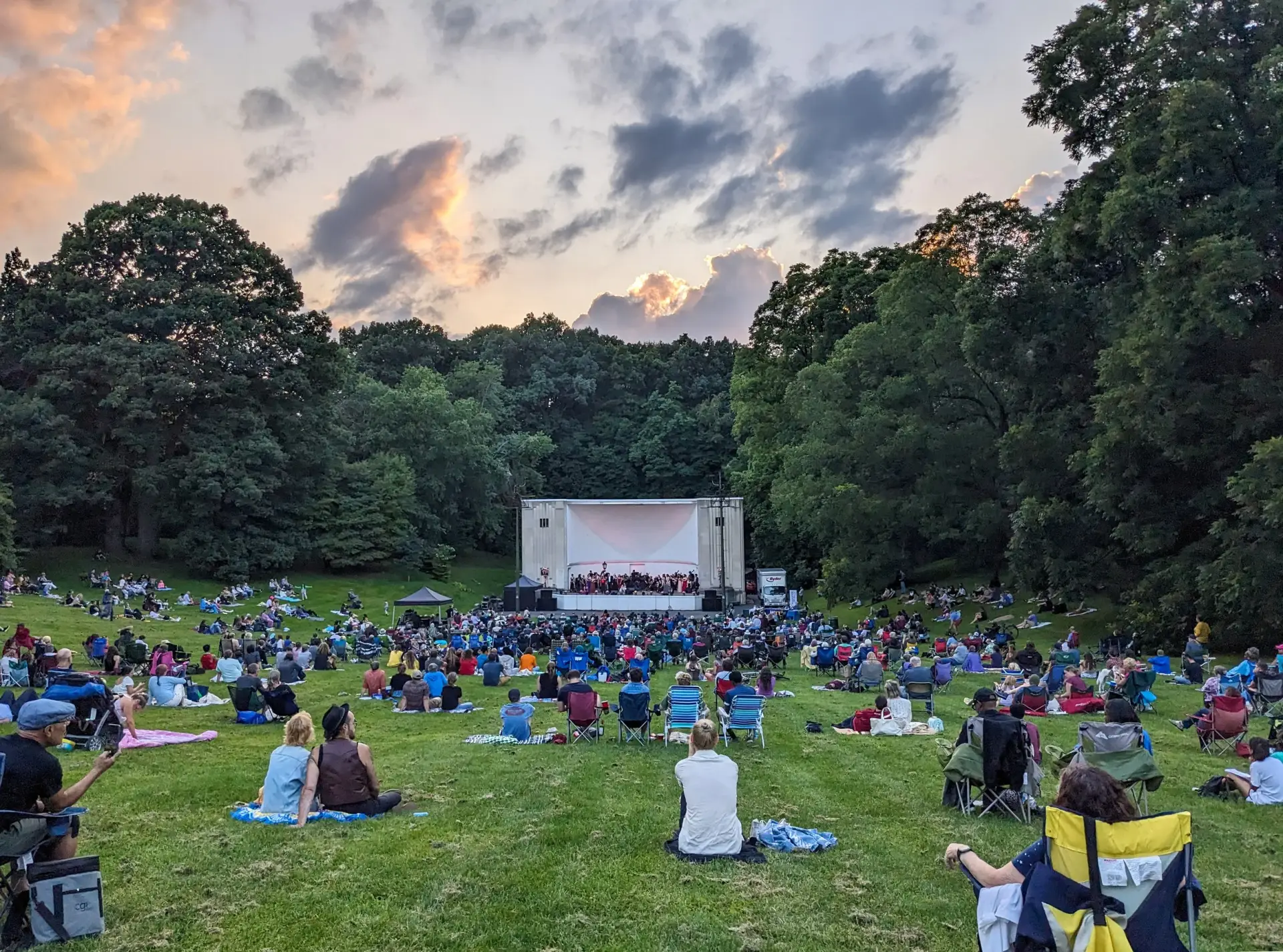
Highland Bowl in Rochester is the outlier and deserves its own framing. This is not a Live Nation amphitheater. It is a city-park bowl — an art deco bandshell at the bottom of a natural grass amphitheater inside Highland Park, with no permanent seating to speak of, no covered pavilion, no $14 beer concession. The programming is largely local — Rochester City Ballet, Jazz in the Bowl, Poetry in the Bowl, Shakespeare in the Park, the occasional touring act — and the experience is closer to a town-green concert than to a SPAC or Bethel night.
The right spot is about one-third of the way up the slope, slightly off-center. Off-center because the bandshell’s projection is broad and the on-axis front rows can run hot. One-third up because the lower bowl is where the sound is most natural and the upper rim near the ring of mature trees is where conversation tends to compete with the music.
Bring your own chair — chairs are welcome — and bring something low. The bowl is not steeply graded, and a tall chair will block the family behind you in a way it would not on SPAC’s slope. A Highland Bowl evening is not a substitute for a SPAC evening. It is its own category — the kind of show you go to in a folding chair with a sandwich and a thermos and remember for reasons that have very little to do with the lineup.
Universal Lawn Tactics
The chair-rule arbitrage matters. SPAC and Bethel Woods have moved to no-outside-chairs for promoter-produced shows and rent you one at the gate. Artpark is event-dependent. Highland Bowl is the relaxed end. The veteran adjustment: own a low-back blanket-style ground seat — not a chair — and you are compliant at every venue, you carry less, and you can still get up and stretch without disassembling a setup.
Blanket etiquette: claim the space you will actually use. A king-size sheet for two people is the move that ruins the lawn for everyone behind you. Tuck your edges. Do not save space for the friend who might show up. The lawn is a commons. Treat it that way.
Arrival ROI varies sharply. SPAC: 30 minutes before gates for major rock, 60 for jam bands, 15 for orchestra. Bethel: 45 minutes before gates. Artpark: at the gate when it opens at 5, no exceptions — the front-of-lawn spots are the show. Highland Bowl: 20 minutes before downbeat is plenty.
What to Bring
Low chair if your show allows one — under 26 inches if you are on SPAC’s center lawn, under 30 everywhere else. Layered clothing for a 15-degree post-sundown drop, more at Artpark with the gorge wind. A hat for west-facing lawns until past 8 p.m. in midsummer (SPAC, Artpark, and Highland Bowl all qualify; Bethel’s slope is more forgiving). Empty water bottle to refill inside. A rain shell, not an umbrella — you will block the view behind you and the staff will tell you to put it away. Cash, because the SPAC parking attendant has been telling people for twenty years that the lot takes cards and the lot remains, year after year, cash-only.
Closer
The lawn is not where you sit because you couldn’t get a pavilion seat. The lawn is the experience — the slope, the canopy, the slow drift of light across the trees, the stranger on the next blanket who turns out to know exactly what year the Allman Brothers played that one Saturday. At SPAC, Bethel Woods, Artpark, and Highland Bowl, the people who know the lawn best have been sitting in the same spot for ten or twenty-five summers. They know where they are going.
Now you know too. Find your spot. Sit there for ten years. Then write your own version and tell me where I got it wrong.
Disclosure: Some links in this article are affiliate links. Upstate Concerts may earn a commission on ticket purchases at no additional cost to you.