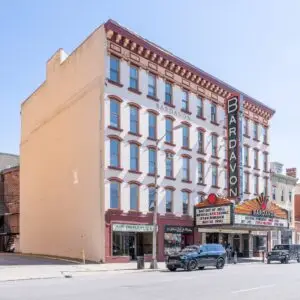
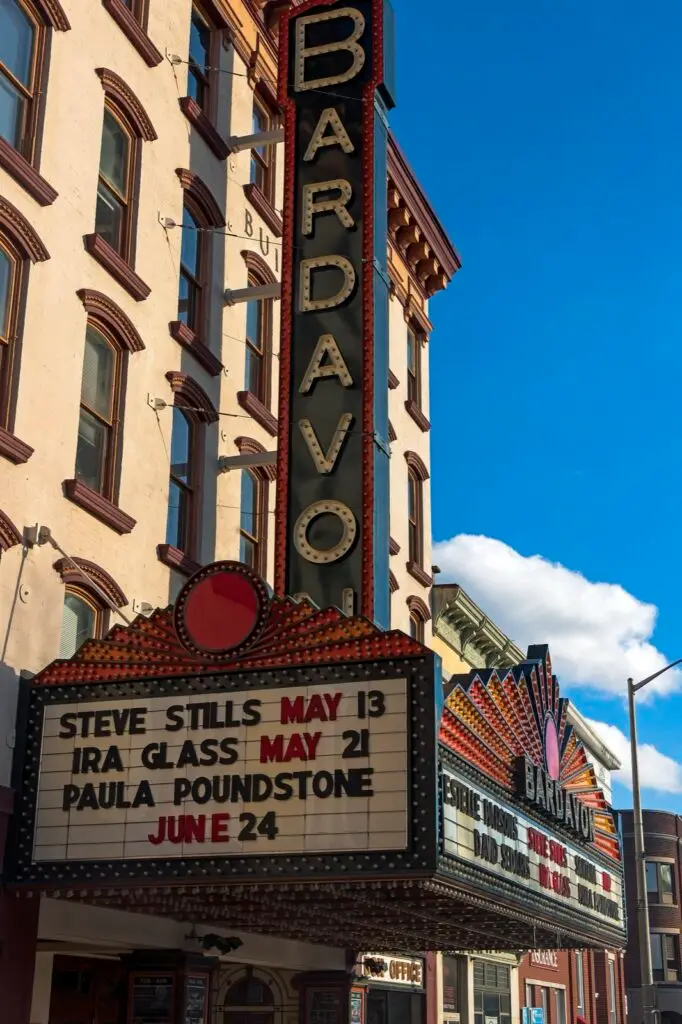
James Collingwood built his opera house on the site of his own coal and lumber yard on Poughkeepsie’s Market Street, which tells you something about the practical ambition that put a grand theater in a Hudson River mill town. The Collingwood Opera House, designed by local architect J. A. Wood, opened on February 1, 1869 (Hudson Valley One). More than a century and a half later, the building is still booking shows under the name it took in 1923: the Bardavon, a contraction of “Bard of Avon,” for Shakespeare. Along the way it spent half a century as a movie house, went dark, came close to becoming a parking lot, and was saved by a retired IBM engineer and his wife. The theater calls itself the oldest continuously operating theater in New York State (Bardavon).
Collingwood’s Opera House
The original house held about 2,000 people, more than twice what the Bardavon seats today (Hudson Valley One). For half a century it drew the touring names of the era: Sarah Bernhardt, John and Ethel Barrymore, Edwin Booth, John Philip Sousa, Isadora Duncan, Buffalo Bill Cody and a young Helen Hayes in her first starring role. Mark Twain appeared there, and both Theodore and Franklin D. Roosevelt were visitors (Hudson Valley One, Bardavon).
The Bardavon Years
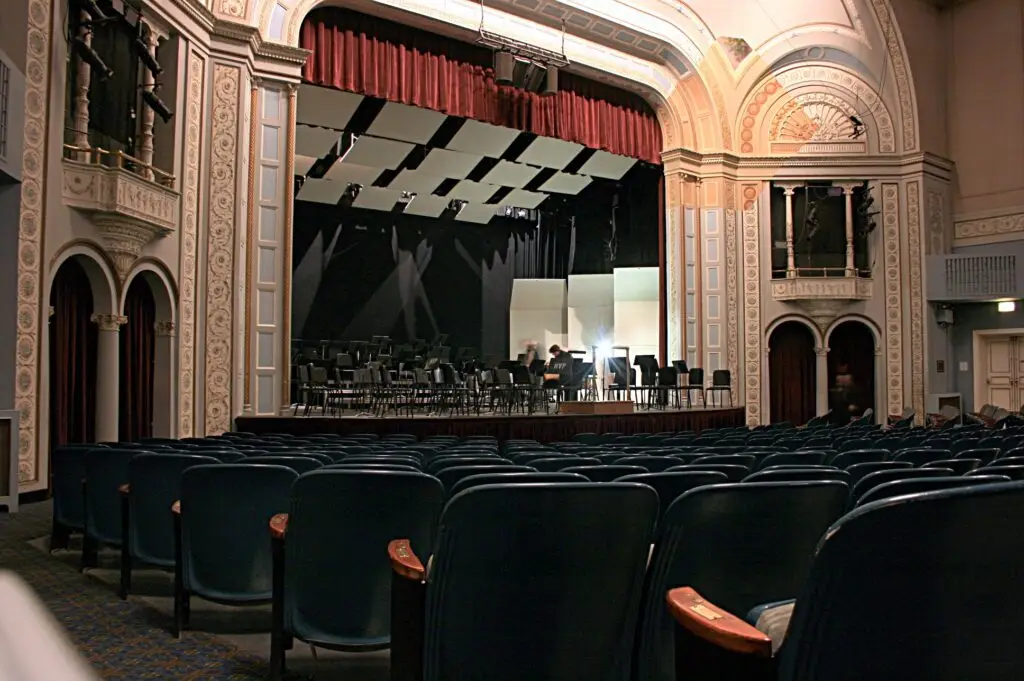
In 1923 the theater was sold, renamed and rebuilt as a “combination house” for vaudeville, stock companies and films. The renovation cut the house to 944 seats and improved its sound, and a portrait of Shakespeare went up to explain the new name (Hudson Valley One). The Bardavon’s own list of past performers from the decades that followed includes Frank Sinatra, Harry Houdini, Cab Calloway, Tommy Dorsey and Martha Graham (Bardavon).
In 1928 the theater installed a Wurlitzer pipe organ to accompany silent films. It didn’t stay put. The organ was removed in the 1960s and installed in a private home in Scarsdale, and its pieces later ended up in storage. The New York Theatre Organ Society found it and bought it in 1983, struck a deal with the Bardavon to reinstall it, and in 1990 the “Mighty Wurlitzer” came home, where it still plays (Bardavon).
Ian Fraser plays the Bardavon’s Wurlitzer, via the New York Theatre Organ Society, which owns the organ.
The Parking Lot That Almost Won
By the 1970s, mall multiplexes were drawing movie audiences away from downtowns everywhere, and the Bardavon closed in 1975. Downtown Poughkeepsie was being rebuilt around a new Civic Center and a proposed arterial highway, and the plan was to tear the theater down and put a parking lot on the site (Hudson Valley One, Wikipedia).
The people who stopped it were an unlikely pair of impresarios. Stephen Dunwell had spent more than 40 years at IBM, where he led the development of Stretch, the company’s first supercomputer. When he retired in 1976, he and his wife, Julia McClure Dunwell, took on the Bardavon, rescued it and ran it themselves for three years until it could be handed to a professional staff (IEEE Computer Society). With the Dutchess County Arts Council and a group of residents who called themselves the Concerned Citizens to Save the Bardavon, they got the building onto the National Register of Historic Places in 1977 and set it up as a nonprofit (NYS Music, Adriance Memorial Library). By 1979, the Bardavon 1869 Opera House was running as a performing arts center again (Bardavon).
The Room Bob Dylan Chose to Disappear Into
Decades after the rescue, the Bardavon picked up a famous, and very quiet, regular. Bob Dylan used it as a rehearsal space in 2005 while recording Modern Times, then came back in 2006 and 2011 to rehearse his band before tours, and each time the staff kept his presence a secret. Executive director Chris Silva put the fit simply: Dylan “likes history and God knows he has roots in the Hudson Valley” (Hudson Valley One).
Fifty Years on the Nonprofit Stage
The concert record since the rescue reads like a survey of American music. David Byrne brought his Rei Momo tour on September 21, 1989 (setlist.fm). Patti Smith played on December 6, 1997 (setlist.fm), Sinéad O’Connor brought her Theology tour on October 21, 2007 (setlist.fm), and Ani DiFranco played on October 6, 2017 (setlist.fm). Ray Davies has made repeat stops, and Natalie Merchant opened a U.S. tour there on April 15, 2023 (Bardavon). No act has come back more often than Hot Tuna: Jorma Kaukonen and Jack Casady have played the Bardavon nine times by setlist.fm’s count, most recently on October 29, 2025 (setlist.fm).
From One Historic House to Two
For more than two decades, the Bardavon also managed the region’s orchestra. What became the Hudson Valley Philharmonic started in 1932 as the Dutchess County Philharmonic Orchestra, formed by four Poughkeepsie businessmen who played strings; Claude Monteux made it a fully professional ensemble by 1959 (Wikipedia, Hudson Valley Magazine). In February 2024 the orchestra parted ways with the Bardavon, renamed itself the Hudson Valley Symphony Orchestra and became self-managed, with an inaugural concert that May (Hudson Valley Magazine).
The Bardavon’s reach also grew up the river. In Kingston, the 1927 Broadway Theatre had been saved by its own community and reopened as the Ulster Performing Arts Center. The Bardavon began managing UPAC in 2006, and the two organizations merged the following year (Wikipedia). Today one nonprofit runs both stages, and the Bardavon 1869 Opera House is still booking shows on the spot where planners once wanted to park cars.
Photo & Video Credits
- Bardavon 1869 Opera House, Market Street, 2026. Photo: ajay_suresh / Wikimedia Commons (CC BY 4.0).
- Bardavon auditorium, 2007. Photo: Rolf Müller / Wikimedia Commons (CC BY-SA 3.0).
- Bardavon marquee, 2016. Photo: Daniel Case / Wikimedia Commons (CC BY-SA 3.0).
- “Ian Fraser in concert at the Bardavon Opera House,” via the New York Theatre Organ Society.