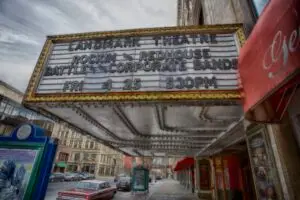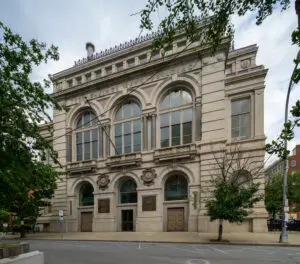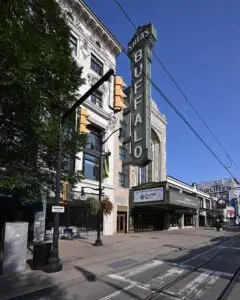
Groundbreaking came on March 15, 1927. Eleven months and three days later — a job that took more than 300 workers and roughly $1.4 million — Marcus Loew’s newest movie palace opened its doors on South Salina Street on February 18, 1928, with “West Point,” starring Joan Crawford and William Haines, on the screen and a twenty-five-cent admission at the box office (Clio, via cross-referenced summary, Jerry’s Brokendown Palaces). Architect Thomas W. Lamb — the same designer behind Madison Square Garden’s 1925 incarnation — called Loew’s State Theatre “European, Byzantine, Romanesque, which is the Orient as it came to us through the merchants of Venice,” and Syracuse audiences had never seen anything like it (Sean Kirst / Central Current, Jerry’s Brokendown Palaces).
An Architect’s Fantasy of the Orient
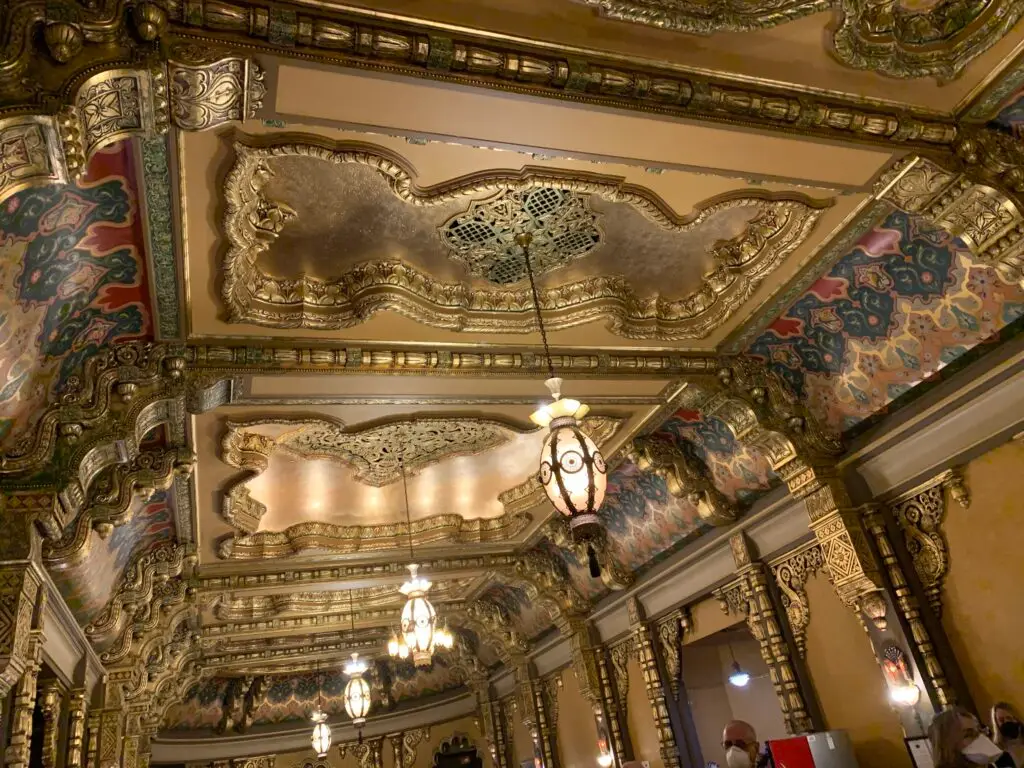
What patrons walked into was less a movie house than a stage set. A promenade lobby led to a fishpond with a Japanese pagoda fountain; overhead hung a Tiffany-designed chandelier originally made for Cornelius Vanderbilt’s mansion, which Loew reportedly paid $40,000 to acquire — a fortune in 1928 dollars (Jerry’s Brokendown Palaces). The auditorium itself was outfitted with a Wurlitzer theater organ built around 1,400 pipes, capable of everything from a glockenspiel shimmer to bird whistles and surf sound effects for silent-film accompaniment (Jerry’s Brokendown Palaces, Landmark Theatre — official history). Today the building carries 2,908 seats across orchestra and balcony levels, and it remains, by its own and outside accounts, the city’s only surviving example of the great 1920s movie palaces that once lined downtown Syracuse (Wikipedia)).
When Television Nearly Killed It
The Wurlitzer went silent in 1964, pulled from the building as movie houses everywhere adjusted to sound film and, later, television (Cinema Treasures). By 1967 the theater was already being talked about as a demolition candidate, and the slow bleed continued into the mid-1970s: by early 1975, Syracuse journalists and preservationists alike were describing Loew’s State as a lost cause. A community rally that same year, led in part by Dennis Connors, then executive director of the Preservation Association of Central New York, turned that resignation into a fight. In 1976, developer Malcolm Sutton bought the theater and the commercial space above it directly from Loew’s — not to demolish it, but to buy time for a rescue that was still being organized (Sean Kirst / Central Current).
The Concert That Helped Save It
Out of that rally came the Committee to Save Loew’s, and out of the committee came a nonprofit formed for a single purpose: Syracuse Area Landmark Theatre, or SALT. The building was listed on the National Register of Historic Places on May 2, 1977, under reference number 77000970 — recognition that arrived while its future ownership was still very much unsettled (Wikipedia)). SALT’s asking price from Sutton was $65,000, and on October 11, 1977, singer-songwriter Harry Chapin — an artist whose own career was defined almost as much by benefit shows as by hits like “Cat’s in the Cradle” — played a benefit concert in the theater to help close the gap (Wikipedia)). Local reporting on the campaign’s fiftieth anniversary indicates the sale was finalized by 1979, with Rose Bernthal serving as SALT’s first executive director and the theater renamed the Landmark in the process (Sean Kirst / Central Current). One of SALT’s earliest hires, in 1978, was a 25-year-old named Jamie Williams — a name that would resurface at the Landmark nearly half a century later.
A Movie Palace Becomes a Concert Hall
With the theater back in community hands, the Landmark spent the following decades building a second life as one of Central New York’s premier touring stops. Jerry Garcia brought his own band to the stage on February 19, 1980, with Grateful Dead lyricist Robert Hunter opening the show — a set built around “Sugaree,” “Simple Twist of Fate,” and “When I Paint My Masterpiece” (setlist.fm, JerryGarcia.com official archive). Bob Dylan followed less than three months later, playing two nights, May 4 and 5, 1980, deep into his Gospel Tour — shows built entirely around his new Christian material from “Saved,” with none of his older catalog performed (Official Bob Dylan site — tour date archive, Wikipedia — Bob Dylan Gospel Tour). A year later, on April 30, 1981, Ozzy Osbourne brought the Blizzard of Ozz tour through, with Randy Rhoads — the guitarist who defined the record and who would die in a plane crash less than a year later — playing “Crazy Train,” “Mr. Crowley,” and “Suicide Solution” before closing with a run of Black Sabbath covers (setlist.fm, Wikipedia — Blizzard of Ozz Tour).
The Band played the Landmark on March 5, 1987, and B.B. King made the room something close to a second home, returning again and again over the decades — setlist.fm’s venue database credits him with nine documented performances there, including dated shows on March 26, 1988, and earlier in 1985 (setlist.fm — The Band, setlist.fm — B.B. King, 1988, setlist.fm — venue history). Tori Amos played June 29, 1994, and Buffalo-born singer-songwriter Ani DiFranco brought her show home to upstate New York on May 5, 1999 (setlist.fm — Tori Amos, setlist.fm — Ani DiFranco). The Tragically Hip, the Canadian rock band whose following runs unusually deep this close to the border, played the Landmark on May 13, 1996, and returned November 7, 2009 — part of a run that setlist.fm’s database puts at eight total Landmark appearances, second only to B.B. King (setlist.fm — The Tragically Hip, Concert Archives — Nov. 7, 2009, setlist.fm — venue history). Jam band moe. — with deep roots in the upstate New York scene — played the room April 18, 2002 (setlist.fm).
Building a Stage Big Enough for Broadway
By the 2000s, the Landmark’s original stagehouse — built for vaudeville acts and silent-film organ accompaniment, not full-scale touring musicals — had become the limiting factor on what the theater could book. SALT closed the building from October 2010 to November 2011 for a $16 million expansion that pushed the stage back over what had been rear storefronts, added dressing rooms and green rooms, replaced the loading dock, and relocated the box office entrance from Jefferson Street to Salina Street (Cinema Treasures). The project is what allows the Landmark to host large-scale touring Broadway productions today, rather than the truncated regional versions many historic movie palaces are stuck with.
Bringing Back the Original Colors
“Landmark Theatre Restoration — The Art of Returning,” via the Landmark Theatre’s official channel.
In the summer of 2025, the Landmark closed again — this time for a $1.5 million restoration of the proscenium arch and balcony walls, roughly a third of it covered by a $500,000 state grant secured through Assemblyman Bill Magnarelli. Conservators from John Tiedemann, Inc. stripped nearly a century of soot, tobacco residue, and coal-furnace grime to identify around thirty of the auditorium’s original colors — gold, red, and green tones that had gone brownish under decades of buildup — with colorist Victoria Bingham leading the paint analysis (Sean Kirst / Central Current). The project architect on the job was Jamie Williams — the same Jamie Williams who, as a 25-year-old, had been one of SALT’s first employees back in 1978, now decades into a career as a preservation architect with Holmes King Kallquist & Associates (Sean Kirst / Central Current, Holmes King Kallquist & Associates — team bio). It was, by Kirst’s reporting, the first time professional conservators had restored the auditorium’s original decorative scheme since the building opened in 1928. The Landmark reopened September 9, 2025, with the touring production of “Hamilton,” and David Byrne played the newly restored room on September 23, 2025 (Sean Kirst / Central Current).
The Room Today
Nearly a century after Marcus Loew opened his Indo-Persian fantasy on South Salina Street, the Landmark is still owned and operated by the nonprofit that pulled it back from the wrecking ball. SALT’s own materials describe an annual mix of touring Broadway, concerts booked through partnerships with Famous Artists and Live Nation Entertainment, and comedy and family programming, drawing more than 150,000 guests a year by the venue’s own count (Landmark Theatre — official history). You can check the current schedule at the Landmark Theatre any week of the year. Every one of those shows plays out under a ceiling that took a rally, a nonprofit, a benefit concert, a $16 million stagehouse, and a paint conservator’s century-old color chart to protect — and under the same fantasy-Orient plasterwork Thomas Lamb dreamed up in 1928.
Photo & Video Credits
- Photo: John Hoey / Wikimedia Commons (CC BY 2.0)
- Thomas Lamb’s polychrome plasterwork, the detail the restoration was chasing. Photo: Eddie891 / Wikimedia Commons (CC BY-SA 4.0).
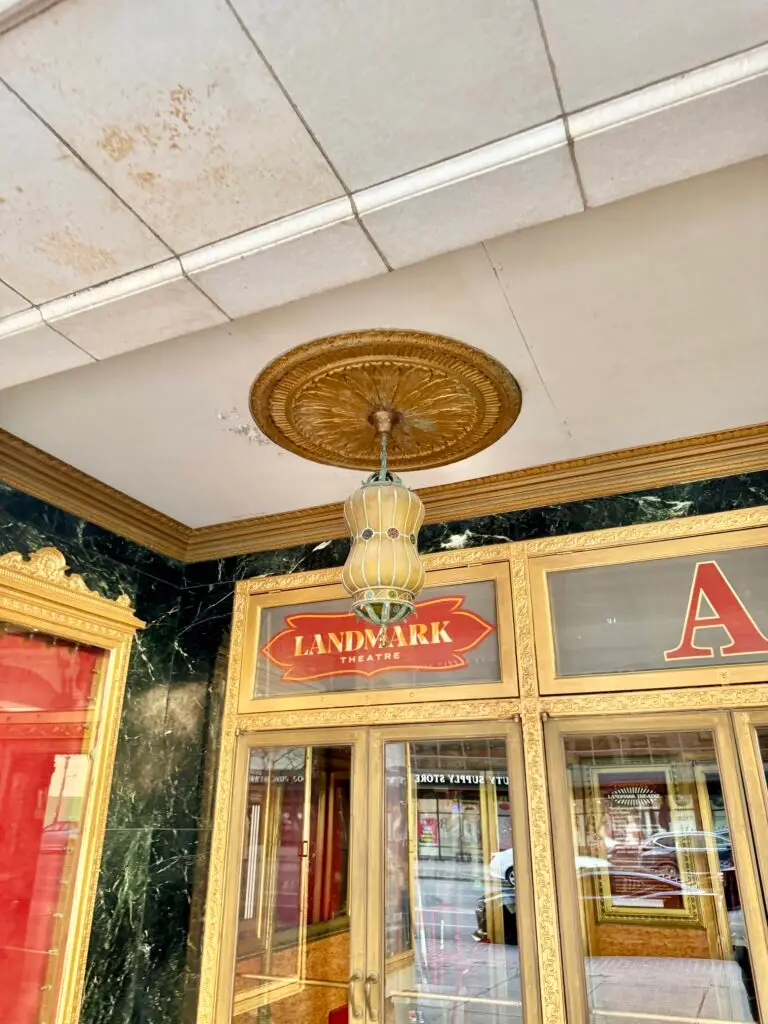
- Gold leaf and green marble in the entrance vestibule. Photo: Warren LeMay / Wikimedia Commons (CC BY-SA 2.0).
- “Landmark Theatre Restoration — The Art of Returning,” via the Landmark Theatre’s official channel.