Across a fortnight in June 1966, a circus tent off Niagara Falls Boulevard hosted the highest-paid Black entertainer in the world, two of the most important Piedmont bluesmen who ever lived, and a country legend in the most documented free-fall of his career. The man who booked them wore an outlandish suit on opening night, ran a pre-show fashion show on a rotating stage, and left so faint a trace in the historical record that 60 years later most of Western New York couldn’t tell you his name.
Under the Canvas
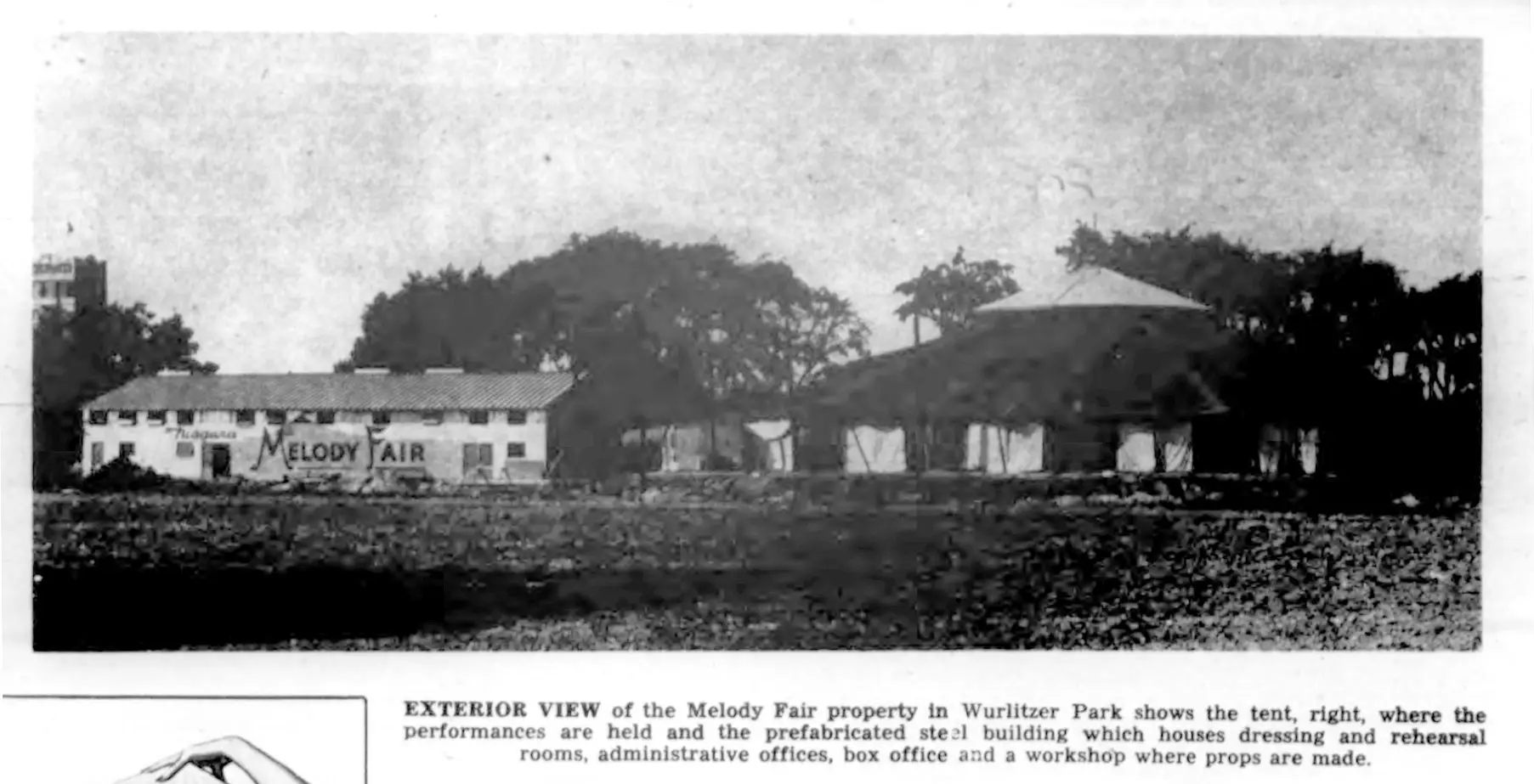
Start in the tent.
It is June 1966, somewhere along Niagara Falls Boulevard in North Tonawanda, where the Wurlitzer organ plant is still humming next door. The tent is red and white. It is the size of a small carnival big top — 3,000 seats in concentric rings around a rotating stage at the center. The canvas flaps move in the breeze off the Niagara. A pit orchestra is warming up underneath the rake. The summer light bleeds through the seams and turns the air pink.
On the radio in the parking lot, the Rolling Stones are number one with “Paint It Black.” Pet Sounds came out three weeks ago. So did Blonde on Blonde. The Civil Rights Act is 22 months old. Selma was 15 months ago.
And in this tent — this tent, this thing that looks like it was set up by carnies the week before — the highest-paid Black entertainer in the world is about to play six nights running. After he goes, a Country Music Hall of Famer with 800 uppers and downers in his luggage will close out the fortnight.
Two weeks. One quiet Sunday in between.
None of it happens by accident. A man in an outlandish suit is about to walk onstage to explain why.
The Architect
The man is Lew Fisher.
He walks out on the evening of Monday, June 13, 1966, into the spot where the orchestra has just stopped warming. The rotating stage carries him slowly toward each quadrant of the audience. He is wearing what Ron Gawel, a 1972 apprentice, would later describe in a Niagara Gazette memoir as “some outlandish suit that some men’s store provided for him.” He thanks the men’s store from the stage. Then he introduces Iney Wallens, who emcees the opening-night fashion show — yes, a fashion show, before the headliner — and only when that is done does the stage carry the night’s real business into view.
That is how a Lew Fisher opening night begins. Not with a drumroll. With local sponsors and runway models and an impresario who has decided that suburban Buffalo deserves theater, and intends to give it whatever it takes.
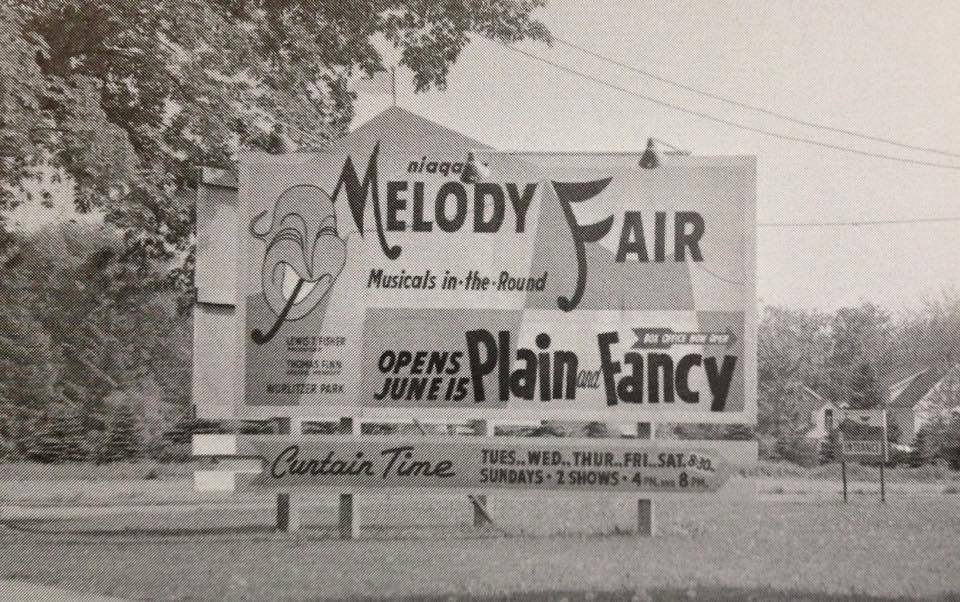
Lew Fisher opened Melody Fair in a tent on this site in June 1956. Construction had begun the year before; he had hired a Massachusetts resident director named John Ring as his consultant, almost certainly because Fisher himself came up through the New England music-circus scene — the Cape Cod Melody Tent in Hyannis or the South Shore Music Circus in Cohasset, where the form was invented. He brought the model west, planted it in a field next to the Wurlitzer plant, and ran it himself for 24 seasons until he sold the operation to the Bersani brothers in 1980.
Here is the thing about Fisher that nobody who writes about Melody Fair seems to remember to say: he was independent. Lee Guber, Shelly Gross, and Frank Ford had built an East Coast empire by then — Westbury, Valley Forge, Camden, Painters Mill — a circuit of tents-then-domes called Music Fair Enterprises that booked the biggest summer tours as a chain. Fisher was not part of it. He stood outside it, in suburban Buffalo, and somehow landed Belafonte and Cash and the names local memory insists also passed through — Sinatra, Streisand, the rest of the lore no archive can quite confirm.
How an unaffiliated operator in the Niagara frontier kept landing those bookings is not really a mystery once you ask the people who worked for him. Linda Sharon, who worked the house from 1966 through 1973, called him “a wonderful man to work for.” Gary Samulski, a 1969 hire, put it more bluntly: “Lew Fisher was the master. He made it happen.” Richard Casselman was 15 when he asked Fisher if he could borrow the South Pacific set for a teenage summer-stock production. Fisher said yes. “Lew was so generous,” Casselman remembers. These testimonials live now where they were left, on a contributor page at pbase.com/lettuce76/melody_fair, curated by the Western New York collector Jacob Kedzierski. It is the closest thing Lew Fisher has to a memorial.
Because here is the haunting fact: the man who built this cathedral and ran it for 24 years has no Wikipedia page. No Find a Grave memorial that surfaces in a normal search. He has a Buffalo News obituary — “Lewis T. Fisher, 96, co-founder of Melody Fair,” Oct. 7, 1915 to Oct. 8, 2011, died in Pasadena after a brief illness — but you have to know to look for it. He has two daughters — Chris Lewis in Pasadena, Amy Fisher in Washington, D.C. — and on August 14, 2014, the two of them visited the North Tonawanda History Museum to walk through its Melody Fair exhibit, three years after their father’s death. The Niagara Falls Reporter covered the visit. That is, in the end, what the historical record of Lew Fisher amounts to: an out-of-state death notice, two daughters at a small-museum exhibit, and a contributor page on PBase.
Hold that. The piece is going to come back to it.
Week One: Belafonte and the Blues
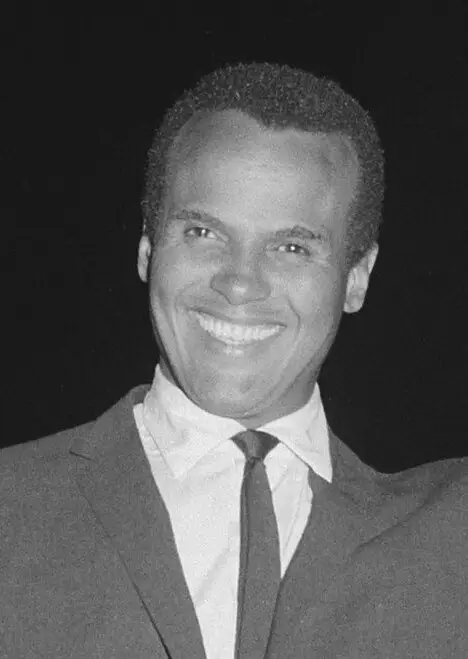
Harry Belafonte was 39 years old in June 1966. He was a year past his Grammy for An Evening with Belafonte/Makeba, the album he made with the South African singer Miriam Makeba that explicitly tied his calypso-folk theatrical to the anti-apartheid movement. He was, by any reasonable measure, the highest-paid Black entertainer in the world. He was also bankrolling SNCC out of his own pocket, bailing Dr. King out of jail when the calls came, and refusing categorically to tour the segregated South.
His 1966 East Coast summer was a defined loop through the music-tent circuit: Cleveland Musicarnival, then Melody Fair, then the Carousel in Framingham, then Westbury. Same package, same circuit, same opening act every night. And the opening act is the point.
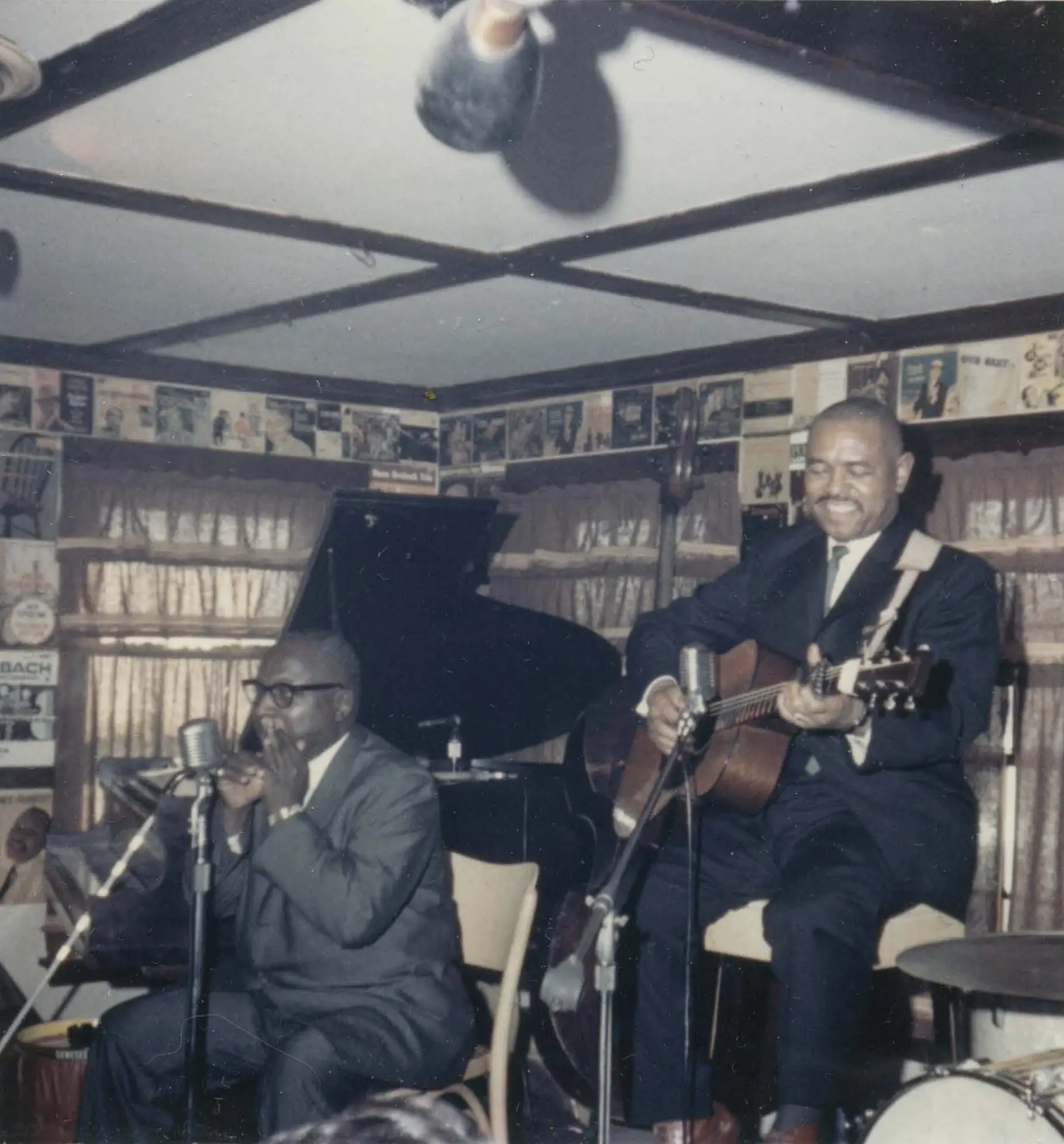
Sonny Terry, the great Piedmont blues harmonica player, and Brownie McGhee, his partner on guitar and vocals — two of the most important elders of the Piedmont tradition still living and working — opened every single one of Belafonte’s six Melody Fair nights. The McGhee oral history at the University of California archives (Tape 010, recorded June 1994) confirms the Belafonte touring period. Six nights in a row at the tent in North Tonawanda. Six nights of Piedmont blues royalty as the warmup for calypso.
Belafonte did this on purpose. He did it on every stop of the loop. He had the platform, and he used it — with the willful clarity of a man who understood that the integration of an American stage was something you had to do, not something you waited for. White suburban Buffalo bought tickets to see Belafonte’s polished theatrical and got, before he ever stepped onstage, the gospel of the Piedmont — Sonny Terry’s whooping harmonica and Brownie McGhee’s rolling guitar, played to a tent full of people who had come for “Day-O.” Monday through Friday at 8:30 p.m. Saturday a double — 7:00 p.m. matinee, 10:30 p.m. late show. The bookings did not editorialize. They did not have to.
The Saturday late show ended sometime after midnight. The crew began the breakdown. Belafonte’s trucks were rolling toward Framingham before the sun came up Sunday.
The Dark Sunday
June 19, 1966 was a Father’s Day.
The tent sat empty.
Belafonte’s load-out trucks had pulled out for Massachusetts. Cash’s load-in was scheduled for Monday morning. For one summer Sunday on Niagara Falls Boulevard, there was nothing happening inside the canvas. The rotating stage was still. The pit was dark. The seats faced an empty center.
Everything before that Sunday was buildup — Belafonte at his political peak, the Piedmont elders on the bill behind him, the engineering of an integrated American stage in the parking lot of a suburban theater. Everything after it was descent. A different kind of silence. A harder one.
Week Two: Cash in Freefall
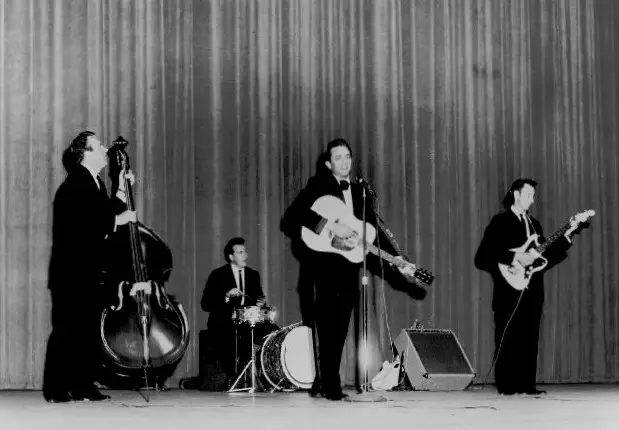
Johnny Cash was 35 years old in the summer of 1966.
He had been arrested eight months earlier, in October 1965, at the El Paso airport with 688 Dexedrine tablets and 475 Equanil tablets in the lining of his guitar case. His first wife, Vivian, was filing for divorce. June Carter was on the bus; their own marriage was still a year and nine months in the future. According to Marshall Grant’s first-person testimony in UNCUT, Cash’s daily intake had climbed to “up to a hundred pills a day, washed down with beer.” At Folsom Prison, the record that would change everything, was 19 months away.
The touring package on the bus in June 1966 was the standard Cash road show of that period: Cash; the Tennessee Three (Luther Perkins, Marshall Grant, W.S. Holland); June Carter; the Carter Family — Mother Maybelle, Anita, and Helen; the Statler Brothers; and Carl Perkins. Cash’s three documented Melody Fair nights — June 23, 24, and 25 — sat at the back end of the same week the calypso crew had played the front of, in the same tent.
And now I have to write into the silence. Because here is what we have on those nights:
Nothing.
No surviving setlist. No surviving review in any indexed archive. No surviving recording. No surviving photograph anyone has been able to surface from any collection, public or private. Fan-compiled concert chronologies log June 23, 24, and 25 firmly; the broader infocenter archive lists a longer Melody Fair run and explicitly invites contributions, meaning even the dates are best-available rather than definitively secondary-sourced. The Belafonte week has the Mouskouri archive and the McGhee oral history. The Cash week has dates and a tent.
Cash is one of the most documented American artists of the 20th century. He recorded everything. He gave thousands of interviews. Somewhere there has to be a Buffalo Evening News clip, a Niagara Gazette review, a fan’s snapshot, a stub. They are not in any indexed archive I can find.
What we do know is what June 1966 looked like in Cash’s life. He was performing across a Melody Fair week in summer heat, in a tent off the Niagara, with a hundred pills a day and a marriage ending behind him and the Tennessee Three carrying him through whatever set he could remember to play. June Carter was watching. Carl Perkins was watching.
We do not know what he sang. We do not know how he looked. We do not know whether the shows were great or barely held together. We know he was there. We know he was at his nadir. We know the tent held him for the back half of June, and then his trucks rolled out, and a fortnight of historic bookings at Lew Fisher’s tent on Niagara Falls Boulevard came to an end.
The Parking Lot
The tent came down in 1974. Fisher replaced it with a permanent dome — same site, same in-the-round configuration, same rotating stage — and ran the dome for six more seasons. He sold the operation to the Bersani brothers in 1980. The dome changed hands again, became the Majestic in 1998, then the New Melody Fair in 2002, and closed for good in 2006.
On May 4, 2010, a Channel 7 Buffalo news crew filmed the wrecking machine arriving. The Martin Group of Niagara Falls had bought the building. Joy Martin, the company’s vice president, stood for the camera in the parking lot and talked about what she called “the mournful sounds of the wrecking machine.” A small handful of locals had come out to watch. The reel is still on YouTube. The dome falls in a few seconds, the way these things do.
What stands on the spot today is a Walmart Supercenter and a strip of complementary retail called Wurlitzer Park, named for the organ plant that was Lew Fisher’s neighbor for the 24 years he ran the tent and the dome. A 2022 YouTube site tour identifies the exact location where the rotating stage once stood: the third or fourth parking space down, between the lampposts.
The Belafonte tapes are catalogued at the Schomburg Center for Research in Black Culture, where he donated his papers in 2017. The Brownie McGhee archive is at the Smithsonian. The Johnny Cash Estate maintains a museum in Nashville. Each of those institutions exists to keep the work accessible to anyone who wants to look. Melody Fair — the tent and then the dome that held all three of them across two weeks in June 1966 — has a parking lot, a Walmart, and a PBase page that Jacob Kedzierski refused to let disappear.
And Lew Fisher? He has Chris in Pasadena and Amy in Washington and a museum visit on a summer afternoon in 2014. He has the staff who remember him as the master and the most generous man they ever worked for. He has the postcards and the program covers and the photograph of him standing next to Liberace from some forgotten season. He has the outlandish suit and the fashion show and the rotating stage. He has an obituary three years older than that museum visit, in the Buffalo News, that almost no one in his old neighborhood has ever read. Maybe someone reading this fixes that.
That is the image I keep arriving at. Opening night. Fisher in the suit the local men’s store loaned him. The rotating stage carrying him slowly toward each quadrant of the tent. Thanking the men’s store from the platform. Introducing Iney Wallens. Standing aside while the fashion show finished its lap. And then — only then — calling out into the lights for Sonny Terry and Brownie McGhee to begin the longest two weeks any tent in Western New York ever held.
Belafonte the following hour. Cash the following week. The Father’s Day silence between them.
And the man in the outlandish suit, somewhere out past the lights, watching the room he built do exactly what he had hoped it would do.
Related reading: James Taylor’s Other Home: Fifty-Six Years of Upstate Tours · Buffalo’s Live Music Renaissance — the Western NY concert scene in 2026