
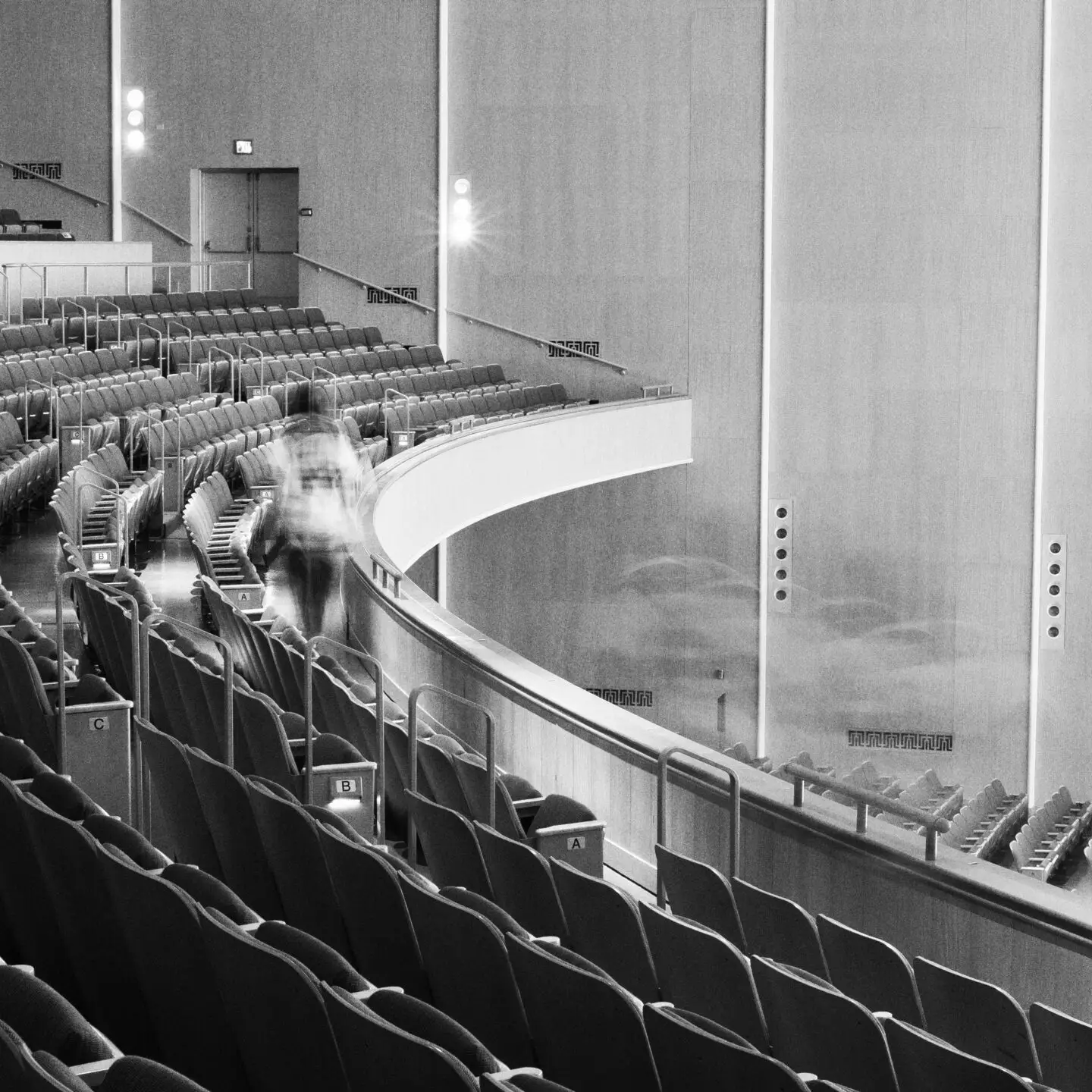
The first thing you notice at Kleinhans Music Hall isn’t the sound. It’s the silence. Step through the doors on Symphony Circle, settle into the curved embrace of the main auditorium, and the city of Buffalo simply disappears. The parabolic ceiling rises overhead like the hull of an enormous wooden ship. The walls arc in gentle, organic lines that feel less like architecture and more like the inside of an instrument. Which, as it turns out, is exactly what the architects intended.
Built Like a Violin
When Edward and Mary Seaton Kleinhans — who had made their fortune in the clothing business — died within three months of each other in 1934, they left roughly a million dollars to the city of Buffalo with a single stipulation: build a music hall. The city turned to Finnish-American architect Eliel Saarinen and his son Eero, then barely thirty, who would go on to design the Gateway Arch in St. Louis and the TWA Flight Center at JFK. Together, the Saarinens conceived a hall shaped not by architectural convention but by the form of a violin itself. The elder Saarinen described the philosophy plainly: a concert auditorium is, at its core, a musical instrument, and its form should follow accordingly.
With additional funding from President Roosevelt’s Public Works Administration, the $1.5 million project broke ground in the late 1930s. Kleinhans opened on October 12, 1940, with the Buffalo Philharmonic Orchestra performing under Maestro Franco Autori. The hall received a National Historic Landmark designation in 1989 — a testament to its architectural significance nearly fifty years after it was built.
The Sound Inside
Kleinhans isn’t just a beautiful room — it’s one of the finest-sounding concert halls in the world. Acoustical adviser Charles C. Potwin and lighting consultant Stanley McCandless worked alongside the Saarinens to shape a space where every seat delivers clarity. The main auditorium is built on a precise 1:1.3 ratio, ensuring that audiences in the back row hear the music with almost the same immediacy as those in the front. No suspended reflectors clutter the ceiling. No heavy drapery deadens the walls. The room itself does the work.
The musicians know it, too. Jascha Heifetz once said of Kleinhans that it was a joy to play there. Artur Rubenstein credited the hall with pulling the best from any artist who stepped onto its stage. The BPO, which has called Kleinhans home since opening night, benefits from that acoustic generosity season after season. In a 2,441-seat hall (reduced from the original 2,839 during 2015 renovations), that kind of intimacy is rare.
Beyond the Orchestra
The BPO remains the anchor tenant, but Kleinhans has always been more than a symphonic hall. The Buffalo Chamber Music Society programs regular performances. Film-concert hybrids — orchestras performing live scores to movies like The Princess Bride and Disney classics projected on screen — have drawn younger audiences into the hall. Singer-songwriters like Andrew Bird and Fiona Apple have played the room. Comedians like Bill Burr have tested its acoustics in an entirely different way. The Strictly Hip brings their Tragically Hip tribute to the stage for crowds who treat it like a revival meeting.
It’s a venue that moves comfortably between a Saturday night Beethoven program and a Tuesday evening with a touring indie act. That range is part of what keeps Kleinhans alive and relevant — a century-old instrument still perfectly in tune.
Getting There and Making a Night of It
Kleinhans sits on Symphony Circle, just north of the Elmwood Village strip and a short walk from Allentown — two of Buffalo’s best neighborhoods for eating and drinking. Street parking is available around the circle, and SpotHero lets you reserve a spot in advance for busier shows.
For pre-show dining, Gabriel’s Gate on Allen Street is a Buffalo institution — wings, burgers, and cold beer in a no-frills tavern that’s been packing them in for decades. Giacobbi’s Cucina Citta offers a more polished Italian dinner within easy striking distance. And if you want to eat without leaving the building, Marcato by Oliver’s operates on the lower level of Kleinhans itself, offering a three-course dinner on Saturday evenings before BPO Classics and Pops concerts — fine dining with table-side service, a salad bar, and a dessert buffet, all timed so you’re in your seat before downbeat.
Insider tip: The Mary Seaton Room — the smaller, more intimate performance space inside Kleinhans — hosts chamber concerts and recitals that feel like private performances. If you see something programmed there, jump on tickets. It’s a completely different experience from the main hall, and equally rewarding.
Plan your visit: kleinhansbuffalo.org