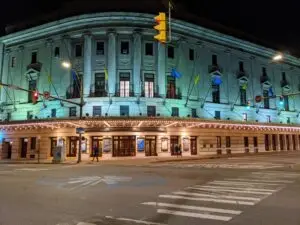
On Labor Day, September 4, 1922, a theater opened in downtown Rochester that its own benefactor admitted was “a little ahead of the times.” George Eastman, the Kodak founder who had quietly become one of the great philanthropists in American history, had just spent more than $17 million building a music school and an adjoining theater on a triangular block at Main and Gibbs Streets — and the theater alone was designed to seat over 3,300 people, in a city of roughly 300,000 (Vincent Lenti, “A History of the Eastman Theatre,” Rochester History, Vol. XLIX, No. 1, January 1987; WXXI News). More than a century later, that theater is still standing, still hosting the Rochester Philharmonic Orchestra, and still doing more or less exactly what Eastman built it to do — which was never really about the movies at all.
A Kodak Fortune, Spent on a Hunch About Music
Eastman’s path to the theater ran through an unglamorous business transaction. In 1918 he quietly purchased a struggling local conservatory, the D.K.G. Institute of Musical Art, for $28,000, with the intention of folding it into the University of Rochester once its charter allowed for a music school. Once that was arranged, he sold the Institute to the University for a token $1 in June 1919 (Lenti, Rochester History). Construction on a full city block followed — architects McKim, Mead & White of New York, working with the Rochester firm of Gordon & Kaelber, designed both the school and the theater, with Lawrence White (son of the firm’s famed Stanford White) credited as the theater’s lead architect (Lenti, Rochester History; Wikipedia). For most of 1921, the construction site was still being labeled the future home of the “National Academy of Motion Pictures” — Eastman didn’t sign off on naming it after himself until that November, writing to his architects, “I agree with the conclusions of the ‘committee on name’ that Eastman Theatre is the logical one” (Lenti, Rochester History). The Eastman School of Music opened its doors on September 14, 1921, a full year before the theater next door was ready (Lenti, Rochester History).
A Movie Palace Built to Double as a Concert Hall
The scale of what Eastman built only makes sense once you understand what he was actually trying to do. His stated plan, laid out to the National Association of the Motion Picture Industry in 1919, was to use first-run films as a delivery mechanism for serious orchestral music — pairing feature pictures with a full orchestra so that Rochester audiences who came for the movie would leave having also heard real music, “furnished by a large orchestra” (Lenti, Rochester History). That ambition required a very large room: Lenti’s account, drawn from University of Rochester archives, puts original capacity at “over 3,300,” while the Eastman School’s own materials cite a more specific 3,352 seats — a figure some later secondary sources round down to as few as 3,094, likely conflating a partial or post-renovation count (Lenti, Rochester History; Eastman Theatre — official venue page). Whatever the exact figure, contemporary reporting called it the third-largest theater in the country at the time (WXXI News). The house was built around a $75,000 Austin theater organ — commissioned by Eastman’s own personal organist, Harold Gleason, with more than 10,000 pipes and 140 stops, and reportedly the largest theater organ in the world at the time of its construction (Lenti, Rochester History). Eastman planned two resident orchestras for the complex — roughly fifty musicians for accompanying films and a larger ninety-piece symphony ensemble — and hired Victor Wagner, lured away from the Criterion Theatre in New York, as associate conductor (Lenti, Rochester History; WXXI News).
Opening Day: Twenty Cents, a Swashbuckler, and Tchaikovsky
The theater opened with continuous performances running from 1 p.m. to 11 p.m., tickets sold strictly first-come, first-served “to avoid any class distinctions” — twenty to fifty cents for afternoon shows, thirty-five cents to a dollar in the evening (Lenti, Rochester History). The opening bill paired Rex Ingram’s swashbuckler “The Prisoner of Zenda” with a live musical program built around Tchaikovsky’s 1812 Overture, soprano Marion Armstrong, dancer Ester Gustafson, and the new Eastman Theatre Orchestra under general music director Arthur Alexander, who had assembled a sixty-two-piece ensemble largely recruited from the existing Rochester Orchestra (Lenti, Rochester History). Above the entrance, Eastman had a phrase carved that still defines the building’s mission today: “For the Enrichment of Community Life.” He put his own ambitions in plainer terms at the time, saying he hoped “to see Rochester become a great musical center, known throughout the world” (Lenti, Rochester History).
From Movie Palace to the Philharmonic’s Permanent Address
The dual mission didn’t last forever. As sound film changed the economics of movie exhibition through the late 1920s, the theater’s identity shifted decisively toward live music, and in 1930 it became the permanent home of the Rochester Philharmonic Orchestra, the ensemble Eastman had helped establish alongside the theater itself (Wikipedia). For nearly three decades after that, the Metropolitan Opera made Rochester an annual tour stop, staging full productions on the Eastman stage rather than a scaled-down touring version — a level of commitment few American cities outside New York could claim (Eastman Theatre — official venue page). The room’s civic weight showed up in other ways too: in 1932, during his “wilderness years” lecture tour of the United States, Winston Churchill spoke from the Eastman stage, a visit noted by the University of Rochester’s own historical materials though not extensively documented elsewhere (University of Rochester — commencement history).
Kodak Hall: A $46.9 Million Second Act
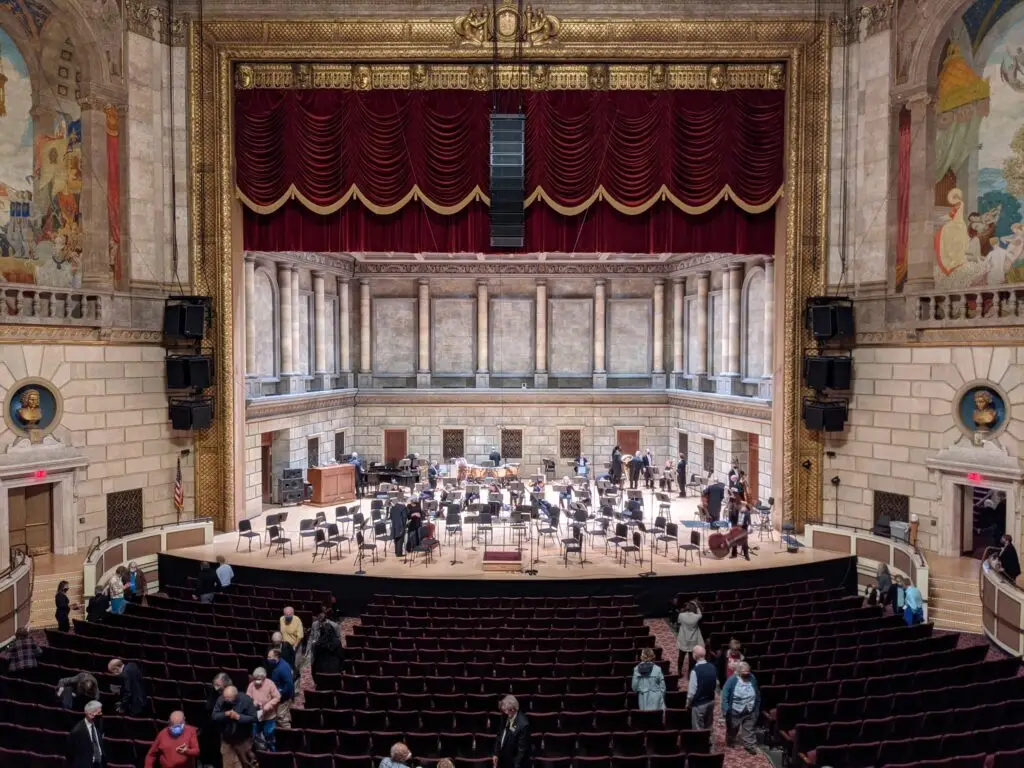
By the 2000s, the eighty-year-old house needed serious work, and the University of Rochester launched a renovation and expansion project that ultimately cost about $46.9 million, adding a new East Wing alongside a full acoustic and technical overhaul of the main auditorium (search-aggregated reporting on the Eastman renovation project, cross-referenced against Eastman School news releases). On April 11, 2008, Eastman Kodak Company committed $10 million to the project — at the time the largest corporate gift in the school’s history — with the explicit understanding that the main hall would be renamed “Kodak Hall at Eastman Theatre” once the work was finished (Eastman School of Music news release, April 2008). New York State had already committed $13 million toward the project in 2007 (Eastman School of Music news release, April 2008). The renovation reconfigured the room around better acoustics rather than raw seat count — the 2008 announcement projected the main hall would shrink from roughly 3,050 seats to about 2,250, and the finished room seats 2,326 today (Eastman School of Music news release, April 2008; Eastman Theatre — official venue page). Two donor gifts gave the new construction its character: a $1.5 million commitment from the Louis S. & Molly B. Wolk Foundation named the six-story, 73-foot Wolk Atrium — lit by a 19-foot Dale Chihuly glass chandelier — while a $2.5 million gift from the Davenport-Hatch Foundation named the new 222-seat Hatch Recital Hall, completed in December 2010 as the centerpiece of the East Wing (Eastman School of Music — Wolk Atrium naming release, July 2010; Rochester Philharmonic Orchestra — Davenport-Hatch Foundation release). The renamed Eastman Theatre reopened to the public on October 7, 2009, with the Rochester Philharmonic’s own grand-opening concert following the next night — the theater’s name changed, but its calendar never actually stopped.
A Concert Hall’s Quieter Rock and Roll History
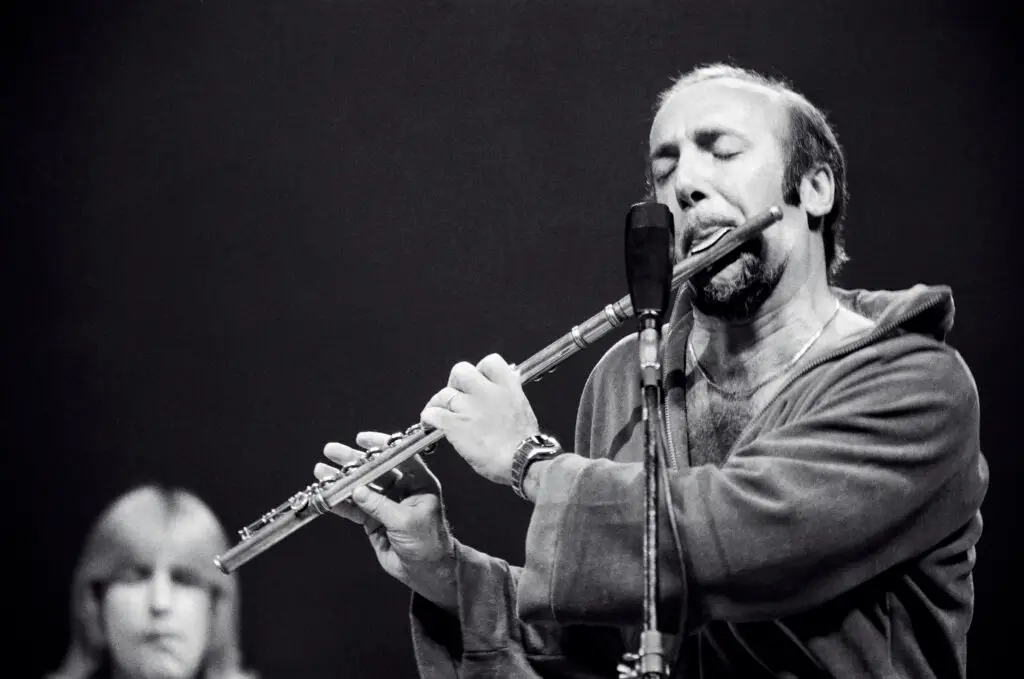
For a room built around opera and orchestral tradition, the Eastman Theatre has a rock and roll history most Rochesterians don’t know about. The Doors played there on March 16, 1968, on the “Waiting for the Sun” tour, with Linda Ronstadt and the Stone Poneys opening — a date documented by contemporary reviews in the Rochester Times-Union and Rochester Democrat and confirmed on the band’s own official history timeline (The Doors — official cool timeline; setlist.fm). English prog-rock band Renaissance played the room on March 17, 1977, opening their set with the Rochester Philharmonic Orchestra itself backing the first four songs before finishing the show alone (setlist.fm). Tom Jones played the hall on September 21, 1995, and Tori Amos brought her “Plugged ’98” tour through on November 12, 1998 (setlist.fm — Tom Jones; setlist.fm — Tori Amos). Ray Charles played the theater on October 27, 2002 (Concert Archives, cross-referenced against multiple concert listings), and since the Rochester International Jazz Festival adopted Kodak Hall as its flagship venue, the room has hosted Jeff Beck on June 18, 2010, and Phish frontman Trey Anastasio’s solo acoustic tour on March 12, 2025 (setlist.fm — Jeff Beck; setlist.fm — Trey Anastasio).
The Room Today
Virtual tour via the Eastman School of Music’s official channel.
The Eastman Theatre was added to the National Register of Historic Places in 1986, a formal recognition of what Rochester audiences already knew — that the room George Eastman built as a hedge on the future of motion pictures had become something more durable: a concert hall that never stopped being a concert hall, no matter what decade or genre showed up on its marquee. Eastman guessed wrong about how long silent film would last. He guessed exactly right about music.
Photo & Video Credits
- Photo: DanielPenfield / Wikimedia Commons (CC BY-SA 4.0)
- Kodak Hall after a performance — the murals and gilded proscenium of Eastman’s 1922 room. Photo: DanielPenfield / Wikimedia Commons (CC BY-SA 4.0).
- Herbie Mann on the Eastman stage with Will Lee, 1975. Photo: Tom Marcello / Wikimedia Commons (CC BY-SA 2.0).
- Virtual tour via the Eastman School of Music’s official channel.