On the evening of September 3, 2015, Miranda Lambert walked out in front of a crowd on the shore of Onondaga Lake and became the answer to a trivia question nobody had thought to ask yet: who plays the first show ever at a brand-new amphitheater built on top of a Superfund site? Lambert ran through twenty-one songs that night, from “Kerosene” to “Little Red Wagon,” and by the time she got to her encore, Central New York had its first purpose-built outdoor amphitheater — a room the region had been driving two hours in either direction to reach for decades.
That venue is now known as Empower Federal Credit Union Amphitheater at Lakeview, and its first decade has been, in almost every sense, an experiment that worked. It was built to solve a specific problem: national tours routinely skipped Syracuse, routing between Darien Lake Performing Arts Center near Buffalo and Saratoga Performing Arts Center near Albany — roughly 120 and 140 miles away, respectively — because Central New York simply did not have a shed big enough to host them. Ten years and roughly 200 different artists later, that gap has closed.
Built on Wastebeds
The site itself is the part of this story that outsiders find hardest to believe. The land on the western shore of Onondaga Lake where the amphitheater now sits was, for most of the 20th century, a dumping ground for the Solvay Process Company and its successor, Allied Chemical — waste from soda ash production stacked into what the industry called “wastebeds,” laced with phenols, benzene, toluene, and other industrial byproducts. A separate parcel on the same site held a capped landfill of steel-mill waste. In 1994, the entire lake and its surrounding upland sites were designated a federal Superfund site by the EPA.
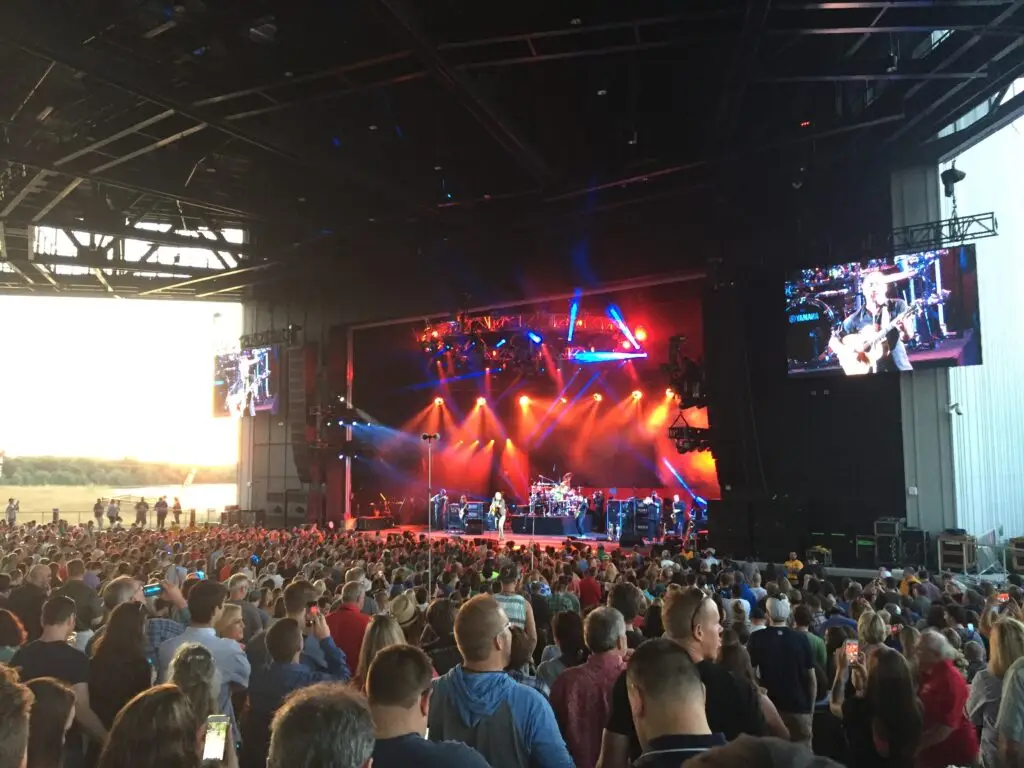
Then-Governor Andrew Cuomo announced plans for the project in January 2014, as the first phase of a broader Onondaga Lake revitalization effort. The Onondaga Nation raised pointed environmental objections during the approval process, noting that the venue would sit atop roughly 80 feet of capped industrial fill and arguing the lake itself would likely never again be swimmable. State, federal, and county officials signed off after extensive testing, and construction broke ground in November 2014 on what county officials and contractors describe as an unusually compressed, fast-track six-month build. The finished amphitheater — a 74,000-square-foot complex with roughly 5,000 seats under a covered pavilion and lawn space bringing its total capacity to 17,500 — opened at a construction cost of roughly $49.5 million. The county’s own address for the site makes the intent explicit: 490 Restoration Way.
Opening Night, Twice Over
Miranda Lambert’s September 3, 2015 show was, by every account, the amphitheater’s true first concert — a single date rather than a full inaugural season, closing out that summer’s fair calendar. The full concert seasons didn’t begin in earnest until 2016, but that first night set the tone: a country headliner, a packed new lawn, and a building that finally gave Central New York a reason to keep touring acts in town rather than routing around it.
The venue has, in a sense, opened twice more since then — each time its name changed hands. It operated simply as Lakeview Amphitheater from 2015 through 2018. In March 2018, Onondaga County announced a five-year, $750,000 naming-rights deal with St. Joseph’s Health, and the venue became St. Joseph’s Health Amphitheater at Lakeview that June. That name lasted through the 2023 season — with the 2020 season lost entirely to the pandemic — before Empower Federal Credit Union, a Syracuse-based credit union, signed a seven-year, $4 million naming-rights deal announced on October 20, 2023. Hozier christened that new era on May 21, 2024, with a sold-out show that opened the venue’s first full season under its current name.
CNY Central tours the finished amphitheater in August 2015, a week before Miranda Lambert opened it. Video: CNY Central via YouTube.
A Decade of Headliners
What’s filled the calendar in between is a genuinely broad cross-section of arena- and shed-level touring acts. As of the 2023 season, Breaking Benjamin and Zac Brown Band were tied for the most appearances at the venue, with five each. Dave Matthews Band has returned repeatedly, including a June 5, 2018 show remembered locally less for the setlist than for a rough night in the parking lot — construction on an overflow lot and a closed pedestrian bridge left hundreds of fans stuck in shuttle lines and missing the opening songs, with County Executive Joanne Mahoney publicly owning the misstep afterward. The venue fixed the bridge access in time for Kenny Chesney’s show two nights later, and DMB came back anyway, playing the amphitheater again in May 2025.
The broader bill reads like a decade-spanning cross-section of mainstream touring music: KISS, Boston, Chicago, Journey, Foo Fighters, blink-182, Def Leppard, Alice in Chains, Godsmack, Disturbed, and Slipknot on the rock and metal side; Kenny Chesney, Jason Aldean, Luke Combs, Chris Stapleton, and Keith Urban on the country side; Janet Jackson, Mary J. Blige, and Earth, Wind & Fire on the R&B and soul side; and, on June 28, 2024, an Outlaw Music Festival bill that stacked Willie Nelson, Bob Dylan, and Robert Plant & Alison Krauss on a single Syracuse night. It is, in short, exactly the kind of national-tour traffic the venue was built to intercept.
What the DOJ Settlement Could Mean
There is one more chapter still being written. In March 2026, Live Nation reached a settlement with the U.S. Department of Justice over the government’s antitrust case, and Appendix A of that settlement — the list of amphitheaters where Live Nation must give up its exclusive booking rights — names Empower FCU Amphitheater at Lakeview specifically, alongside a dozen other sheds nationally, including Bethel Woods Center for the Arts in the Hudson Valley. Because the amphitheater is publicly owned by Onondaga County rather than by Live Nation itself, the practical effect is narrower than “divestiture” implies — Live Nation would lose its exclusive booking arrangement and the venue would open its calendar to competing promoters, rather than the building changing hands. The settlement was still working through federal court review in the summer of 2026 — the public comment period runs through September 4, 2026, and a coalition of states including New York has requested discovery into the deal — so what this actually means for who books the Empower FCU stage going forward remains an open question.
Whatever comes of that, the amphitheater has already done what it was built to do. A decade ago, Central New York had a 17,500-capacity gap between two other regions’ amphitheaters and nothing to show for it. Now it has a shed with its own five-time headliners, its own controversies, and its own opening night — and a tenth-anniversary season, in 2026, that’s still adding names to a list that started with Miranda Lambert and twenty-one songs on a Thursday in September. To see who’s on the bill next, the Empower FCU Amphitheater’s upcoming concert calendar is the place to look.
Photo & Video Credits
- Exterior (Phish, 2016): Shannon McGee / Wikimedia Commons (CC BY-SA 2.0)
- Pavilion interior, 2016: MattCC716 / Wikimedia Commons (CC BY-SA 2.0)
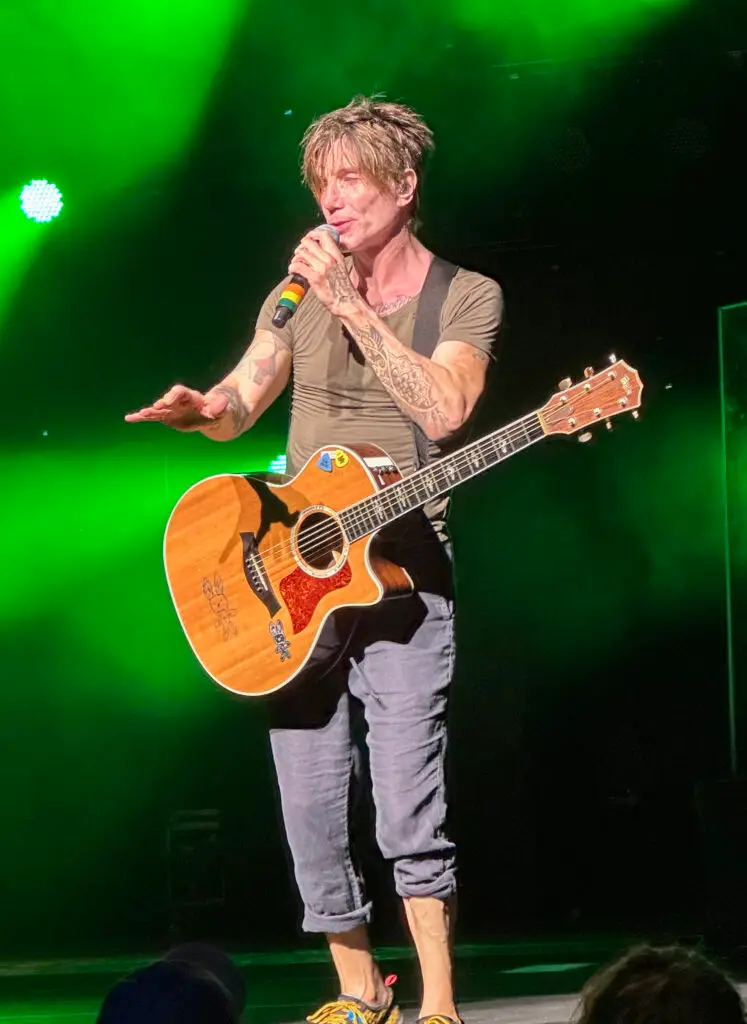
- Goo Goo Dolls, 2023: Quintin Soloviev / Wikimedia Commons (CC BY 4.0)
- “The concert venue is complete” (2015): CNY Central / YouTube