
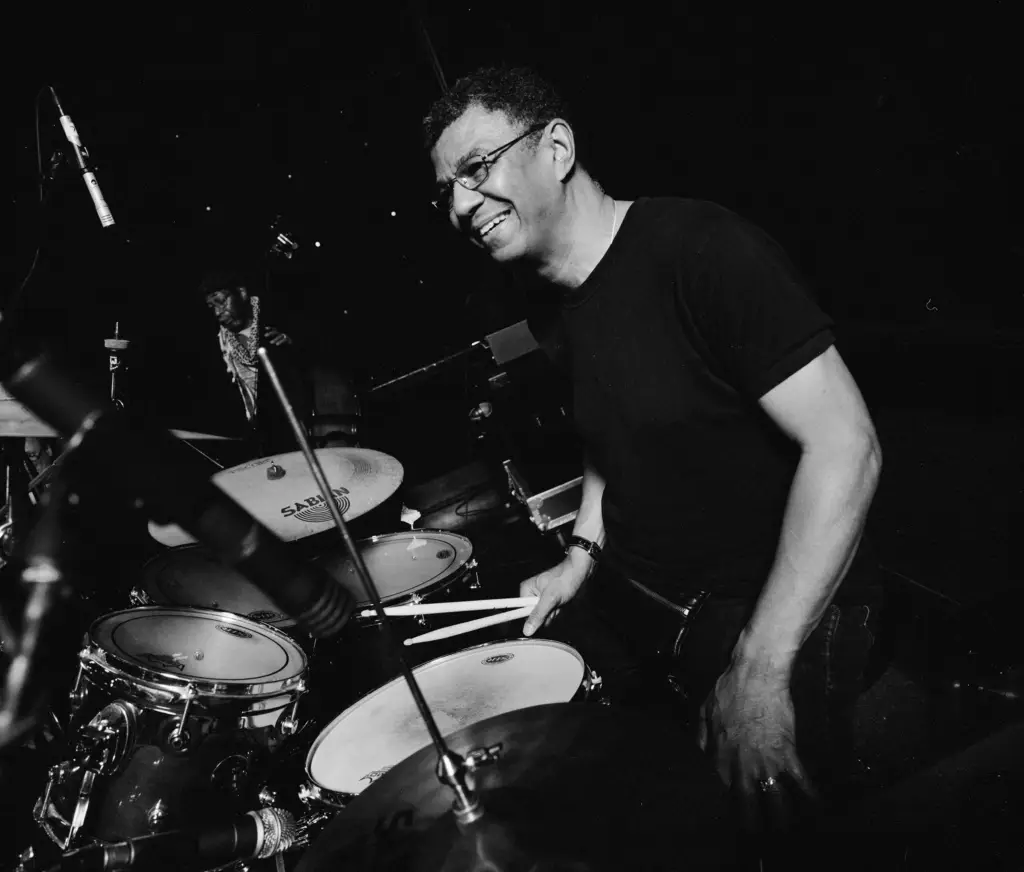
For more than half a century, Jack DeJohnette was one of the most important drummers in jazz — a musician whose vocabulary behind the kit expanded what was possible in improvised music. Born August 9, 1942, in Chicago, he would eventually make his home in the Woodstock, New York area, where he lived and created for decades until his death on October 26, 2025, at a hospital in nearby Kingston.
The Miles Davis Years
DeJohnette joined Miles Davis’s band in 1969, replacing Tony Williams, and served as the primary drummer on the landmark fusion album Bitches Brew — one of the most consequential recordings in jazz history. He continued with Davis through mid-1971, contributing to Live-Evil, Jack Johnson, and On the Corner, as well as the incendiary Fillmore East and Fillmore West live albums. His ability to anchor Davis’s increasingly electric, unstructured explorations was essential to the fusion revolution.
The Keith Jarrett Standards Trio
DeJohnette’s partnership with pianist Keith Jarrett and bassist Gary Peacock, which began in Charles Lloyd’s quartet in 1966 and evolved into the Standards Trio, lasted decades and produced some of the most revered recordings in the ECM catalog. Their interplay became a benchmark for small-group jazz performance.
A Life of Distinctions
As a leader, DeJohnette released more than 50 albums, beginning with The DeJohnette Complex in 1968. His 1979 album Special Edition was a major critical success. His 2022 album Skyline won the Grammy for Best Jazz Instrumental Album. He was named an NEA Jazz Master in 2012, inducted into the Modern Drummer Hall of Fame in 2007, and the Percussive Arts Society Hall of Fame in 2010.
Woodstock Home
DeJohnette’s collaborators read like a directory of modern jazz royalty: Herbie Hancock, Chick Corea, John Scofield, Michael Brecker, Sonny Rollins, and dozens more. But it was in the hills of the Hudson Valley that he found his creative home, blending rock grooves, jazz improvisation, and avant-garde exploration into a singular drumming language that influenced generations.