On September 20, 1980, Syracuse University opened a building that had no real precedent north of the Sun Belt: a 220-ton roof held aloft by nothing but air, covering a football field, a basketball court, and — almost immediately — some of the loudest rock shows the Northeast had ever heard. Forty-five years, three names, and one total roof replacement later, the JMA Wireless Dome is still standing on the same Syracuse hilltop, still hosting arena-scale tours, and still known to two generations of Central New Yorkers by the name that came before it: the Carrier Dome.
Understanding why concerts belong at the center of this building’s story starts with the deal that named it. Carrier Corporation, the Syracuse-based air conditioning giant, was one of the city’s dominant employers when the university needed roughly $26.85 million to finish construction of what was then simply called Syracuse University Stadium. Carrier’s chairman, Melvin Holm, pledged $2.75 million toward that goal in exchange for putting the company’s name on the building — one of the first corporate naming-rights deals in college sports history, and one the university and Carrier both understood, at the time, to be permanent. It held for 42 years, longer than almost any comparable arrangement in American sports.
Stadium Rock’s Northeast Outpost
What made the Dome unusual wasn’t just its name — it was its size. At its 1980 opening, the building ranked as the fifth-largest domed stadium in the United States and the first air-supported dome of its kind built anywhere in the Northeast. Syracuse still bills it as the largest domed stadium on any college campus in the country and the largest domed stadium in the northeastern United States — a claim about geography and construction type rather than about any single indoor arena, but a real one all the same. For touring acts in the early 1980s, that meant Syracuse suddenly had a room that could compete, capacity-wise, with the football stadiums and coliseums that hosted stadium rock’s biggest package tours.
The Dome didn’t waste time cashing that in. The Rolling Stones played the building in late November 1981 on their Tattoo You Tour — one of the first major concerts to fill the new room, drawing a crowd north of 40,000. A year later, The Who brought their first farewell tour to Syracuse on December 10, 1982, and drew 47,319 fans — at the time, believed to be the biggest indoor rock audience in the history of the Northeast, and a Dome attendance record that would stand, remarkably, for the next 43 years.
The rest of the decade read like a stadium-rock highlight reel. Genesis and Sting & The Police each drew 40,000-plus crowds in 1983 and 1984. Bruce Springsteen sold out two nights in 1985. Pink Floyd’s A Momentary Lapse of Reason Tour stopped at the Dome on October 3, 1987, and U2 followed less than a week later — October 9, 1987 — playing to a sold-out crowd of 39,157 on the Joshua Tree Tour at a face value of $17.50 a ticket. The Rolling Stones returned for two more sold-out nights in 1989 on the Steel Wheels Tour, and Billy Joel closed out that run of blockbuster double-headers with two nights of his own in 1990. Van Halen’s 1988 show is still remembered by longtime Syracuse concertgoers, half-affectionately, as the loudest thing they ever sat through inside the Dome.
The Long Cooldown
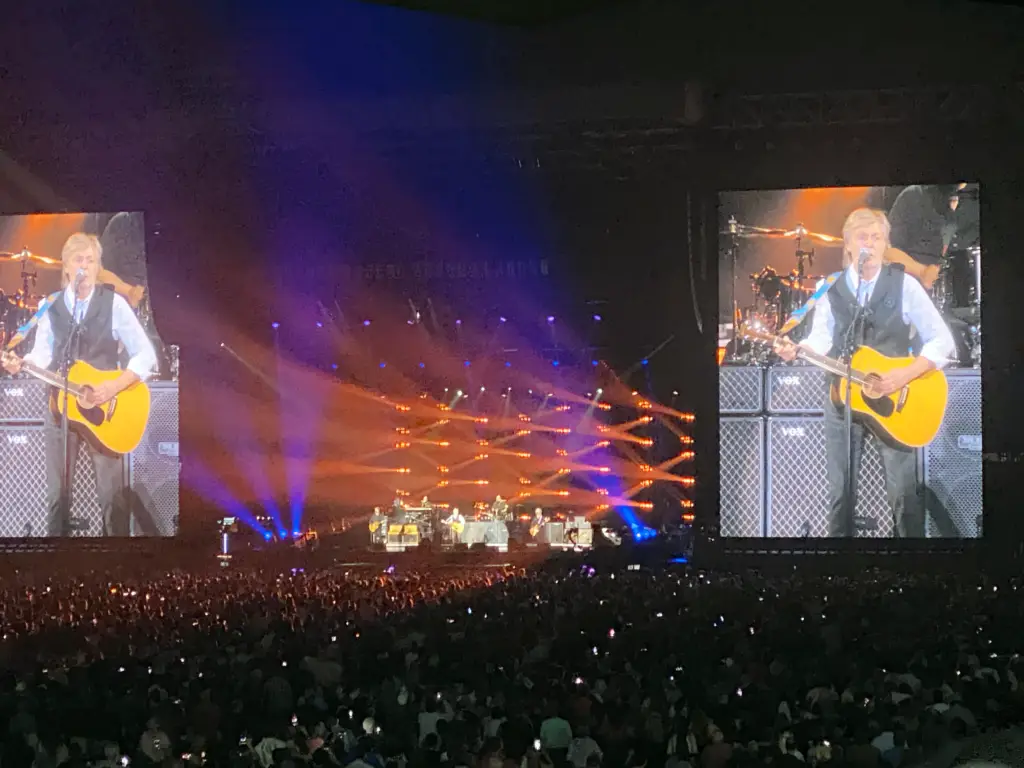
That density of A-list bookings didn’t last. Pink Floyd returned once more on June 6, 1994, for the Division Bell Tour, selling out nearly 39,000 seats — but by most locals’ accounting, that show marked something closer to a last hurrah than a new normal. The Rolling Stones played the Dome again on April 17, 1998, on the Bridges to Babylon Tour with Our Lady Peace opening, and Billy Joel and Elton John brought their “Face to Face” co-headlining tour through in 2006. Zac Brown Band’s 2012 concert is remembered locally as the last major non-university-sponsored show at the Dome for nearly three years, until Billy Joel returned solo in March 2015.
The reasons for the slowdown were structural as much as musical. Because the Dome is first and foremost a working sports venue — home to Syracuse football, men’s and women’s basketball, and lacrosse — the calendar dates available to touring promoters shrank year over year, and a building that could only offer a promoter “these two days” lost out to arenas that could offer an open summer. At the same time, Albany, Buffalo, and Rochester built out competing venues, and the broader touring industry itself was drifting away from 40,000-seat stadium shows toward arenas, amphitheaters, and festivals. By the Dome’s own accounting in its 35th-anniversary year, the building had hosted 67 major concerts since 1980 — still an enviable number, but one increasingly weighted toward its first two decades.
From Air to Steel
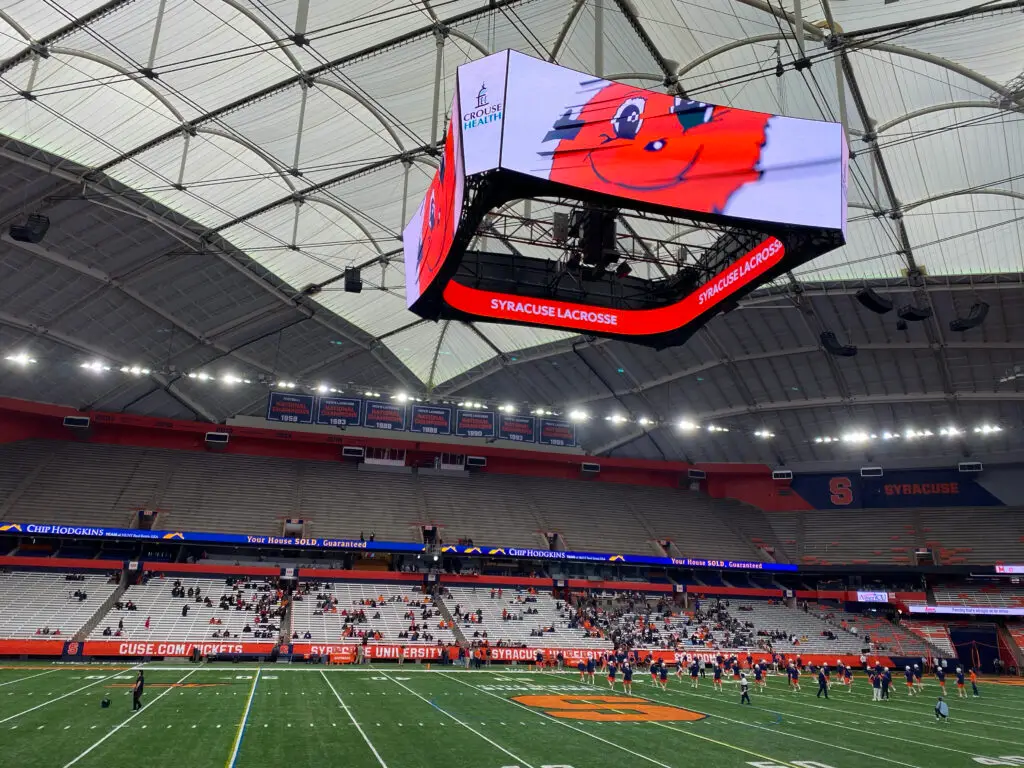
The Dome’s original roof was itself a marvel worth pausing on: 64 Teflon-coated fiberglass panels, cinched together by fourteen bridge cables (some stretching more than 700 feet and weighing seven tons apiece), kept aloft over the playing surface by sixteen five-foot fans moving more than a million cubic feet of air per minute, with heated air pumped through to melt snow before it could accumulate. Syracuse actually re-skinned that roof once already, installing a new air-supported fabric membrane in the summer of 1999 at a cost of roughly $14 million, designed to last another three decades.
It didn’t need to last that long. In May 2018, the university announced a far more ambitious plan: replace the air-supported design entirely with a fixed, non-inflatable roof, two-thirds of it translucent, engineered by the same firm — Geiger Engineers — that designed the original structure in 1980. The old roof was deflated for the final time on March 16, 2020, and the new $118 million fixed roof was in place for the 2020 football season, with air conditioning — long the Dome’s most-mocked absence — completed the following year. University officials were explicit about one of the payoffs: the old air-supported design required air-lock chambers that made it genuinely difficult to move staging, sound, and lighting equipment in and out, a real obstacle to booking major concerts that the fixed roof eliminated outright.
A New Name, A New Record
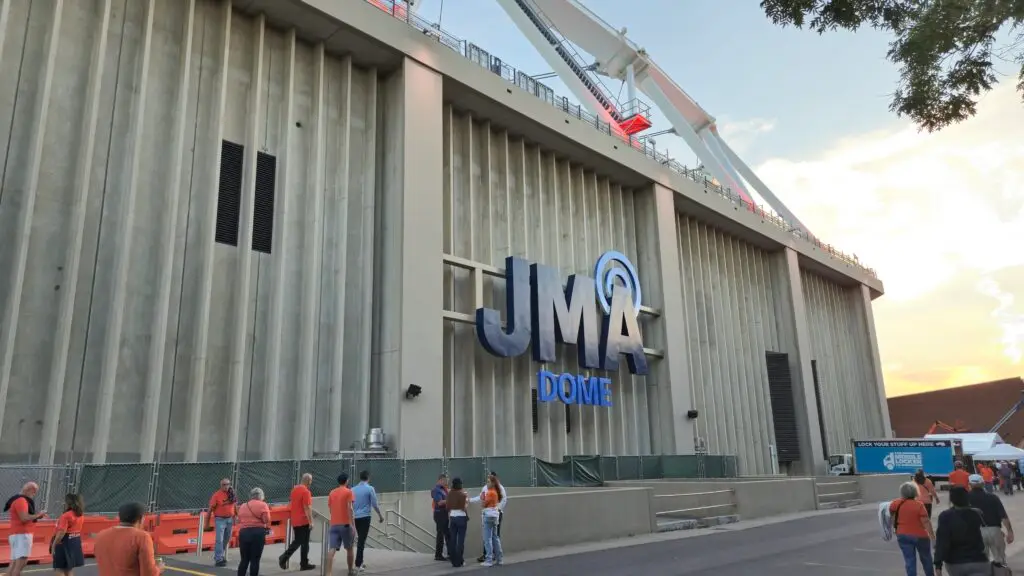
Syracuse’s 42-year relationship with Carrier ended in April 2022, and on May 19 of that year the university signed a new 10-year naming-rights deal with JMA Wireless, a Syracuse-based technology company — the building’s first name change since it opened. The rebrand landed in the middle of a genuine concert revival. Bruce Springsteen and the E Street Band were booked to open a run of September 2023 tour dates at the Dome, only for Springsteen to postpone the shows while being treated for peptic ulcer disease; the Syracuse date was rescheduled and finally played on April 18, 2024. A year later, Metallica opened their M72 Tour at the JMA Wireless Dome on April 19, 2025, drawing more than 47,500 fans and finally breaking The Who’s 43-year-old attendance record — a genuinely full-circle moment for a building whose concert legend had been built, in no small part, on that single December night in 1982. One piece of context is worth keeping straight: Metallica’s crowd is the largest ticketed concert in the Dome’s own history, though the New York State Fair’s outdoor Suburban Park stage — where Lainey Wilson drew an estimated 53,200 fans in August 2023 — holds the record for the largest concert crowd in Syracuse overall.
Forty-five years after Melvin Holm signed his name to an air-supported roof nobody else in the Northeast had tried, the building he helped fund is still doing the job it was built for — just with a steel-and-membrane roof overhead instead of a fabric one held up by fans, and a new name on the marquee for the first time in its history. If you want to see who’s taking that stage next, the JMA Wireless Dome’s upcoming concert calendar is the place to look.
Metallica’s “One” at the JMA Wireless Dome, April 19, 2025 — the night 47,500-plus fans broke The Who’s 43-year attendance record. Video: Metallica (official) via YouTube.
Photo & Video Credits
- Exterior (air-supported roof): MattCC716 / Wikimedia Commons (CC BY-SA 2.0)
- Paul McCartney, 2022: MattCC716 / Wikimedia Commons (CC BY-SA 2.0)
- Interior: MattCC716 / Wikimedia Commons (CC BY-SA 2.0)
- JMA Dome signage: Kiran891 / Wikimedia Commons (CC BY-SA 4.0)
- “One” (Syracuse, April 19, 2025): Metallica (official) / YouTube