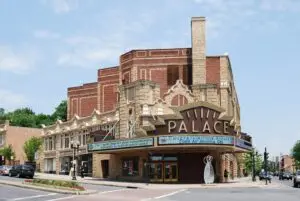
Construction started in June 1930, in the teeth of the Great Depression, which alone tells you something about how much Albany wanted this building. When the doors finally opened on October 23, 1931, the “RKO Movie Palace” wasn’t just another downtown theater — it was, by contemporary accounts, the third largest movie theatre in the world and the largest in the city, a nearly 3,800-seat monument to escapism dropped into a city that badly needed one (Cinema Treasures, Palace Theatre — official history). Ninety-five years later, it’s the only one of Albany’s grand old movie houses still standing, still lit, and still putting on a show almost every week. This is the story of how a Depression-era dream house became the Capital Region’s marquee concert hall.
Depression-Era Splendor, Built to Impress
The Palace was designed by John Eberson, one of the most sought-after theater architects in the country, who gave Albany an ornate Baroque/atmospheric interior meant to make ticket buyers feel like they’d left Clinton Avenue entirely (Cinema Treasures). Opening night paired the Ann Harding film “Devotion” on the screen with a full slate of RKO vaudeville on the stage — movies and live entertainment sharing a bill, which was the standard model for a grand movie palace of the era. Built by Fabian Securities and operated under lease by RKO, the theater became Albany’s premier first-run house, the place where the city’s moviegoers and vaudeville fans converged for the better part of a decade (Cinema Treasures, Palace Theatre — official history).
The Stones Play Albany, Twice in One Night
Even as a working movie house booking the occasional live act, the Palace landed one of the defining nights in its history on April 29, 1965, when the Rolling Stones played two shows there as part of their first American tour. The band was barely into its stateside breakthrough — “The Last Time” had only just cracked American radio — and Albany got a full night of it, back-to-back sets in front of a screaming, standing-room crowd (setlist.fm, Daily Gazette). It’s the kind of booking that reads almost unbelievable in hindsight — a band that would go on to define rock and roll for the next six decades, playing a mid-sized theater on Clinton Avenue, twice, in a single evening.
The Lights Nearly Went Out
The Rolling Stones show was a high point in what was, by the 1960s, a slow decline. Television kept people home, the suburbs pulled shoppers and moviegoers away from downtown, and Albany’s center city was hollowing out. A $250,000 renovation in 1960 — new facade, new marquee, a reopening on October 28, 1960 with Doris Day in “Midnight Lace” — bought the Palace some time, but not enough (Cinema Treasures). The theater finally closed as a movie house in September 1969. What happened next is the hinge of the whole story: rather than let the wrecking ball finish the job, the City of Albany bought the building from Fabian Enterprises for $90,000 and repurposed it as a civic auditorium (Palace Theatre — official history, Cinema Treasures). Albany had been home to a run of opulent movie houses in the early twentieth century. The Palace is, today, the only one of that generation still standing and still in use — a fact the theater’s own historical materials and multiple independent theater databases all point to directly (Palace Theatre — official history, IBDB). On October 4, 1979, in recognition of that survival, the Palace was added to the National Register of Historic Places under reference number 79003235 (Wikipedia), Palace Theatre — official history).
A Soundboard Tape Worth Waiting Forty Years For
Bruce Springsteen, “The Promise,” recorded live at the Palace Theatre, Albany, February 7, 1977. Official audio via BruceSpringsteenVEVO.
The civic-auditorium era turned out to be some of the most musically interesting years the building would ever have. On February 7, 1977, Bruce Springsteen and the E Street Band — expanded that tour by the Miami Horns — played the Palace on the road behind “Born to Run,” and someone was rolling tape from the board. The recording sat in the archive for four decades before the Springsteen organization released it in August 2017 as “Palace Theatre, Albany 1977,” the first-ever soundboard recording to surface from that year’s tour, featuring early live versions of “Something in the Night,” “Rendezvous,” and “The Promise” (Wikipedia). Three years later, the room hosted a much stranger juxtaposition: on April 27 and 28, 1980, Bob Dylan brought his Gospel Tour to the Palace for two nights of exclusively born-again Christian material, a run so divisive nationally that some venues reported fans giving tickets away rather than sit through a show with none of the old songs (Wikipedia — Bob Dylan Gospel Tour). That October, on the 28th, Frank Zappa played the same stage — one of at least two Zappa shows the Palace hosted, with the second landing on February 2, 1988 (setlist.fm, setlist.fm). Dylan came back to the Palace on May 8, 1991, and once more on November 17, 2017 (setlist.fm, Wikipedia — Never Ending Tour 1991, setlist.fm). Few Upstate rooms can claim a Springsteen soundboard tape, a Dylan gospel show, and Frank Zappa in the same handful of years.
Restoration and a Second Life
The building the city had rescued in 1969 needed rescuing again by the 1980s. A nonprofit, Palace Performing Arts Center, Inc., was established in 1984 to take over day-to-day operation of the theater, formalizing what had until then been an ad hoc civic-auditorium arrangement (Palace Theatre — official history). The bigger physical turnaround came in 2002 and 2003, when a roughly $3 million restoration by Conrad Schmitt Studios brought the interior closer to Eberson’s original vision and added a state-of-the-art LED marquee built to replicate the 1931 original (Palace Theatre — official history). Today the Palace Theatre seats nearly 3,000, down from roughly 3,800 at its opening — the difference largely a function of the wider, more comfortable seating installed over decades of renovation (Wikipedia), IBDB).
Home to the Albany Symphony
Threaded through all of this is the Palace’s relationship with the Albany Symphony Orchestra, the oldest professional symphony based in the Capital District, founded in 1930 — the same year construction began on the theater — as the People’s Orchestra of Albany under conductor John Carabella (Wikipedia — Albany Symphony Orchestra). The Palace is one of the orchestra’s home venues today, alongside the Troy Savings Bank Music Hall, Proctors in Schenectady, and EMPAC in Troy, and it’s where the two-time Grammy Award-winning ensemble — honored in 2014 and again in 2021 — regularly opens its season (Albany Symphony). It’s a pairing that makes sense of the whole building’s second act: a room built for spectacle in 1931 now doubling as a symphony hall and a rock club, sometimes in the same month.
The Room Today
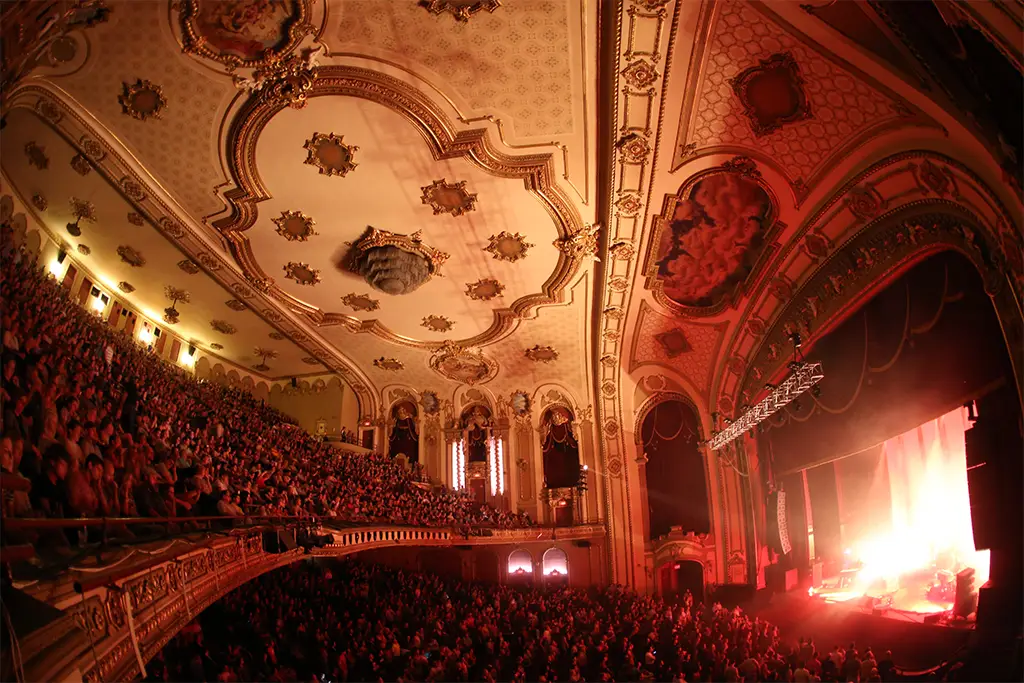
That range is still the Palace’s calling card. Melissa Etheridge has treated the room as a regular stop across three decades, returning again and again since the early nineties — an October 19, 2001 show is documented in full, and she was back on the Palace stage as recently as April 29, 2025 (setlist.fm, 2001, setlist.fm, 2025). Jerry Seinfeld has played the room twice, once on March 17, 2007, and again on October 27, 2023 (Concert Archives). Comedy, Broadway touring productions, classic film screenings, and touring musical acts round out a calendar the venue puts at roughly 150 events a year. Not bad for a building that was one renovation away from the wrecking ball twice in its first fifty years. The Palace has now outlasted every other movie palace Albany ever built, and it did it not by staying frozen as a museum piece but by continually finding a new act to put on its stage — vaudeville, then film, then a symphony, a comedian, and a rock band, sometimes all in the same season.
Photo & Video Credits
- Photo: UpstateNYer / Wikimedia Commons (CC BY-SA 3.0)
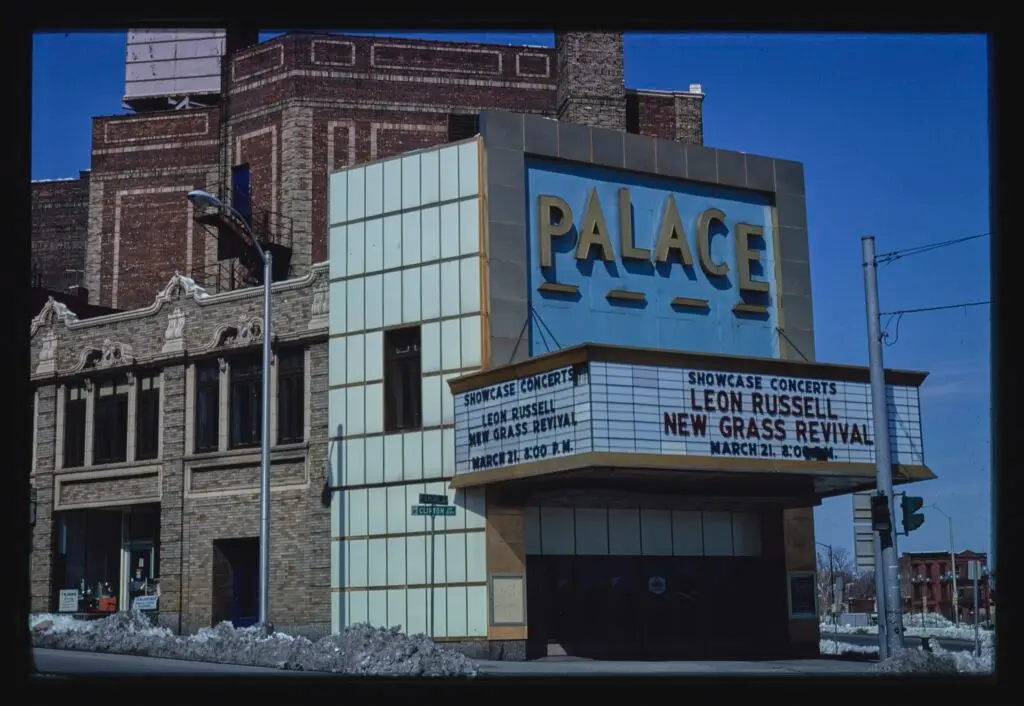
- The Palace in its concert-hall years, the marquee advertising Leon Russell and New Grass Revival. Photo: John Margolies, Library of Congress (public domain).
- A sold-out house under John Eberson’s 1931 ceiling. Photo: Hex1995 / Wikimedia Commons (CC BY-SA 4.0).
- Bruce Springsteen, “The Promise,” recorded live at the Palace Theatre, Albany, February 7, 1977. Official audio via BruceSpringsteenVEVO.