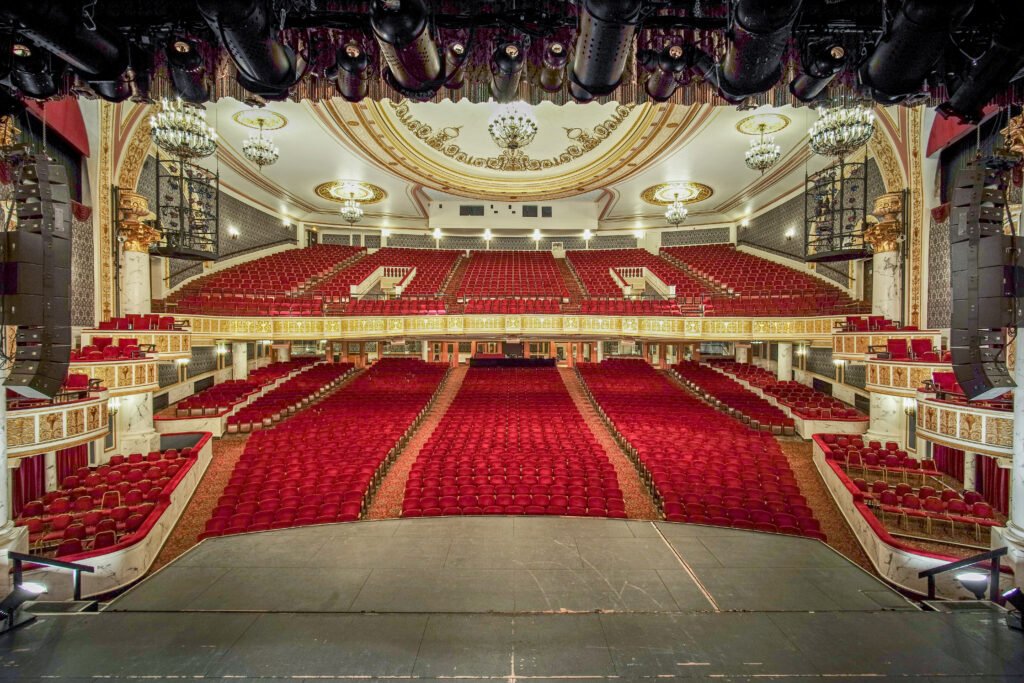
On the night of January 3, 1979, a standing-room-only crowd packed into a theatre that, on paper, no longer belonged to anyone who wanted it. Proctors had been seized by the City of Schenectady for unpaid back taxes, boarded up, and marked for demolition. But that night, magician Harry Blackstone Jr. — whose own father had played the building’s vaudeville stage in its heyday — took over the Mainstage for a reopening bill, and Mayor Frank Duci handed the theatre’s key and deed to Katherine Rozendaal, president of a scrappy nonprofit called the Arts Center and Theatre of Schenectady. Rozendaal handed him back a single dollar, the agreed-upon purchase price. “This is a significant, historic moment,” Duci told the crowd. He had no idea that the building he’d just handed away for a dollar would still be standing a century after it first opened.
The Dean of Vaudeville’s Last Great House
Frederick Freeman Proctor, known in his lifetime as the “Dean of Vaudeville,” had already been operating a theatre in Schenectady since 1912, a modest venue near the Erie Canal. By the mid-1920s, with General Electric and American Locomotive Company fueling the city’s growth, Proctor decided Schenectady deserved something grander. He bought real estate at 432 State Street, broke ground in 1925, and hired Thomas Lamb — the same architect behind Madison Square Garden — to design what Proctor himself called “the largest, handsomest and most costly theater I have ever built.”
It cost $1.5 million, an Italian Baroque and Egyptian-influenced showplace with a Louis XV marble fireplace, 18 dressing rooms with private baths, and a $50,000 Wurlitzer organ. Proctors opened December 27, 1926, with a silent film, “Stranded in Paris,” paired with six live vaudeville acts. More than 7,000 paid admissions came through the door that first day — a matinee cost 35 cents, an evening show 50 cents. Twelve-year-old Michael Riccio bought the very first ticket.
The vaudeville and movie-palace years that followed brought a run of names that still sound improbable for a mid-sized upstate city: theatre managers’ ledgers from the 1930s record Bob Hope and Red Skelton working the Mainstage, alongside big-band stars Cab Calloway and Duke Ellington. And on May 22, 1930, Proctors hosted a genuine footnote in broadcast history — GE engineer Dr. Ernst F. W. Alexanderson’s public demonstration of large-screen television, projecting a live performance from GE’s laboratories a mile away onto a seven-foot screen inside the crowded theatre. It was a one-time demonstration rather than an ongoing broadcast operation, but it placed Proctors, however briefly, at the birth of television itself — a fitting footnote for a theatre built in a city that General Electric had turned into a company town.
Boarded Up
Vaudeville didn’t survive the talkies, and by the 1950s and ’60s, Proctors was a first-run movie house losing ground to suburban multiplexes and a downtown Schenectady that was emptying out. Ownership passed through RKO and the Fabian chain; by the 1970s, the building owed more than $200,000 in back taxes and was seized by the city. Officials scheduled demolition.
A group of citizens — organized in the summer of 1977 as the Arts Center and Theatre of Schenectady, or ACTS — refused to let that happen. They funded a $25,000 feasibility study, ran a fundraiser called “Proctors is Alive and Well” that brought in more than $7,000, and secured roughly $500,000 in city and federal money for repairs. A Schenectady Employment and Training Administration crew built scaffolding to clean, paint, and re-plaster the auditorium. Volunteers scrubbed all 2,700 seats by hand because new ones were too expensive. The theatre reopened on January 3, 1979, was added to the National Register of Historic Places that same year, and has operated as a nonprofit ever since under what is now called Proctors Collaborative.
Goldie Comes Home
The original 1926 Wurlitzer organ didn’t survive the lean years; it was sold off in 1957 and disappeared into a private collection. In 1977, a committee of local organ enthusiasts began hunting for a replacement and eventually located one in a private Minnesota collection — a 1931 Wurlitzer theatre organ built in North Tonawanda, New York, and nicknamed “Goldie” for its gold finish. The Golub family — the Schenectady-based grocery dynasty behind Price Chopper, whose foundation has supported Proctors since the wrecking-ball years — funded the organ’s cross-country move with a $90,000 grant, and it arrived in July 1983. Organist Allen Mills was named Proctors’ first artist in residence the following year, recording albums on the instrument and presiding over holiday shows for more than a decade.
Goldie suffered serious water damage in 2021 when a drainpipe broke during a storm, destroying the organ’s wind chest. As this piece goes to press, Proctors is in the middle of a $400,000 restoration, led by COSS Organs of Delmar and the Hudson-Mohawk Chapter of the American Theatre Organ Society, timed to have Goldie’s full voice back for the theatre’s 100th-anniversary season this December.
Tripling the Stage
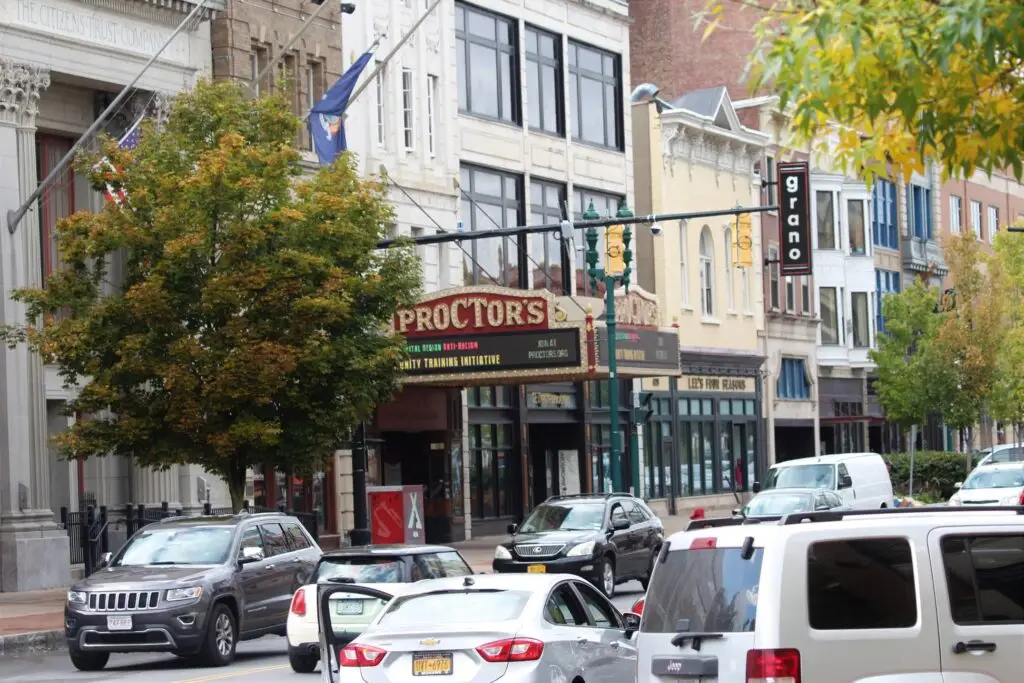
The theatre that reopened in 1979 was a museum piece with a shallow stage house that couldn’t fit a modern touring production. That changed with a $40 million expansion, launched in 2003, that tripled the size of the stage house and was completed in December 2005 — finally giving Proctors a stage big enough for large-scale Broadway tours. In September 2007, Proctors finished a further expansion into the adjacent former Carl Company department store building, adding a second performance space — the GE Theatre, a black-box venue seating in the low 400s — along with a new box office, gallery, and café. It was at that point the theatre officially rebranded itself simply as “Proctors,” dropping the apostrophe from its marquee name even though the marquee itself never did.
The bigger stage paid off. Starting with “Ghost the Musical” in 2013, Proctors began hosting full technical rehearsals — “teching” — for national Broadway tours before they hit the road, an arrangement estimated to have pumped roughly $30 million into downtown Schenectady from the “Ghost” engagement alone. Newsies, the Tony-winning revival of The Color Purple, Anastasia, Hadestown, Aladdin, Company, and Some Like It Hot have all teched at Proctors since, turning a once-shuttered movie house into a working piece of Broadway’s supply chain.
The Night Mariah Came to Schenectady
Broadway wasn’t the only industry that came calling. In July 1993, a Sony Music production crew scouted nearly two dozen theatres across four states looking for a venue to tape Mariah Carey’s first televised concert special — and picked the 2,700-seat Proctors for its acoustics, its architecture, and its proximity to Carey’s upstate home. Over three nights, Carey debuted songs from her then-unreleased “Music Box” album, including “Hero” and “Dreamlover,” in front of roughly 4,500 fans whose tickets were distributed through her fan club rather than sold. The resulting special, “Here Is Mariah Carey,” aired on NBC that Thanksgiving to an audience of 19 million and was later released on video, DVD, and — for its 30th anniversary — remastered audio.
The official music video for “Hero” was cut from Carey’s 1993 performance on the Proctors Mainstage. Video: MariahCareyVEVO.
Five years earlier, PBS affiliate WMHT had recorded a very different kind of concert on the same stage: “Susannah McCorkle and Friends: Jazz Meets Pop,” a 1988 television special featuring the acclaimed jazz vocalist alongside Gerry Mulligan, Mark Murphy, and the Eastman Jazz Ensemble — proof that the Mainstage could hold a national pop phenomenon and an intimate jazz session with equal comfort.
A Century Almost Here
Proctors turns 100 this December, and it’s worth sitting with how close the theatre came to not making it: a boarded-up building, a scheduled demolition, and a dollar bill changing hands on a January night in 1979. Everything that followed — Goldie’s return, the tripled stage, the Broadway tech residencies, the television specials — only happened because a handful of Schenectady residents decided a “musty white elephant” was worth saving. If you want to see what that century of stubbornness looks like on a concert night in 2026, Proctors’ current concert and touring calendar is still being written on the same Mainstage where it all started.
Photo & Video Credits
- Exterior: Matt H. Wade / Wikimedia Commons (CC BY-SA 3.0)
- MainStage auditorium interior: Proctors Collaborative Archive / Wikimedia Commons (CC BY 4.0)
- State Street marquee: Tyler A. McNeil / Wikimedia Commons (CC BY-SA 4.0)
- “Hero” (Live) official video: MariahCareyVEVO / YouTube