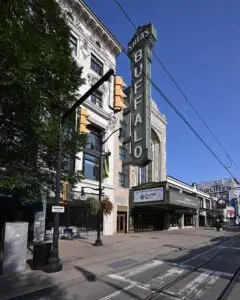
Groundbreaking came on January 15, 1925. Remarkably, it took exactly one year and one day to finish the job: on January 16, 1926, Michael Shea’s namesake movie palace opened its doors on Main Street with “The King on Main Street,” starring Adolphe Menjou, on the screen (Shea’s Performing Arts Center — official history, Wikipedia). Budgeted at roughly $1 million and finished for closer to $1.8 million, the “Wonder Theatre” sat nearly 4,000 people and was, by the standards of the day, one of the largest and most opulent theaters in the country (Shea’s — official history). This January, exactly one hundred years after that opening night, Shea’s marked its centennial with a yearlong celebration — a milestone made possible only because, fifty years into the building’s life, a handful of Buffalonians refused to let it come down (BroadwayWorld).
Rapp & Rapp, and an Interior Built to Rival Europe
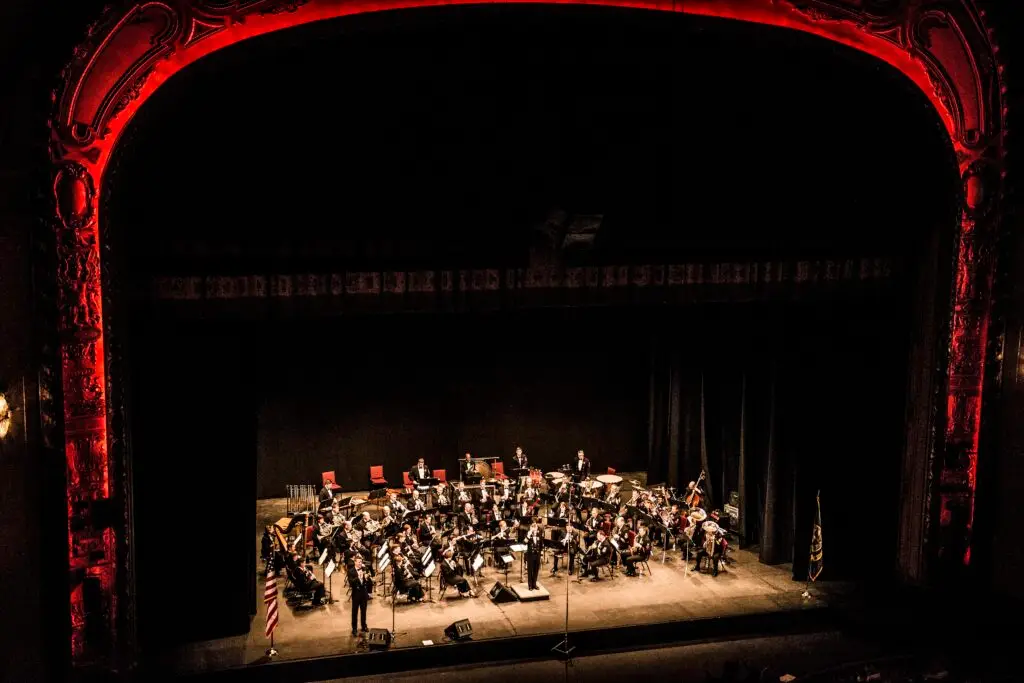
Shea’s was designed by the Chicago firm Rapp & Rapp — Cornelius Ward Rapp and George Leslie Rapp — the architects behind some of the grandest movie palaces built anywhere in America, working here in a French and Spanish Baroque-Rococo style meant to evoke the opera houses and palaces of 17th- and 18th-century Europe (Cinema Treasures, Shea’s — official history). Michael Shea, who had already built a chain of theaters across the city, brought in Tiffany Studios to design the interior — a rare commission for a movie house, and one Shea’s still points to today as making it the only surviving Tiffany-designed theater in the country (Shea’s — official history, Metropolitan Museum of Art collection record — Tiffany design for Buffalo Theater). The house organ, a four-manual, 28-rank Wurlitzer built and factory-voiced specifically for the room, was part of the same original vision — a “Mighty Wurlitzer” meant to accompany silent films and headline vaudeville bills alike (Shea’s — official history).
Vaudeville’s Biggest Names
Cab Calloway played the theater’s opening week in 1926, before he’d become a household name, and the room spent its first two decades as one of the premier vaudeville and movie stops in western New York — hosting the Marx Brothers, Frank Sinatra in 1941, George Burns, Bob Hope, and Ella Fitzgerald in 1945, according to the venue’s own account of the era (Shea’s — official history). It was, for a generation of Buffalo audiences, the biggest stage in the city.
A Signature Away From the Wrecking Ball
In 1948, Loew’s Inc. took over operation of the theater, running it for the next quarter-century as Loew’s Buffalo Theater (Cinema Treasures). By the mid-1970s, television and the suburbs had done to Shea’s what they did to grand movie houses everywhere: the theater closed as a movie house on June 30, 1975, its owner in tax default, and Loew’s — preparing to walk away for good — began making plans to strip the building of its fixtures and its organ (Wikipedia, Cinema Treasures). Demolition orders were drafted. Buffalo’s comptroller, George O’Connell, wouldn’t sign them (Buffalo News). That refusal bought time for a rescue that was already underway from the inside: L. Curt Mangel III, a 23-year-old engineer and watchman living out of a backstage dressing room, had spent months quietly inventorying every antique and fixture in the building. Working with a small volunteer group that incorporated as Friends of the Buffalo Theatre, Inc., Mangel’s inventory became the evidence base for a State Supreme Court injunction that stopped Loew’s from stripping the theater (Buffalo News). Mangel’s own photographs of the building went into the nomination that put Shea’s on the National Register of Historic Places on May 6, 1975, under reference number 75001186 — a listing secured in the very same year the theater went dark (Shea’s — vault archive, Wikipedia).
Reopening on Its Own Fiftieth Birthday
The Friends kept Shea’s open and rented from the city while restoration work slowly began. On February 25, 1976 — just over a month past the theater’s actual 50th anniversary — Shea’s staged a sold-out rededication built entirely around symmetry: George Burns, who had played the room in the 1940s, and bandleader Cab Calloway, who had played its 1926 opening week, shared the stage to rededicate the theater before an audience of roughly 3,000 (Buffalo News).
A Restoration Two Decades in the Making
Virtual tour of the restored house, via Shea’s Performing Arts Center’s official channel.
The rescue didn’t end with a reopening night. The Wurlitzer organ restoration began in 1977 under organ technician Allen Miller and wasn’t finished until it was rededicated in a April 1984 concert with organist Lyn Larsen at the console (Shea’s — vault archive). In 1985, the City of Buffalo formalized its support — assuming utility payments, forgiving accumulated deficits, and helping establish the Shea’s-O’Connell Preservation Guild, named for the comptroller who’d refused to sign the demolition order a decade earlier, as the nonprofit that operates the theater to this day (Shea’s — vault archive). Grant support from the Margaret Wendt Foundation helped carry the work forward, and by the venue’s own accounting, more than $30 million in restoration was completed over roughly twenty years — the overwhelming majority of it powered by volunteer labor, the same spirit that had saved the building in the first place (Shea’s — official history).
When the Rock Shows Came to Town
With the theater open and its finances stabilized, Shea’s spent the late ’70s and ’80s building a second identity as a touring rock stop. Welsh pub-rock outfit Rockpile played the room on April 25, 1978. AC/DC brought the Highway to Hell tour through on October 17, 1979, with Bon Scott still fronting the band. Frank Zappa played November 11, 1981, and the Jerry Garcia Band followed on May 25, 1983. Robert Plant brought his Fate of Nations tour to the same stage on November 17, 1993 — a run of bookings that shows just how far the room’s reach extended beyond Broadway and organ concerts once it reopened (setlist.fm — Rockpile, setlist.fm — Frank Zappa, setlist.fm — Jerry Garcia Band, setlist.fm — Robert Plant, ac-dc.net tour archive).
Buffalo’s Own Come Home
No booking captures what Shea’s means to the city quite like the Goo Goo Dolls’ returns. Buffalo’s own multi-platinum band played a two-night homecoming stand at Shea’s on December 1 and 3, 1999, in the middle of the “Dizzy Up the Girl” tour that had made them national stars (setlist.fm, Dec. 1, 1999, setlist.fm, Dec. 3, 1999). They came back nearly two decades later for the album’s 20th anniversary, playing three sold-out nights, October 19 through 21, 2018, performing “Dizzy Up the Girl” front to back followed by a set of deep cuts, with the run filmed for a future release (setlist.fm).
The Room Today
Shea’s today seats just over 3,000 — down from the nearly 4,000 it opened with, the difference owed to decades of wider, more comfortable seating installed through multiple renovations (Wikipedia, Cinema Treasures). It’s still owned by the City of Buffalo and still run by the nonprofit that grew out of the fight to save it, and its calendar still mixes touring Broadway with concerts the way it always has — David Byrne played the room in September 2025, and the Buffalo Philharmonic Orchestra performs there regularly alongside the touring musicals (setlist.fm venue page). You can check the current schedule at Shea’s Buffalo any week of the year. A hundred years after Michael Shea opened his “Wonder Theatre,” and fifty years after Curt Mangel and a handful of volunteers refused to let it fall, the room they saved is still doing exactly what it was built to do.
Photo & Video Credits
- Photo: G. Edward Johnson / Wikimedia Commons (CC BY 4.0)
- The Rapp & Rapp proscenium, lit for a performance. Photo: United States Navy Band (public domain).
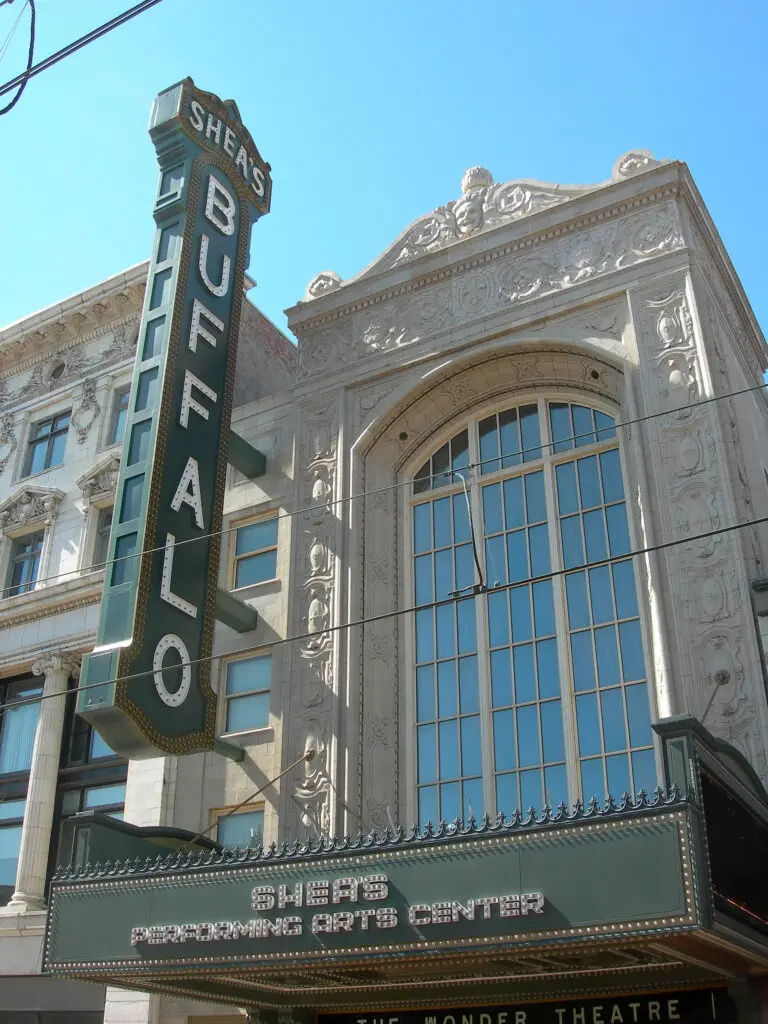
- The blade sign and marquee that Buffalo refused to lose. Photo: JasonParis / Wikimedia Commons (CC BY 2.0).
- Virtual tour of the restored house, via Shea’s Performing Arts Center’s official channel.