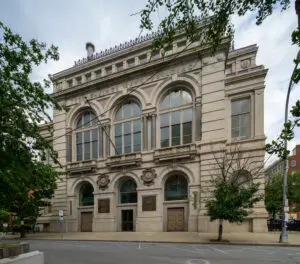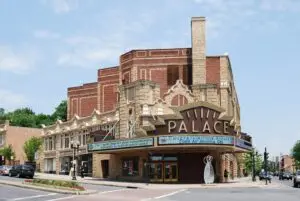
Troy Savings Bank had a simple, unglamorous problem in 1870: it had outgrown its building and needed a bigger one. What the bank’s trustees built instead of a plain headquarters was something stranger — a six-story structure at the corner of State and Second Streets with banking offices and rentable commercial space on the lower floors, and, tucked above all of it, a freestanding concert hall with its own entrance and its own box office (Wikipedia, Troy Savings Bank Music Hall — official history). Ground broke in July 1871; the building was finished in April 1875, designed by architect George B. Post at a total cost of $435,000 (Wikipedia, New York By Rail). A century and a half later, the bank is gone. The hall is still there, still full most weekends, and still regarded as one of the finest-sounding rooms in North America.
A Bank That Built a Concert Hall on Top of Itself
The arrangement was unusual even by Gilded Age standards, when plenty of American banks built grand headquarters to project stability and civic weight. Troy Savings Bank went further, carving out the upper floors for a self-contained auditorium — a room roughly 106 feet long, 69 feet wide, and 61 feet high, built in the “shoebox” shape that later became a term of art among concert-hall acousticians (Wikipedia, WGNA). The hall opened with roughly 1,250 seats, a figure that has stayed close to constant for a century and a half — venue materials cite 1,180, while Wikipedia and a 1999 American Heritage account put it at 1,253 — but it has never been a large room, and that has always been part of the point (Wikipedia, Troy Savings Bank Music Hall — official history, American Heritage).
By the standards of 1875, the reviews were not kind. Critics found Post’s design cold and the acoustics unremarkable — an inauspicious start for a room now synonymous with sound (WMHT, News10). The turning point, as the hall’s own history tells it, came fifteen years later: in 1890, the bank installed a massive pipe organ, and something about the room changed. Whether the organ altered the room’s acoustics or simply gave critics a reason to listen more closely is a question nobody can answer with certainty — but from that point forward, the hall stopped being an also-ran and started being a destination.
The Organ That Filled the Room
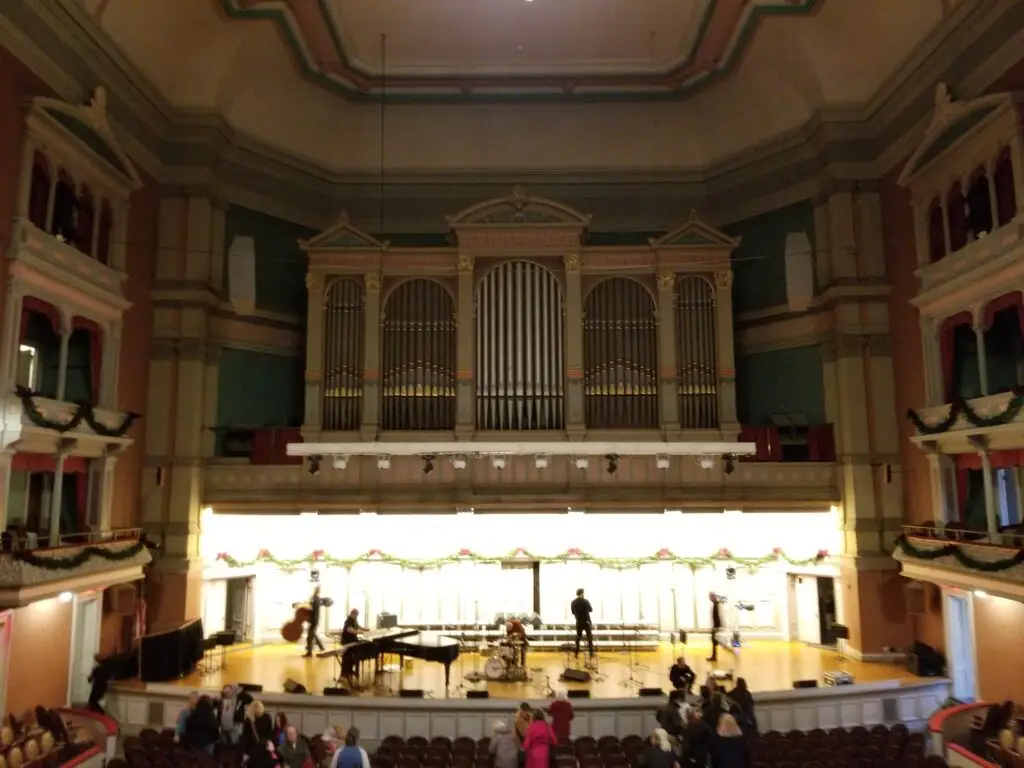
The instrument at the center of that story has its own strange history. Built in 1882 by the Yonkers firm of J.H. & C.S. Odell — cataloged as Opus 190 — it was originally installed in the private New York mansion of financier William Belden, not built for Troy at all (Wikipedia, WMHT). Troy Savings Bank acquired it and had it reinstalled in the hall in 1890, and the Odell Company reportedly had to redesign parts of the installation because the instrument was too large for the space (News10). The first notes sounded on October 20, 1890, and it has been there since — today billed as the largest nineteenth-century concert organ surviving in original condition (Wikipedia). It underwent a major restoration in early 2006, led by S.L. Huntington & Co. of Stonington, Connecticut, celebrated at that year’s Organ Historical Society national convention (Wikipedia).
Who Actually Said This Room Sounds That Good
“The Music Hall | Troy NY’s Monument to Sound,” via WMHT (PBS).
“World-class acoustics” is the kind of phrase every historic hall claims about itself, and Troy is no exception — the venue’s own materials cite the shoebox form, the tall ceiling, the padded wooden seats, and the thick plaster surfaces as likely ingredients of the sound, while conceding there is no single agreed-upon reason the room works as well as it does (Troy Savings Bank Music Hall — official history, WMHT). But the reputation did not stay confined to marketing copy. According to a detailed 1999 American Heritage account, conductor George Szell called it the best hall he ever played in and reportedly vowed to stand in front of it with his arms out if anyone tried to tear it down, and Dimitri Mitropoulos is said to have offered to perform there for free, moved by what he heard from the podium (American Heritage). The most consequential endorsement, by that same account, came from Harold C. Schonberg — chief music critic of the New York Times from 1960 to 1980, and in 1971 the first music critic ever to win the Pulitzer Prize for Criticism — who visited the hall that year and wrote that it produced “sound you could reach out and touch.” American Heritage credits that review with helping galvanize the effort that would, within the decade, save the hall from neglect (American Heritage, Washington Post — Schonberg obituary). That single account is the most detailed sourcing available on the Szell, Mitropoulos, and Schonberg anecdotes; Schonberg’s stature as a real, Pulitzer-winning Times critic is independently documented, lending weight to the claim even without a second outlet corroborating the 1971 visit itself.
The Room That Almost Went Quiet
Whatever revived interest that 1971 visit generated, it arrived just in time. By the early 1970s the hall’s bookings had thinned, and the building itself was showing its age. In 1979, a dedicated nonprofit, the Troy Savings Bank Music Hall Corporation, was formed to lease and operate the hall independently of the bank’s own business (Wikipedia, News10). Its first season, 1979–80, opened with a performance by the Benny Goodman Band, announcing the hall was back in business as a serious concert destination (Wikipedia). Ten years later, on April 11, 1989, the building was added to the National Register of Historic Places and simultaneously designated a National Historic Landmark, under reference number 89001066 (NPS NPGallery, Wikipedia).
The bank itself outlasted that transition by decades, continuing to operate out of the ground floor even after the hall above it was spun off. It was First Niagara Bank, the successor institution by then occupying the space, that finally closed the ground-floor branch for good at 3:00 p.m. on Friday, May 18, 2012 — ending 142 consecutive years of banking on that corner, even as the Troy Savings Bank Music Hall kept its calendar running upstairs, unaffected (WGNA).
The Room’s Second Career: A Recording Studio Nobody Built
Once the hall’s reputation was restored, it found an entirely new use with nothing to do with live audiences. Dorian Recordings, a classical label founded in Troy in 1988, adopted the Music Hall as its primary recording space and, over the following decade, made more than a hundred compact discs there, leaning on the same acoustics that had won over Szell and Mitropoulos to capture chamber ensembles, early-music groups, and soloists in natural, unprocessed sound (Wikipedia — Dorian Recordings, American Heritage). Few concert halls get to play that role twice — first drawing the world’s touring soloists, then serving as a studio good enough that a record label built its entire identity around its walls.
Six Generations of Performers, One Unchanged Room
The list of who has actually stood on that stage is where the hall’s reputation gets tested against the record, and it holds up. In the early twentieth century, the roster reads like a syllabus of the era’s greatest names: Ignace Jan Paderewski, Sergei Rachmaninoff, Vladimir Horowitz, Yehudi Menuhin, and Artur Rubinstein all performed there, drawn by a room touring virtuosi of the period rarely skipped on an American tour (Wikipedia, New York By Rail). In December 1990, cellist Yo-Yo Ma joined violinists Isaac Stern and Jaime Laredo and pianist Emanuel Ax for a pair of free Music at Noon concerts following a joint recording session — chamber royalty treating the room as a working studio between takes (News10).
The hall’s range beyond classical music is documented just as concretely, thanks to setlist archives that track touring artists date by date. Bluegrass and folk fiddler John Hartford played the room on November 18, 2000; Jethro Tull frontman Ian Anderson brought his solo tour through on October 15, 2002; jazz saxophonist Branford Marsalis played a date there on January 16, 2025; and Yes keyboardist Rick Wakeman closed out a solo tour with a stop at the hall on October 6, 2024 (setlist.fm — John Hartford, setlist.fm — Ian Anderson, setlist.fm — Branford Marsalis, setlist.fm — Rick Wakeman). Folk singer-songwriter Arlo Guthrie played the hall on November 24, 1996, in a show a contemporary review describes as him spending nearly as much time talking to the crowd as singing (J. Eric Smith — concert review).
The Room Today
What makes the hall unusual isn’t that it survived — plenty of nineteenth-century halls survive as museum pieces, rented out occasionally for weddings and lectures. What makes it unusual is that it never stopped being used for exactly what it was built for. The bank that built it is gone; the vault, the tellers, the 142 years of ground-floor commerce are gone. The room upstairs is not. It is still booking classical recitals, still hosting jazz and folk and the occasional prog-rock elder statesman, and it is still, by the testimony of people who have stood in front of orchestras all over the world, one of the best-sounding rooms any of them have ever heard.
Photo & Video Credits
- Photo: Kenneth C. Zirkel / Wikimedia Commons (CC BY-SA 4.0)
- The Odell organ above the stage, still the room’s defining feature. Photo: Coasterlover1994 / Wikimedia Commons (CC BY-SA 4.0).
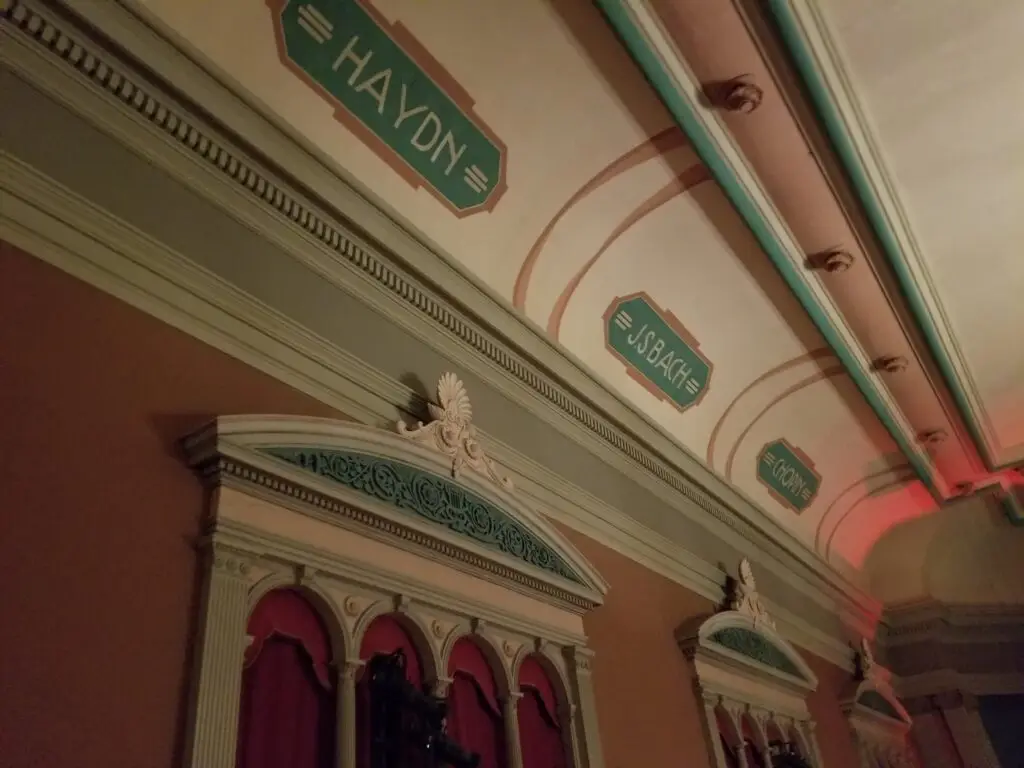
- Composer cartouches ring the ceiling — Haydn, Bach, Gounod. Photo: Coasterlover1994 / Wikimedia Commons (CC BY-SA 4.0).
- “The Music Hall | Troy NY’s Monument to Sound,” via WMHT (PBS).