About halfway through “Cherry Licorice,” off the Felice Brothers’ 2024 record Valley of Abandoned Songs, Ian and James lean into a harmony on the chorus and the arrangement seems to pull a step back to let the two voices through. It is not a clean harmony. It is not supposed to be. The brothers have been singing together since they were kids in a hamlet called Palenville, in the Catskills foothills of Greene County, and what you are hearing is twenty years of breath and proximity — the kind of blend you cannot fake, cannot teach, and cannot, in any meaningful sense, recreate with session players. It is the sound of family, and it is the sound of a specific corner of Upstate New York, and on a good night in the right room it will reduce a crowd to silence.
That sound is the whole story.
The Origin Story — Sunday Cookouts to Subway Platforms
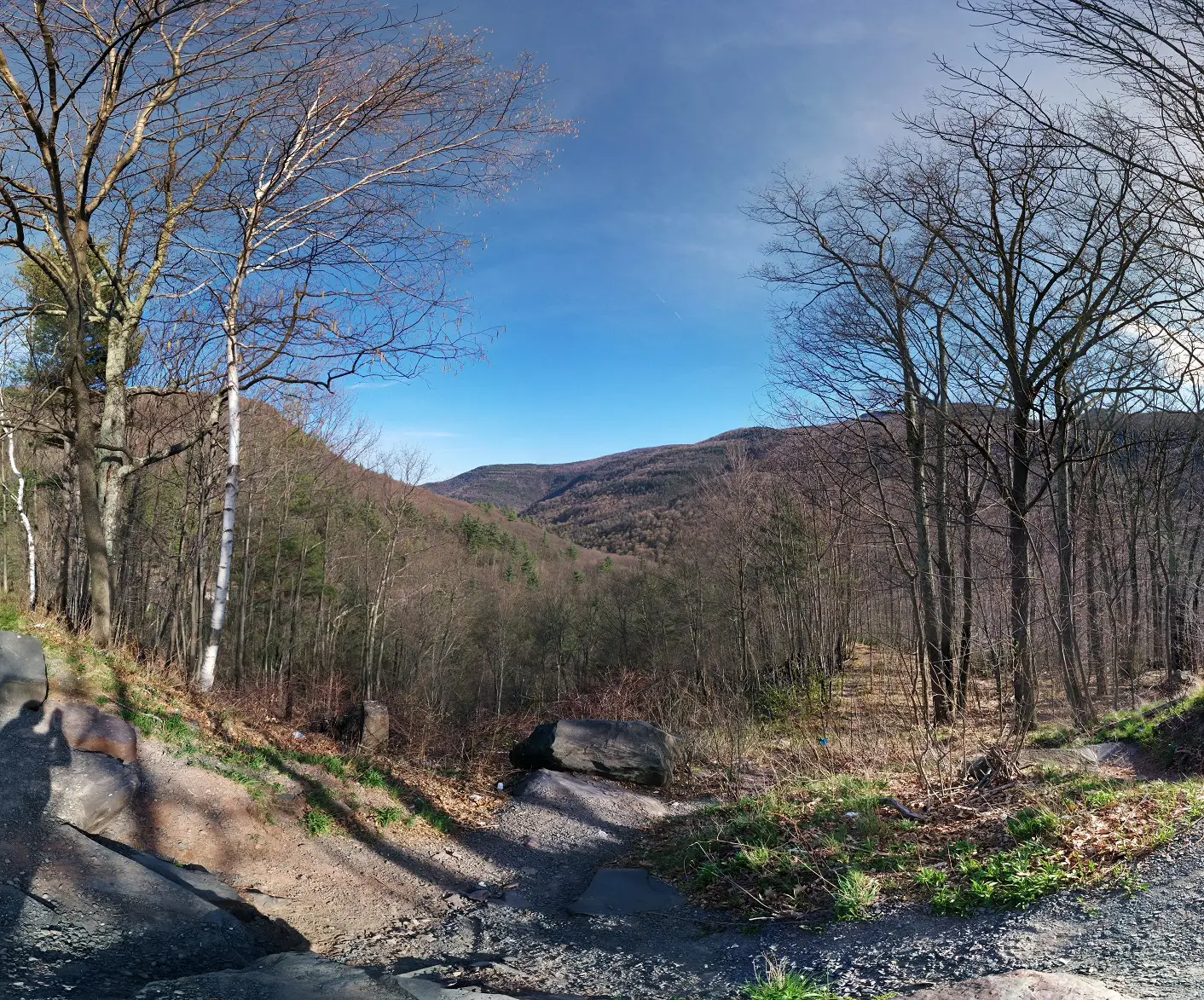
Palenville sits at the intersection of Routes 32A and 23A in Greene County, population 1,037. It is the kind of place Washington Irving wrote into Rip Van Winkle — wooded, vertical, slightly off the modern map. Ian has described his childhood there as “Huck Finn-ish”: rope swings, camping, the Sleepy Hollow quiet of a town wedged into the eastern wall of the Catskills. Their father was a builder. None of the brothers had formal musical training. What they had was a kitchen, a couple of guitars, and the habit of gathering at the family house on Sundays for what they called song swaps.
The Sunday cookouts produced a band. The band — James on accordion and keys, Ian on guitar and lead vocals, and their older half-brother Simone on drums — eventually took itself out of the kitchen and onto the subway platforms of Manhattan, where the Felice Brothers worked as buskers in the mid-2000s, playing 42nd Street and Union Square for whatever the morning commute would drop in the hat. Early recordings circulated on self-released CDs they sold off a card table. By the time Conor Oberst’s Team Love label signed them in early 2008 — releasing the self-titled The Felice Brothers that March — they already had four homemade records behind them and the kind of cohesion you only get from playing every day, in front of strangers, for tips.
They had also, almost as an aside, sketched out their sound. The early Felice Brothers records are recognizably a continuation of the Greenwich Village folk revival rerouted through the Catskills — narrative-driven, accordion-heavy, willing to be ramshackle in service of the song. It is music that does not exist in a vacuum, but it also does not really sound like anyone else.
The Field-Recording Aesthetic
The Felice Brothers’ early catalog was famously recorded in places that were not studios. An abandoned cafeteria. A converted school bus. A chicken coop. A leaking old theater in New York. The band would set up microphones wherever they could afford to — which is to say, wherever someone would let them in for free — and the resulting recordings carried the rooms with them. The slap of a wood floor on Through These Reins and Gone. The close-mic’d intimacy of Yonder Is the Clock. The lo-fi warmth that became their signature long before anyone called it that.
The chicken-coop reference, often misremembered as a single permanent studio, was actually a working ethos. Celebration, Florida (2011) was tracked in an old high school in Beacon. Life in the Dark (2016) was made in a farm-outbuilding garage at Letterbox Farm in Columbia County, adjacent to a working chicken coop and a tractor repair shop, engineered by James himself. “Sometimes the chickens come by and hang out when we’re playing,” he told Chronogram at the time. James, for a stretch, also lived in a converted chicken coop. The recent records — Asylum on the Hill (2023) and Valley of Abandoned Songs (2024) — were tracked at The Church in Harlemville, a converted country chapel in Columbia County that James and producer Nate Wood have built into something like a permanent base of operations.
The point is consistent across the catalog: the room is part of the band. The Felice Brothers do not make Felice Brothers records anywhere else, because there is no one else who would build a record this way. The structures they record in have a way of becoming the album’s other instrument.
The Catalog
Nine studio albums of consequence, depending on how you count.
The early self-released run — Iantown (2005), Through These Reins and Gone (2006), Tonight at the Arizona (2007), and Adventures of The Felice Brothers Vol. 1 — established the songbook. The Team Love debut, The Felice Brothers (2008), brought them into wider rotation; the follow-up, Yonder Is the Clock (2009), is the record many longtime listeners still hold up as the band’s high point. Celebration, Florida (2011) muscled the arrangements up. Favorite Waitress (Dualtone, 2014) tightened the songwriting. Life in the Dark (Yep Roc, 2016) introduced the Hudson farm-outbuilding sessions. Undress (2019) leaned political and produced some of Ian’s sharpest writing. From Dreams to Dust (2021) sat with the pandemic — and earned the strongest critical notices of the band’s career to that point, with reviewers from American Songwriter to Spectrum Culture calling it a contender for album of the year.
Then came the late chapter, which has been one of the band’s most productive stretches. Asylum on the Hill, recorded at The Church in Harlemville in 10 days in May 2023, was released as a surprise album that December and drew an even stronger reception. Valley of Abandoned Songs followed in June 2024, a 13-track collection of material Ian had initially intended to release quietly online. Conor Oberst, by Ian’s account, talked him out of it and offered to put it out on Million Stars — a label Oberst started specifically for the record.
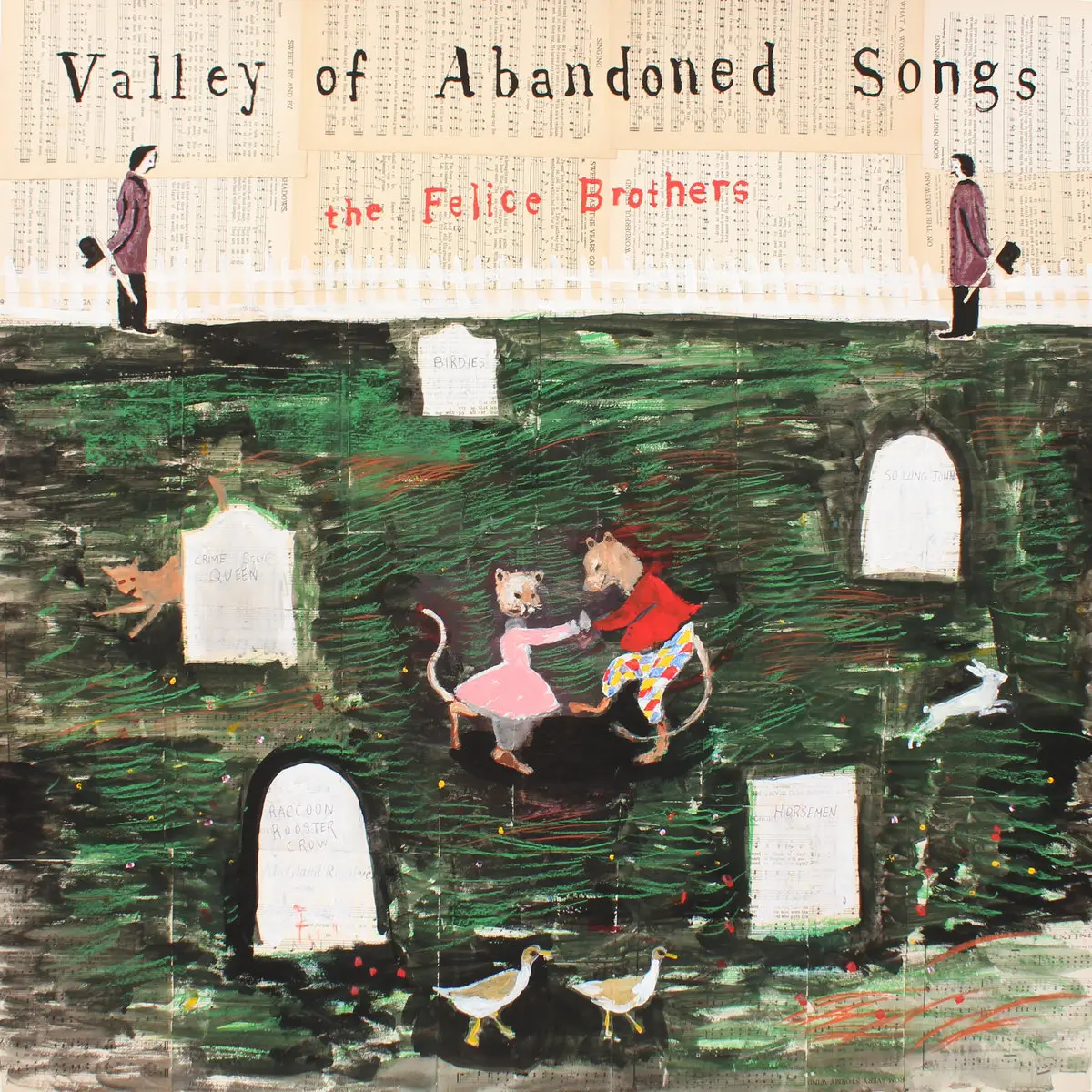
Two albums in two years, both vital, both made on the band’s own terms in a room they trust, both released on labels run by people who actually love the band. Twenty years in is not when most American bands are doing their best work. The Felice Brothers, by any honest measure, are.
What the Music World Finally Heard
The Dylan-and-The-Band comparisons have followed the Felice Brothers since the first major-label record dropped, and James has been explicit about not buying into the framing. “An accident of geography,” he told Chronogram. “We never tried to get into that world and we never felt like part of that scene.”
That is the right line, and worth taking seriously. The Felice Brothers grew up two ridges over from Big Pink. They have played the Midnight Ramble at Levon Helm Studios on Plochmann Lane — most notably the September 17, 2021 album-release show for From Dreams to Dust, with subsequent return visits — and have known the Helm family circle for years. The geography is real. But the Felice Brothers’ music does not actually sound much like The Band’s music, and the through-line that does run through their catalog is something different — closer to the Greenwich Village folk revival as filtered through their own Catskills isolation than to the Big Pink basement tapes. The records they have made in the Hudson Valley sound like records made by people who grew up there. They do not sound like records made by people trying to extend a legacy that belongs to somebody else.
The validation arc that did happen, and that deserves to be named, ran through Conor Oberst. Oberst saw the Felice Brothers early and never stopped saying so: asked his favorite band, he has answered, simply, the Felice Brothers. His Team Love label signed them in 2008 after putting them in front of his own audience the fall before, when they opened a Bright Eyes run that included the November 19, 2007 Radio City Music Hall finale of the Cassadaga tour — a stage roughly a hundred times the size of any room they had played to that point. They went on to serve as Oberst’s backing band on his 2017 Salutations record. When Ian sent Oberst the Valley of Abandoned Songs material with the plan of putting it up online, Oberst, in his own telling, “flipped out” — and started a record label on the spot to release it properly.
That is the recognition arc. It just was not Dylan’s. It was something more durable: a peer-to-peer endorsement from one of the most respected songwriters of the generation that came up alongside them, repeated publicly for two decades, and ultimately translated into a label built specifically to put their work out. Most American bands would trade a Dylan opening slot for that. They earned it the slow way.
The Brothers as Family Business
Simone left the band in 2009 to pursue The Duke & The King and a solo career, and what could have been a dissolution turned out to be the start of something the family-business model handled better than most. Simone has built one of the more interesting parallel careers in American roots music — five solo records, producer credits on what amounts to a substantial chunk of the modern Americana shelf. He produced The Lumineers’ Cleopatra (2016), III (2019), and Brightside (2022), and co-produced Bat for Lashes’ The Bride (2016). Last year ICM Crescendo’s music royalty fund acquired a portion of his producer catalog — the kind of transaction that, in 2026, is the music industry’s clearest way of saying this person made things that are still going to be worth money in 20 years.
Ian and James, meanwhile, kept making Felice Brothers records. The current touring lineup pairs the founding brothers with Jesske Hume on bass (formerly with Conor Oberst, Jade Bird) and Will Lawrence on drums — the configuration that debuted on Undress in 2019. It is a tight four-piece, leaner than the rotating-cast versions of the band that came through Greg Farley, Christmas Clapton, and David Estabrook, and it is the configuration that has produced the late-career records that have so quietly turned into the band’s strongest run.
Summer 2026
The 2026 touring schedule, as confirmed at the time of writing, is light on Upstate dates but heavy on the one that matters most to readers of this publication who happen to live west of Syracuse. The Felice Brothers play Rec Room in Buffalo on Sunday, July 19, 2026. It is a 350-capacity room on Chippewa Street — exactly the kind of stage the band has been playing well for two decades, and exactly the kind of stage where the harmony moment in “Cherry Licorice” lands the way it is supposed to land. If you live in Western New York and you have never seen this band, that is the date. If you live anywhere east of Buffalo and you have not seen them, drive west.
European dates follow in late summer. No additional Hudson Valley, Catskills, or Capital Region dates have been announced for 2026 as of mid-May, and no new album has been formally scheduled — though, given the pace of Asylum on the Hill and Valley of Abandoned Songs, it would not be surprising to see one before the year is out.
Why They Matter
There is a story the regional music economy has been telling itself for fifty years, and the short version is that you have to leave Upstate to do the work that matters. Move to Brooklyn. Move to Nashville. Move to Los Angeles. Come back for the holidays. The story is sometimes true. It is also, in 2026, less true than it used to be — and the Felice Brothers are part of the reason.
They grew up in Palenville. They went to the city, got a record deal, and came back. They have made nine studio albums of their own and a handful of self-releases on top of that, almost all of them tracked in rooms within an hour’s drive of where they grew up. They built a career that does not require them to leave the Catskills to do the work that matters, and the work has gotten better as they have gone, not worse. Asylum on the Hill and Valley of Abandoned Songs are the best two consecutive Felice Brothers records, and they were made in a converted chapel forty miles from the kitchen where the Sunday cookouts started.
That is the argument. Not that the Felice Brothers are the next Band, because they are not, and they would not want to be. The argument is that one of the most consequential American folk bands of the last twenty years has been quietly making its case from a corner of Upstate New York that the rest of the music industry has spent fifty years driving past on the way to somewhere else. The records are on the shelf. The brothers are still here. And on July 19, in a 350-cap room in Buffalo, you can hear what twenty years of singing together sounds like up close.
Go.
Disclosure: Some links in this article are affiliate links. Upstate Concerts may earn a commission on ticket purchases at no additional cost to you.