On Saturday, July 26, 2025, three of the venues on this list had headliners on the same night. Guns N’ Roses played the lawn at the Saratoga Performing Arts Center. The Goo Goo Dolls played CMAC in Canandaigua. The Doobie Brothers played Bethel Woods. The state’s outdoor calendar had room for all of it and barely noticed.
Every Upstate music fan who has been at this long enough eventually arrives at the same question: how does one state have this many great outdoor rooms? I’ve been covering live music here for more than twenty-five years. The answer is the back half of this piece. The first half is the ranking — five venues, in order, with the argument for each. Companion to the Saratoga Sound flagship from May, which made the case for SPAC as the best outdoor venue in America. This one extends the argument.
The Criteria
A ranking that isn’t an argument is just a directory with serial numbers. Five things I’m weighing: setting, architecture and acoustics, programming range (the breadth of musical traffic a room can absorb), cultural weight (institution versus facility), and the lawn — because at four of these venues, the lawn is the modal seat (the Lawn Bible goes deep on the specifics). SPAC tops four of five. The others trade strengths. That’s the order.
#1 — Saratoga Performing Arts Center (Saratoga Springs)
The full case lives in the Saratoga Sound piece. The short version: SPAC is the best outdoor music venue in America. Capacity 25,103 inside the 2,400-acre Saratoga Spa State Park. The cantilevered roof was engineered for the New York City Ballet and the Philadelphia Orchestra in 1966, and it survived the touring rock economy that arrived on top of it — the harder problem. The Saratoga Jazz Festival has anchored the late-June calendar for more than four decades. Dave Matthews Band returns July 17 and 18, 2026 for its 51st and 52nd performances on the property — more than at any other venue in DMB’s history. Phish has logged more than two dozen nights here. Goose runs two nights July 3 and 4. Guns N’ Roses July 26. The Philadelphia Orchestra residency runs through August. NYCB opens its summer with the same Balanchine A Midsummer Night’s Dream that christened the venue in 1966.
No other outdoor amphitheater in America anchors world-class ballet, a major orchestra residency, a heritage jazz festival, and a multi-decade jam-band relationship simultaneously. SPAC does. It’s the only venue in the country where a 75-year-old NYCB subscriber and a 25-year-old in a Phish T-shirt eat from the same food trucks on consecutive nights. First, and not close.
#2 — Bethel Woods Center for the Arts (Bethel)
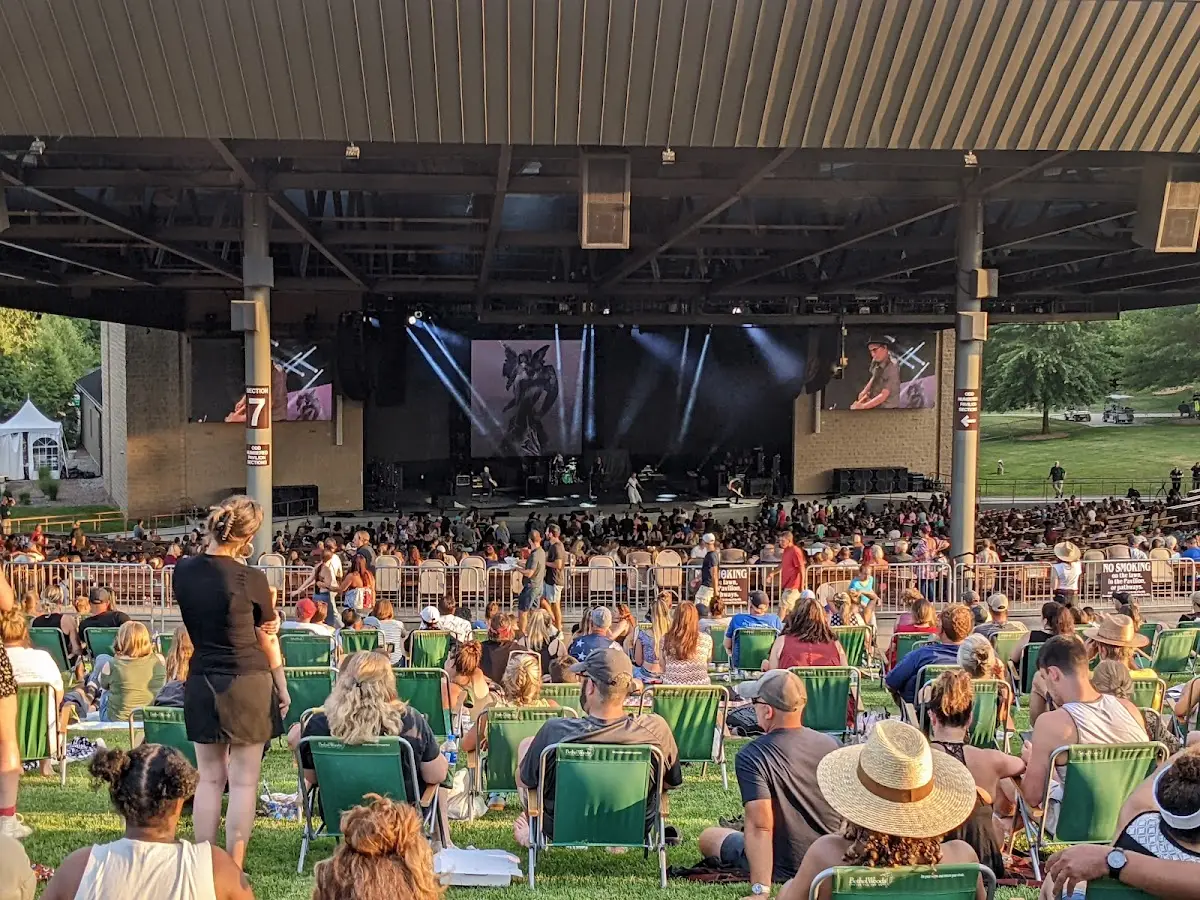
Bethel Woods, which opened in 2006, was the answer to a question two failed attempts had already proven was the wrong question. Woodstock ’94 survived as muddy peace. Woodstock ’99 ended in fire, assault, and three deaths. Both tried to recreate a moment. Cable executive Alan Gerry’s development on the actual 1969 Yasgur’s farm site did something different — it built a permanent place.
The result is a 15,000-capacity outdoor pavilion (4,500 covered seats plus 10,500 on the natural-bowl lawn), a 1,000-seat outdoor Terrace Stage, and the Museum at Bethel Woods, all on the grounds where Hendrix played the anthem at dawn on Aug. 18, 1969. The booking runs country, heritage rock, the jam economy, and the contemporary touring product on top of it all.
What you cannot do, despite the natural assumption, is sit on the original 1969 field during a show at the modern pavilion. The historic field is preserved as a museum experience — paid self-guided and golf-cart tours only, not available on show days. The right call. The field is consecrated ground. The modern amphitheater lawn, meanwhile, is the most architecturally honest on this list: a consistently graded symmetrical bowl with usable sightlines from anywhere along the centerline. Bethel takes silver because the facility is first-rate and because no other venue in America carries the cultural weight the ground itself confers.
#3 — Artpark (Lewiston)
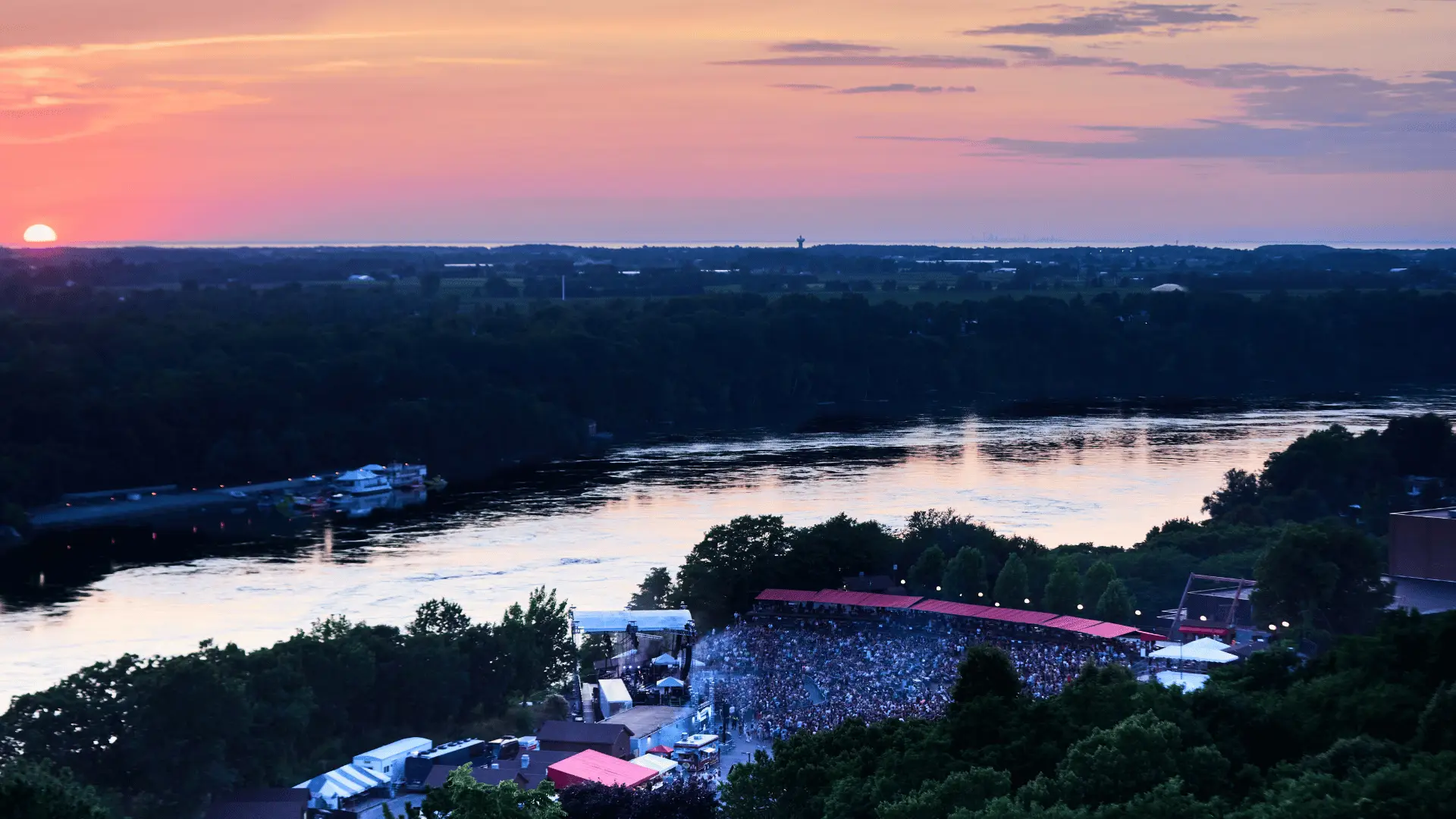
Artpark is the most cinematic outdoor venue in Upstate New York and the Western NY anchor of any serious touring calendar. The amphitheater sits atop 150 acres of state park land at the rim of the Niagara River Gorge, with a tiered configuration that handles several thousand across reserved seating and lawn. The gorge — visible during the show, glowing pink at sundown on a clear August evening — is the entire visual story. The 2026 Live Nation calendar runs heritage (Sarah McLachlan, Ziggy Marley), Americana (Ryan Bingham), indie, and the touring middle. The free “Tuesdays in the Park” series anchors midweek programming on the smaller Mainstage Theater lawn.
The variable is the wind. The river runs north-south at Lewiston, the amphitheater opens to the south, and the gorge channels air. Light wind cools the slope. Building wind pulls high-end sound away from the back half of the lawn and out across the gorge. The fix: sit as close to the seated bowl as possible — front-of-lawn at Artpark beats mid- or back-of-lawn for sound, which contradicts standard amphitheater intuition. The Lawn Bible has the rest.
What keeps Artpark out of the silver and gold, despite the most dramatic setting on the list, is volume. The calendar is a fraction of SPAC’s or Bethel’s. Fewer chances, spectacular when the right show aligns. Western New York has accepted the trade, correctly.
#4 — CMAC / Constellation Brands–Marvin Sands Performing Arts Center (Canandaigua)
CMAC is the Finger Lakes anchor of the Live Nation/AEG touring economy and the venue I recommend most often to first-time Upstate outdoor concertgoers. The reason is simple — it’s essentially impossible to have a bad time at CMAC.
The room has a longer history than most realize. CMAC opened in 1983 and ran two decades in its original configuration before a roughly $13 million rebuild between the 2005 and 2006 seasons expanded covered seating to about 5,000 and added luxury boxes. Current capacity is 15,000. The setting is rolling Finger Lakes hills west of Canandaigua Lake; the wine trail, the lake, and the food scene in town extend the show into a weekend.
The 2026 sheet is the working middle of the touring rock economy. Teddy Swims opens the season Friday, June 5 with Marc Scibilia supporting. The Allman Betts Band, Lynyrd Skynyrd’s 50th anniversary swing, Caamp on July 21, and Sublime follow later in the summer. Broader than Bethel’s on the indie/contemporary side, narrower on the classical/jazz institutional side — and that’s the point. The tailgating tradition is real; two hours before doors is on schedule.
CMAC at #4 reflects two costs: the setting is gorgeous but doesn’t carry Artpark’s gorge-cinema or Bethel’s cultural weight, and the institutional programming layer that lifts SPAC and Bethel doesn’t exist here. What it has is a serious touring sheet, a usable lawn, and the best concert-to-total-trip ratio in the state.
#5 — Empower Federal Credit Union Amphitheater at Lakeview (Geddes/Syracuse)
The Empower FCU Amphitheater at Lakeview — Central New York’s default outdoor venue — has cycled through three names in its decade of operation. It opened as the Lakeview Amphitheater on Sept. 3, 2015. St. Joseph’s Health took over the naming rights, holding them through 2023. Empower Federal Credit Union paid $4 million for seven-year rights in October 2023, producing the cumbersome legal name and the merciful local shorthand. Use “Empower FCU” or “Lakeview.” The locals do.
The venue holds 17,500 — 5,000 under the pavilion and 12,500 on the lawn — on the southern shore of Onondaga Lake in Geddes, on the New York State Fairgrounds. The $49.3 million facility replaced the aging Mohegan Sun Grandstand and serves double duty as the primary concert stage during the State Fair’s late-summer run. The 2026 season opens Monday, June 8 with Kid Cudi’s Rebel Ragers Tour — Cudi with M.I.A., Big Boi, and Mё Nü. Centro launches dedicated shuttle service from downtown Syracuse that night, the right institutional response to a decade of parking bottlenecks.
What pulls Empower FCU into fifth rather than fourth is the setting. Onondaga Lake’s environmental history is a Superfund-level story I won’t relitigate; the waterfront has improved substantially in the venue’s decade, but the surrounding landscape doesn’t carry the natural beauty of CMAC’s hills, Artpark’s gorge, Bethel’s bowl, or Saratoga. What it offers in exchange is geographic centrality — within reach of Rochester, Albany, Binghamton, and Utica, the most accessible major amphitheater in the state. For Central New York, it’s the home room. There’s a real gap between the top five and everything that follows.
Honorable Mention — Highland Bowl (Rochester)
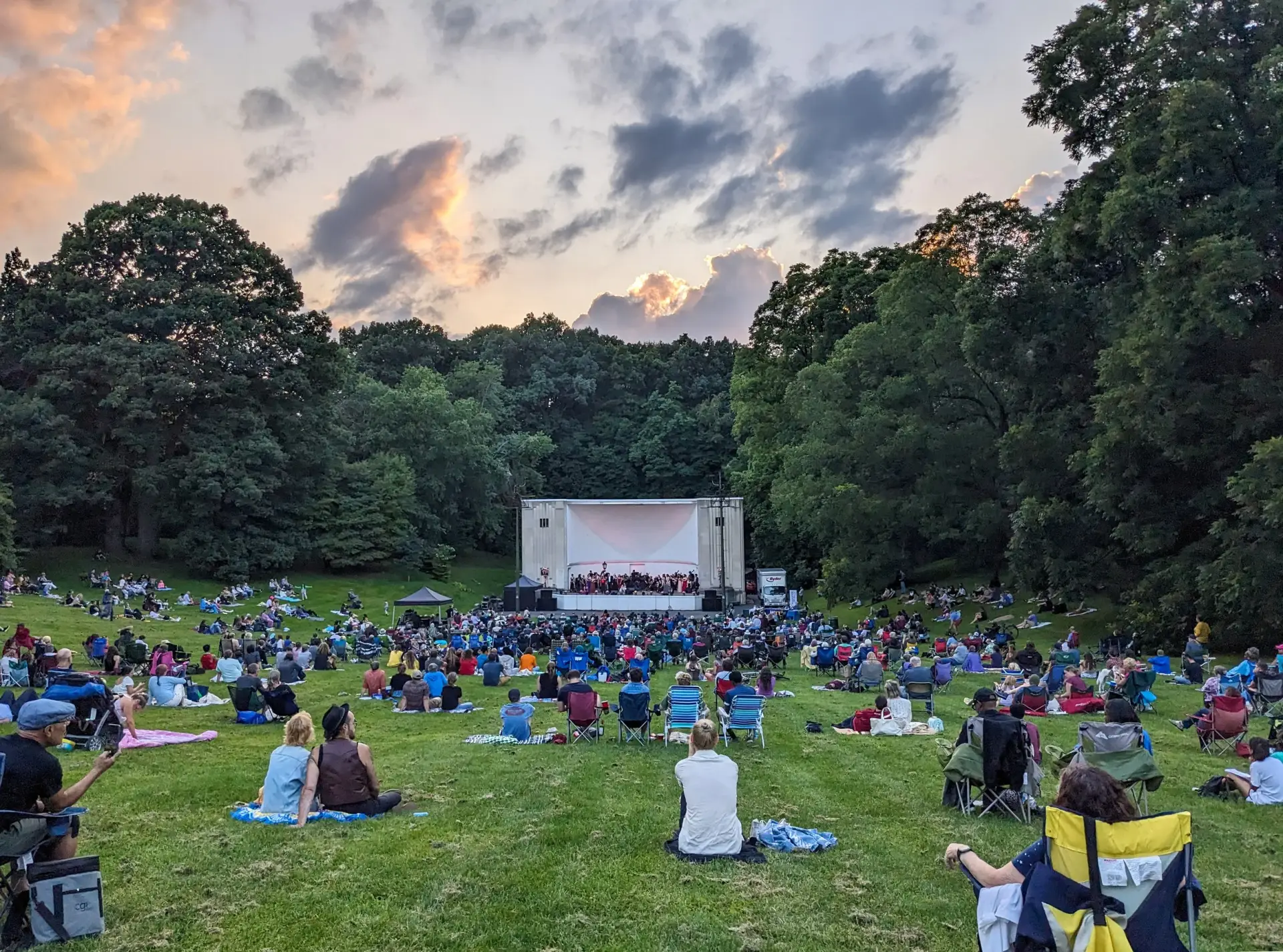
Highland Bowl in Rochester is the city-park outlier and earns the mention by being its own category. No Live Nation booking, no covered pavilion, no $14 beer. What there is, at the bottom of a natural grass amphitheater inside Highland Park, is an art deco bandshell programmed by the Highland Park Conservancy — Shakespeare in the Park, the Flower City Poetry Fest, Jazz in the Bowl, Movies in the Bowl, the occasional regional booking. Almost all of it free, chairs and blankets welcome. A different category from a SPAC night. The right move is to do both in the same summer.
Honorable Mention — Beak & Skiff 1911 Stage (LaFayette)
The other honorable mention is a category we didn’t have ten years ago. Beak & Skiff Apple Orchards in LaFayette has spent the last decade turning its Apple Hill campus into a serious outdoor venue. The 1911 Tasting Room produces cider, spirits, and wine on the orchard property; the open-air 1911 Stage has pulled genuine touring acts — Noah Kahan, Lake Street Dive, the Wood Brothers, Death Cab for Cutie. Different model from the amphitheaters: agritourism plus craft beverage plus music. Not yet a Top 5 contender on volume, but the trajectory is real and the orchard-and-cider setting is unduplicable.
Best Free Concert Series Venue — Music Haven (Schenectady)
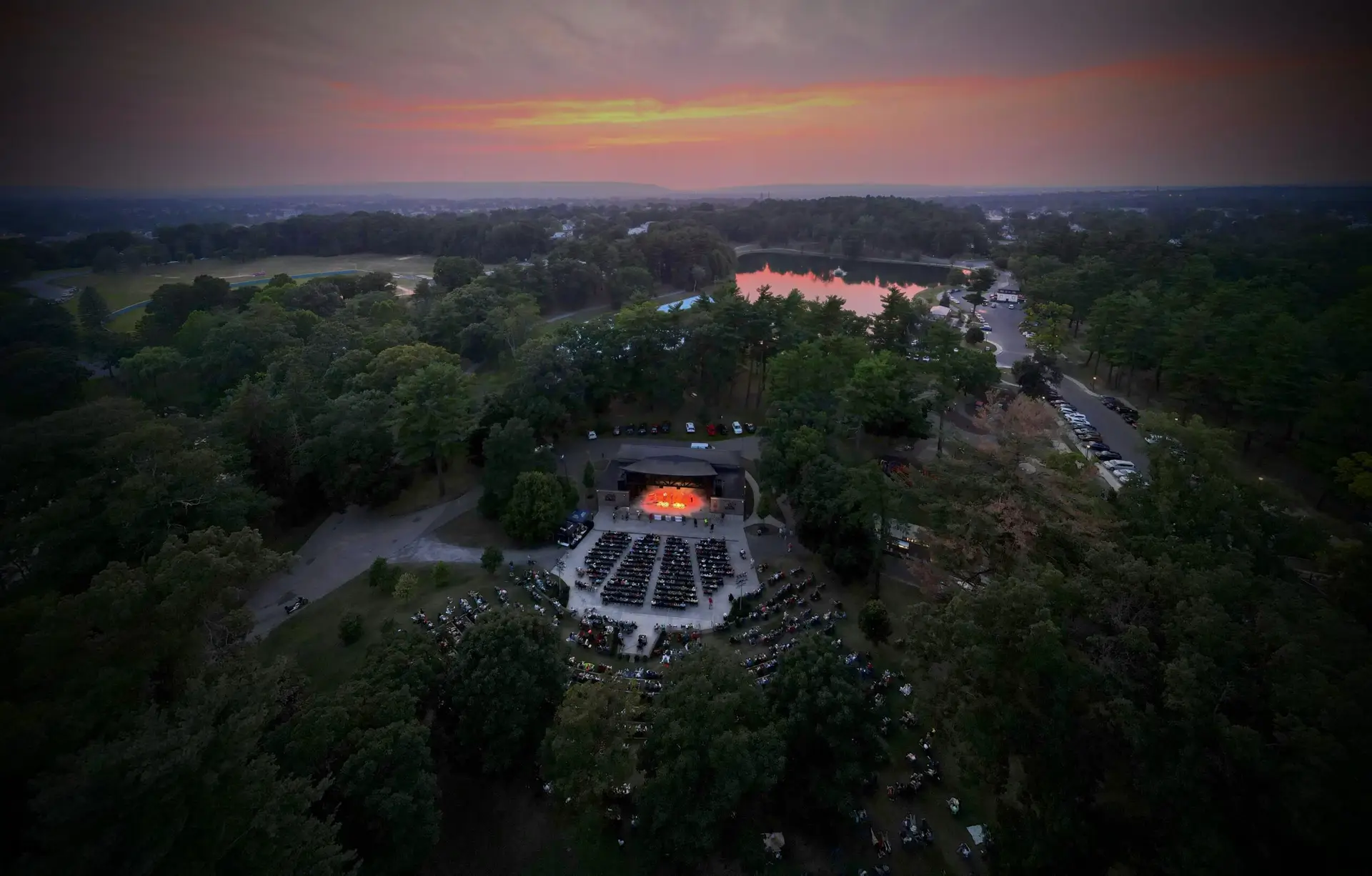
The most undervalued piece of Upstate New York’s summer music economy is the network of free outdoor concerts that runs parallel to the ticketed touring circuit, and its institutional center is Music Haven in Schenectady’s Central Park.
Music Haven was founded in 1990 by Mona Golub, who has run it as producing artistic director ever since. The 2026 season — Music Haven’s 35th — runs July 13 through Aug. 29 at the Agnes Macdonald Music Haven Stage, the permanent bandshell that replaced the original 1950s trailer stage in 1999. Seven free Sunday concerts at 7 p.m. anchor the calendar: Red Baraat opens July 13, Mali’s Bamba Wassoulou Groove follows July 20, the Blues BBQ on Aug. 3 brings Rick Estrin & the Night Cats with Selwyn Birchwood, and the SteelDrivers headline a bluegrass night Aug. 10. Midweek specials including WEXT’s Local 518 Fest and the Schenectady-Saratoga Symphony’s “Classical Mystery Tour” Beatles tribute round out the season.
What Music Haven does that almost no ticketed venue can is curate genuinely global programming — Punjabi brass, Malian Bambara, zydeco, klezmer, samba — in front of an audience that shows up because it’s free and stays because it’s good. Civic park, free programming, decades of consistency, world-music curatorial seriousness — the model every other Upstate city has been trying to figure out for thirty-five years. Schenectady got there first and has kept doing it.
Why Upstate Has So Many
The honest answer is that the conditions for great outdoor venues existed in Upstate New York before there were outdoor venues, and the state filled them.
Start with geology. The Catskills are a dissected plateau — rivers carved deep valleys into a high tableland, and what remains is a landscape of natural bowls. Stand on Hunter Mountain or look at a topographic map of Bethel and you see the shape repeated: amphitheaters. The Finger Lakes do something similar at smaller scale, glacial troughs producing the rolling-hill geometry CMAC sits inside. The land does the work before any architect shows up.
Add the highway map. Drag a finger northwest from New York City along the Thruway. You’re in Sullivan County in two hours, the Catskills in three. Boston four northeast. Philadelphia four southeast. The densest population corridor in North America drains toward Upstate New York along highways pointing exactly the right direction. Festival promoters don’t invent that. They notice it.
Then the inheritance. From the late nineteenth century through the 1960s, Sullivan County and the western Catskills hosted the Borscht Belt — at peak, hundreds of resort hotels running constant entertainment calendars in ballrooms, nightclubs, and outdoor stages. The most-cited inheritance is comedy. Less remarked is the physical infrastructure: a region that had, for fifty years before rock and roll, normalized building stages in the Catskills and putting people in front of them. By the late 1960s the resorts were dying. The infrastructure remained. Eli Thorne went deeper on this in the festival culture flagship.
What this produced is a state with three things almost no other had simultaneously: natural amphitheaters carved by geology, road infrastructure funneling audiences from the country’s largest markets, and a regional muscle memory of staging-and-crowd that predated rock and roll by half a century. SPAC arrived 1966 inside Saratoga Spa State Park. Artpark opened 1974 above the Niagara Gorge. CMAC opened 1983 in Canandaigua. Bethel Woods opened 2006 on the most consecrated music-related real estate in America. Lakeview/Empower FCU arrived 2015 on the Onondaga waterfront. Each filled a condition that already existed.
Closer
The ranking is an argument. SPAC at the top, Bethel silver, Artpark bronze, CMAC at four, Empower FCU at five. Highland Bowl and Beak & Skiff as honorable mentions. Music Haven as the free-series anchor. You will disagree about the order. That is what rankings are for.
But the actual takeaway isn’t the order. It’s the abundance. No other state in America has this many serious outdoor music venues, this geographically distributed, this consistently programmed, this deep into the touring economy. Texas has rooms. California has rooms. Colorado has Red Rocks. None has five rooms of this caliber stitched across the same state, plus the Highland Bowls and Beak & Skiffs and Music Havens running underneath.
Pick a weekend. Pick a venue. Pick a show. The rest will work itself out.
Disclosure: Some links in this article are affiliate links. Upstate Concerts may earn a commission on ticket purchases at no additional cost to you.