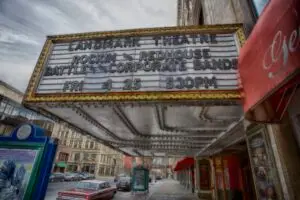
On the night of June 21, 1989, one of the biggest bands in the history of rock and roll walked back onto a stage for the first time in seven years — and they did it in Glens Falls.
The Who had been off the road since their 1982 farewell. When they decided to reunite for a twenty-fifth-anniversary run in 1989, the world’s music press was pointed at Toronto, where the tour would officially open on June 23. But two nights earlier, quietly, at the Glens Falls Civic Center, Roger Daltrey, Pete Townshend, and John Entwistle plugged in and played their first live notes of the reunion — a new drummer, Simon Phillips, in Keith Moon’s old chair, and an expanded band behind them. The cameras were in Toronto. The Who were in Glens Falls first.
That is the improbable magic of this small southern-Adirondack city. Its arena seats fewer than eight thousand people, and yet for four decades it has pulled in giants — the reunion of the Who, the birth of a Phish tradition, the world debut of a touring innovation, and a guitar smashing that came with its own backstage prank. This is the story of the greatest concerts a little arena on the edge of the mountains ever hosted. This is where we prove it.
The rules
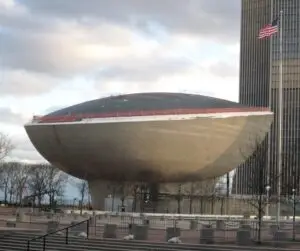
The same promise we make in every chapter of this series holds here. Every concert below actually happened, on the date we give, at the venue we name; where the record is contested, we say so. And a note on that venue: it opened in 1980 as the Glens Falls Civic Center and was renamed Cool Insuring Arena in 2017. Every concert on this list happened under the Civic Center name, so that is what we will call it throughout — the little downtown arena that, improbably, kept booking the biggest acts on earth. Let’s count down.

10. Queen — Glens Falls Civic Center — September 23, 1980
In the months after The Game had given them the biggest hits of their career — “Another One Bites the Dust,” “Crazy Little Thing Called Love” — Queen brought their spectacle to Glens Falls on September 23, 1980. Roughly seven thousand eight hundred people packed the young arena to watch Freddie Mercury command a room the way only he could, with the band Dakota opening. It was one of the earliest signs of what this new building could pull off: barely six months old, and already hosting one of the greatest live acts in the world at the height of its powers.

9. Billy Joel — Glens Falls Civic Center — September 29, 1986
By the fall of 1986, Billy Joel was one of the defining pop-rock voices in America, touring behind The Bridge, and on September 29 he brought the piano and the songbook to Glens Falls. It is the kind of booking that defined the Civic Center’s golden decade — a genuine superstar, the sort of name that fills far bigger buildings, playing a downtown arena in the Adirondack foothills. Glens Falls did not get the acts that couldn’t sell tickets. It got Billy Joel.

8. AC/DC with Yngwie Malmsteen’s Rising Force — Glens Falls Civic Center — September 5, 1985
When AC/DC finally headlined the Capital Region for the first time, they did it in Glens Falls.
On September 5, 1985, the Australian titans brought the Fly on the Wall tour to the Civic Center, with the guitar virtuoso Yngwie Malmsteen and his band Rising Force opening. It was a genuine milestone: in the Bon Scott years AC/DC had only ever passed through the region as an opening act, supporting the likes of Rush at Albany’s Palace Theatre. This was the night they came back as headliners and conquered — the biggest hard-rock band on the planet, top of the bill, in Glens Falls.

7. Foo Fighters — Glens Falls Civic Center — October 9, 2007
Some of the best concert stories are the ones with a punchline, and this one has a great one.
On October 9, 2007, the Foo Fighters played the Civic Center at the very start of their Echoes, Silence, Patience & Grace world tour — and it was the last show they’d play before appearing on Saturday Night Live four nights later, on the episode Jon Bon Jovi hosted, performing “The Pretender.” But the night is remembered for what happened during “See You.” The evening before, in Wilkes-Barre, guitarist Pat Smear had pulled a prank on Dave Grohl: mid-song, Smear had secretly swapped in a cheap knock-off acoustic and smashed that, to Grohl’s astonishment. So in Glens Falls the next night, Grohl got his revenge — he grabbed Smear’s real guitar, a Gibson Dove worth some three thousand dollars, and destroyed it on stage, pieces flying into the crowd. A prank, a callback, and a genuinely expensive punchline, all four days before a national television audience. Only in Glens Falls.

6. Def Leppard — Glens Falls Civic Center — October 1, 1987
Here is a concert that changed how rock tours are staged, and it happened in Glens Falls.
When Def Leppard launched the North American leg of their Hysteria tour on October 1, 1987, they debuted their famous “In The Round” stage — a full 360-degree platform set in the middle of the arena floor, letting the band play to every seat in the building at once. Center-stage shows became a staple of the arena-rock playbook, used by acts from Garth Brooks to Metallica, and Def Leppard’s production did as much as anything to make the format famous. The very first time they rolled it out for a paying crowd was that night at the Civic Center, in front of fewer than six thousand people. A piece of touring history, born in Glens Falls.
5. Metallica opening for Ozzy Osbourne — Glens Falls Civic Center — April 27, 1986
On April 27, 1986, Ozzy Osbourne headlined the Civic Center — and got upstaged so thoroughly by his opening act that people are still talking about it.
That opening act was Metallica, touring Master of Puppets at the absolute peak of their thrash-metal ascent, months before the bus crash that would kill bassist Cliff Burton. By the account of the regional press that still retells the night, the four young men from the Bay Area simply blew the doors off the building — “Ozzy Osbourne lost, Metallica won,” as one retrospective put it flatly. It is the eternal opening-act story, and Glens Falls got one of its greatest examples: the future biggest metal band in the world, announcing themselves as the main event while they were still second on the bill.

4. Bon Jovi — Glens Falls Civic Center — September 14, 1986
Catch the timing. On September 14, 1986, Bon Jovi played the Civic Center just weeks after releasing Slippery When Wet — and just weeks before “You Give Love a Bad Name” would rocket to number one and turn them into one of the biggest bands on earth. Glens Falls caught them in the last moment before the explosion: a hungry New Jersey band on the very cusp of superstardom, playing a downtown arena to a few thousand people who would soon be able to say they saw Bon Jovi right before. The Civic Center made a specialty of exactly this — grabbing enormous acts on the way up.

3. The Grateful Dead — Glens Falls Civic Center — May 8, 1980
Every venue has a first concert. The Glens Falls Civic Center’s was the Grateful Dead.
When the brand-new arena opened its doors in the spring of 1980, the very first act to christen the stage was the Grateful Dead, on May 8 — a fitting beginning for a building that would spend the next four decades chasing exactly that kind of legend. The Dead being the Dead, they came back, playing the Civic Center again in 1981 and 1982 and cementing an early bond with the room. There is something perfect about it: the little Adirondack arena that would go on to host the Who and Queen and Metallica opened for business with the most beloved touring band in America. The soundboard tape survives; the affection never faded.

2. Phish — Glens Falls Civic Center — October 31, 1994
On Halloween night, 1994, Phish invented one of the most beloved traditions in modern music — in Glens Falls.
That was the night the band debuted its “musical costume”: the idea of covering a classic album, in full, as the middle set of a Halloween show. The fans had voted, and Phish delivered the Beatles’ White Album front to back — thirty songs, most of which the band had never played live before — inside a three-set, roughly six-hour marathon that ran past three in the morning. It was released, years later, as Live Phish Vol. 13, and to this day Phish’s own devoted fanbase ranks it among the greatest shows of the band’s entire forty-year history. The tradition they started that night — Halloween “musical costumes” — has continued ever since. It began on a sold-out Halloween in a small arena in the southern Adirondacks.

1. The Who — Glens Falls Civic Center — June 21, 1989
And so we come back to the night we opened with.
By 1989, the Who were rock and roll royalty seven years into an apparent retirement, and when they chose to come back, the reunion was a genuine event — a twenty-fifth-anniversary run with an expanded band, a horn section, and Simon Phillips filling the seat that had belonged to Keith Moon and then Kenney Jones. The tour would be officially unveiled two nights later in Toronto, in front of the world’s cameras. But the first time Roger Daltrey and Pete Townshend and John Entwistle actually stood together on a stage again — the very first live moment of the whole reunion — happened at the Glens Falls Civic Center, on June 21, 1989, in front of a few thousand people who got to witness something the rest of the world would only see later.
That is why it is number one. Not because it was the biggest crowd or the flashiest production, but because of the sheer improbability of it: one of the most important bands in the history of the music, ending a seven-year silence, choosing a small arena in the Adirondack foothills to take their first breath. The press was waiting in Toronto. Glens Falls got them first. In a single night, a little building that seats fewer than eight thousand people held the return of the Who — and that is the whole story of this improbable arena, distilled into one evening.

A city that makes its own
Glens Falls does not only host greatness; it produced one of the most important figures in the history of recorded music, and almost nobody knows it. Teo Macero was born in Glens Falls in 1925, and as a staff producer at Columbia Records he became the studio architect behind Miles Davis’s most revolutionary work — the tape-splicing, collage-like masterpieces In a Silent Way and Bitches Brew, two of the most influential albums jazz ever produced, along with Sketches of Spain and Dave Brubeck’s Time Out. The man who helped invent the sound of jazz-fusion in a New York studio was a kid from Glens Falls. The city has other music sons — the contemporary jazz-pop singer Tony DeSare among them, and the 1960s garage band the Sundowners, who scraped a regional hit and a Decca contract — but Macero is the one who changed the music itself.

Beyond the arena
The Civic Center may be the star of this story, but the music of the southern Adirondacks runs up the lake and into the mountains, in places and eras you would never expect.
Long before the arena, the now-vanished resort of Scaroon Manor on Schroon Lake ran a five-hundred-seat lakeside amphitheater — built with a revolving stage, like a miniature Hollywood Bowl in the woods — and across its 1930s-to-1950s heyday it brought some of the biggest names in American entertainment to the mountains: Sophie Tucker, the Metropolitan Opera great Robert Merrill, the comedians Red Skelton and Alan King. The exact dates have faded from the record, and the resort itself is a state campground now, but for a run of golden summers a Schroon Lake stage rivaled the great Catskills resorts.
A little further up, Schroon Lake still hosts the Seagle Festival, founded in 1915 as America’s oldest summer vocal-training program — a pipeline that has sent singers to the Metropolitan Opera and Broadway for more than a century. On Lake George itself, Shepard Park has held the Lake George Jazz Weekend every year since 1984, one of the twenty oldest jazz festivals in the country, with legends from Sun Ra to James Moody passing through. In Bolton Landing, the Metropolitan Opera diva Marcella Sembrich kept a lakeside studio in the 1920s, teaching the next generation of singers at the water’s edge. And today the Charles R. Wood Festival Commons carries the torch into the present, hosting Blue Öyster Cult, Charlie Daniels, and the jam faithful of moe. and Dark Star Orchestra. One last footnote worth a smile: the Lake George Forum, a multi-use hall that hosted concerts and festivals for years, was owned for a stretch by the actor Ralph Macchio — the Karate Kid himself — who bought it at a bank auction in 2009.

The ones that just missed
No list of ten could hold all of it. Iron Maiden treated the Civic Center almost like a home away from home, playing it across the Number of the Beast, Piece of Mind, and Powerslave eras. Ozzy Osbourne headlined in his own right in 1981, with the doomed guitar prodigy Randy Rhoads at his side and a young Def Leppard opening. KISS brought the Creatures of the Night tour through in 1983; Aerosmith sold the building out completely on the Permanent Vacation tour in 1987. From the Dead christening a brand-new arena to the Who breaking their silence, from a Phish tradition born on Halloween to a Foo Fighters guitar smashed as a punchline, this little corner of the Adirondacks has been quietly hosting rock history for more than forty years. It is all here, and it is all true.
🎫 Upcoming Shows in the Glens Falls Area
The legends made history here — now go make your own.
Image credits
- Glens Falls Civic Center (Cool Insuring Arena), 2024 — photo: Quintin Soloviev, CC BY 4.0 via Wikimedia Commons.
- Freddie Mercury / Queen, 1977 — photo: Carl Lender, CC BY 2.0 via Wikimedia Commons.
- Billy Joel, 1978 — Columbia Records, Public Domain via Wikimedia Commons.
- AC/DC, 1981 — photo: Andrew King, CC BY-SA 2.0 via Wikimedia Commons.
- Dave Grohl / Foo Fighters, 2008 — photo: flimsical (Flickr), CC BY 2.0 via Wikimedia Commons.
- Metallica, 1983 — Megaforce Records, Public Domain via Wikimedia Commons.
- Jon Bon Jovi, 1987 — photo: Jonathan King, CC BY 3.0 via Wikimedia Commons.
- Jerry Garcia / Grateful Dead, May 1980 — photo: Carl Lender, CC BY 2.0 via Wikimedia Commons.
- The Who, 1980 — photo: Ueli Frey / DrJazz.ch, CC BY-SA 4.0 via Wikimedia Commons.
- Teo Macero, 1996 — photo: Catherine Rankovic, CC BY-SA 2.0 via Wikimedia Commons.
- Lake George — photo: Sarahhnva58, CC BY-SA 4.0 via Wikimedia Commons.
What did we get wrong? Which Glens Falls or Lake George night belongs on this list that we left off? Tell us on Facebook and Instagram — your picks help decide our upcoming ranking of the greatest concerts in all of Upstate New York.
This is the latest chapter in The Greatest Concerts Ever, Upstate Concerts’ city-by-city search for the most legendary nights in New York live-music history. Catch up on the rest of the series: Buffalo, Syracuse, Albany, Rochester, Ithaca, Poughkeepsie, the North Country, Saratoga, Utica/Rome, Woodstock, and Jamestown.